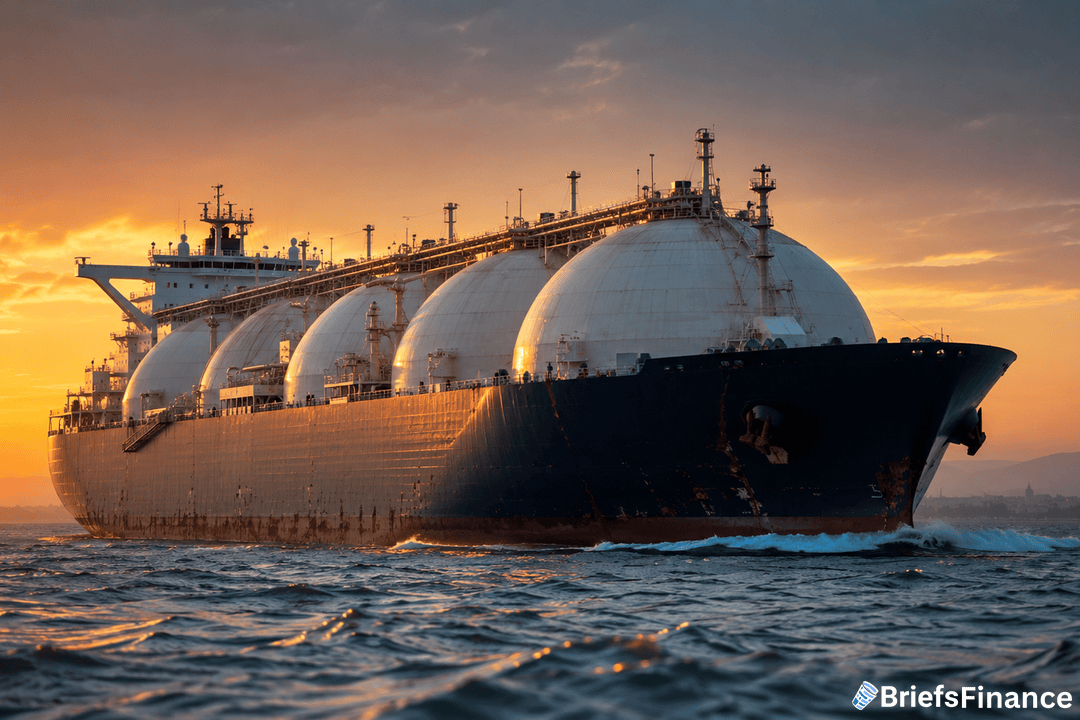
Europe spent two years winning every bidding war for global gas. That just flipped, with Asian buyers now paying more for the same cargoes and sending tankers east.
That's a problem for a continent that still needs to refill its storage tanks before winter.
Asia Is Paying More For Gas
Asia's main gas price (called the JKM, or Japan Korea Marker) and Europe's (called the TTF, or Title Transfer Facility) used to trade close. Not anymore.
The gap hit $1.87 per million BTU in May, up from $1.59 in April. When that gap gets wider, tanker owners reroute their cargoes east.
Shipping LNG is a margin business. The better margin is in Asia right now.
The shift didn't happen overnight. Asian buyers started outbidding Europe in late 2025, and the gap got wider once the Iran war shut Hormuz.
Asia's gas demand should rise more than 4% this year. The region's LNG imports are on track to climb 10% in 2026, after a drop in 2025.
The buyers are loading up. South Korea brought in about 42 million tonnes for the year in May, and China is on pace for roughly 67 million tonnes by the third quarter.
China's pace has picked up sharply. The country went from importing at a 36-million-tonne annual rate in March to 48 million by May.
We track moves like this every morning, what's happening in energy and what it means for your portfolio, in Market Briefs, the five-minute daily that also includes a free investing masterclass when you sign up.
Middle East Shipments Collapsed
Middle East suppliers used to send a steady stream of LNG to Europe, led by Qatar. In April, that mostly stopped.
Shipments from the Middle East to Europe fell from 1,093 million cubic meters in March to 117 million in April. The Strait of Hormuz handles about a fifth of all LNG shipped worldwide.
The Strait has been mostly shut since the war with Iran flared up in late February. U.S. and Israeli air strikes set off the broader conflict, and tanker traffic through the chokepoint hasn't recovered.
The catch: U.S. flows have held steady. American terminals will supply two-thirds of Europe's LNG this year, up from 57% last year.
But U.S. supply can't fully cover what's gone offline, so Europe swapped one supply problem (Russian pipelines) for another (Middle East shipping risk).
Russian Arctic LNG has filled some of the hole. The EU brought in nearly 9 billion cubic meters of Russian LNG in the first four months of 2026, up more than 18% from a year ago.
IEEFA expects the U.S. share could climb as high as 80% of EU LNG imports by 2028.
Worth Noting
Storage is the next thing to watch. Europe needs to refill its tanks before winter, and every cargo Asia outbids is one less cargo going in.
If the Hormuz crunch drags into the second half of the year, European gas prices stay high for longer.
Join 350,000+ investors reading Market Briefs every weekday morning, and you also get a 45-minute investing course as a bonus.