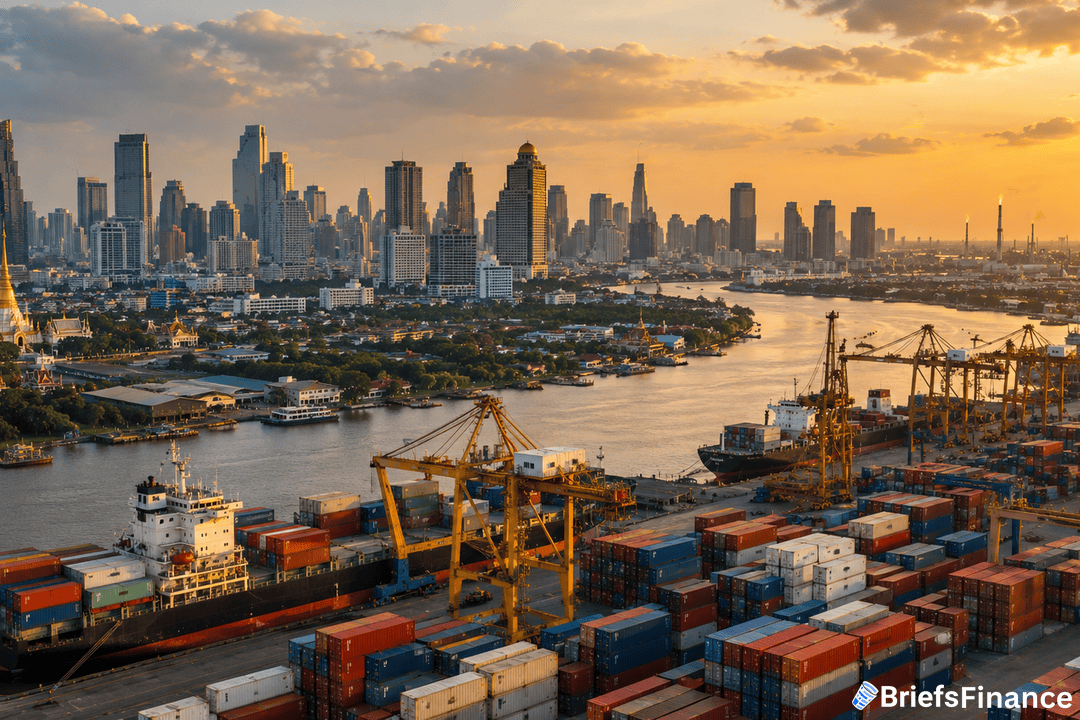
Thailand just printed its best growth quarter in over a year. The government still won't lift its 2026 forecast, which tells you what the economy is bracing for.
The Beat
GDP grew 2.8% year over year in the first quarter, beating economist forecasts of 2.2%. On a quarter-over-quarter basis the economy expanded 0.7%, well above the 0.1% poll forecast.
Exports, consumption and investment all pulled in the same direction. Manufacturing, electricity supply, accommodation, food services and finance all expanded.
The National Economic and Social Development Council (NESDC, Thailand's main forecasting body) raised its 2026 export growth forecast to 9.6%, up from 2.0%. That's a big upward revision for an economy that depends on shipping goods abroad.
But the NESDC also cut its tourism forecast. Foreign arrivals are now expected to hit 32 million this year, down from a February estimate of 35 million.
The Q1 beat broke a streak of softer quarters, since Thailand's economy grew just 2.4% in all of 2025.
Market Briefs digs into stories like this one every morning in five minutes, and you also get a free investing masterclass when you join.
Why The Outlook Stayed Flat
The NESDC kept its full-year growth call at 1.5% to 2.5%. The agency laid out three scenarios for the rest of the year.
The best case puts growth at 1.4% if the war ends in the first half of 2026. A stagflation scenario, where growth slows but inflation stays high, drops growth to 0.9% and pushes inflation to 4.4%.
The worst case has growth at just 0.2% and inflation at 5.8% if the conflict drags on for six to nine months.
The variable is the U.S.-Israel war against Iran. If that conflict ends early, Thailand's growth holds up, but if it stretches into next year, oil-importing economies like Thailand take a real hit.
Thailand brings in nearly all of its oil from abroad. With crude near $107 a barrel, the cost-of-living crunch is the next problem on the government's desk, and officials are working on a relief package.
Every 1-baht jump in diesel prices cuts Thailand's GDP by about 0.02%, per NESDC estimates.
The NESDC's baseline scenario assumes oil settles around $85 a barrel if Hormuz reopens. In the worst case, the agency models crude hitting $135 to $145 a barrel.
Inflation is the bigger worry. The NESDC sees 2026 inflation between 2.5% and 3.5% in the baseline, but it could top 5% if oil prices stay high.
Worth Noting
The Bank of Thailand cut its own 2026 growth forecast to 1.3% earlier this month. TRIS Rating, a major Thai credit agency, warned growth could fall to 1% if the Iran war lasts six months.
Watch the next NESDC update in August for a clearer read on whether the Q1 beat carried into Q2 or whether oil prices started to bite.
A Q1 beat is good news, and a government that won't raise its outlook on the back of it is telling you why.
Read Market Briefs every weekday morning to spot global moves like this early, plus a 45-minute investing course when you sign up.