Free NewsletterPro Login

Canada Post Lost $1.57 Billion Last Year. It's Burning Through Federal Loans To Stay Open

Published Apr 21, 2026
Share:
Summary:
  • Canada Post reported a record $1.57 billion pre-tax loss for 2025.
  • The Crown corporation is surviving on $2 billion in federal loans.
  • Plans to end doorstep delivery for 4 million addresses and switch them to community mailboxes.

Canada Post just reported the worst year in its history. It's also telling Ottawa that won't be enough.

The Crown corporation posted a $1.57 billion pre-tax loss for 2025. That's its biggest ever. It's surviving on $2 billion of federal loans, roughly split between a $1.03 billion package approved last year and another $1.01 billion approved in early 2026. Both are supposed to be repaid. Nobody inside the company believes that's realistic on the current trajectory.

Where The Losses Came From

Parcel volumes dropped by 79 million pieces last year. That alone translated to $850 million in lost revenue. Canada Post blamed strike action and private carrier competition.

Amazon and other retailers shifted more Canadian last-mile delivery to private carriers during the 2024-2025 labour uncertainty. Once those contracts moved, they haven't come back. Customers rarely do.

Think of the postal service as a grocery store that lost its biggest buyer. The lights stay on. The bills don't.

The Fix Is A Mailbox

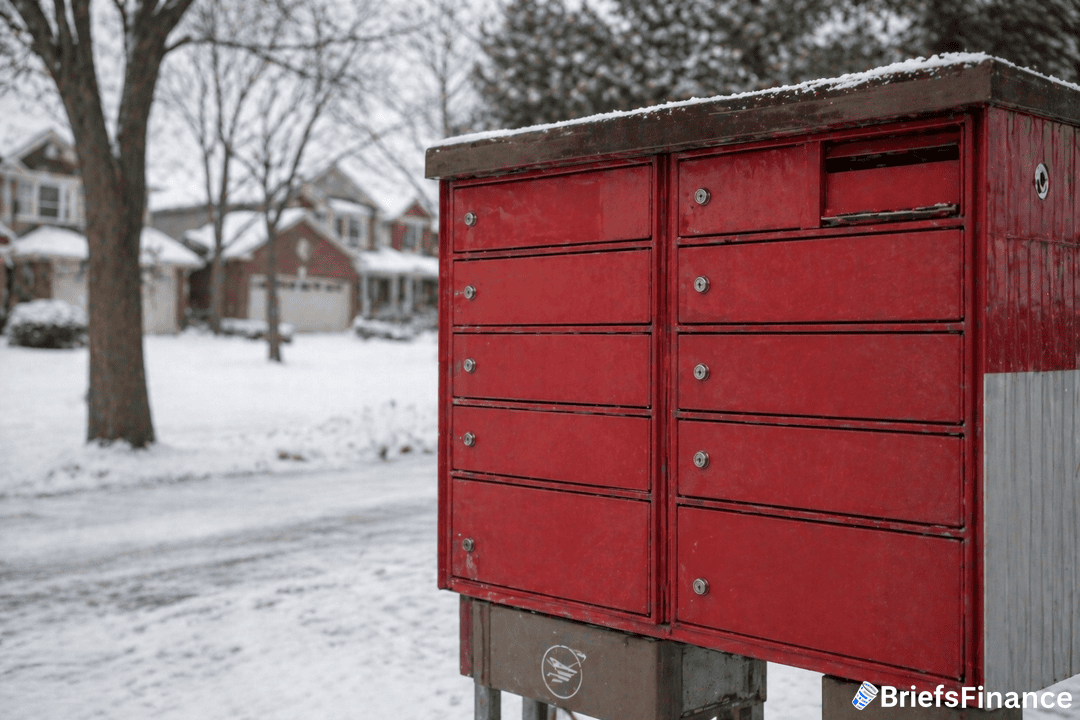
Canada Post is planning to end doorstep delivery for the 4 million addresses that still have it. Those customers will get assigned to community mailbox clusters over the next five years. The company says that move alone saves $400 million a year.

That's a quarter of the 2025 loss, recovered by cutting the thing that most Canadians associate with mail service. The political fight will be loud. Rural residents, elderly Canadians, and accessibility advocates have already pushed back. The math isn't really in question. The politics is.

The Mailbox Fight Already Brewing

The community mailbox rollout is set to run over five years, which gives opponents plenty of time to turn it into an election issue. Rural MPs are already raising the accessibility angle, arguing that elderly Canadians and people with mobility issues can't walk to a cluster box in a Manitoba winter.

Accessibility groups have filed formal objections with Canada Post's regulator, which pushes the timeline longer and adds legal costs on top of the delivery savings.

The underlying business math doesn't change while the politics plays out. Parcel volume that moved to private carriers during the 2024-2025 strike uncertainty is not coming back, which means the $850 million in lost revenue is baked in whether the mailbox plan clears the fight or not.

Think of Canada Post's problem as a store that lost its anchor tenant. You can cut staff. You can change the sign. You can renegotiate the lease. The foot traffic that left does not walk back in because you did any of it.

Worth Noting

Canada's post office is not alone. The US Postal Service has lost money for 17 of the last 18 years. Royal Mail is privatising. Deutsche Post has leaned into logistics and away from letters.

Government-run mail services built for letters are trying to survive in a world where the parcel business has already been taken by private couriers. Canada Post's story is what happens when that transition stalls.

The loans bought Canada Post a year. The mailbox plan has to buy it the next decade.
Disclosure

Get Market Briefs delivered to your inbox every morning for free!

No fluff. No noise. No politics. Just finance news you can read in 5 minutes.

Blogs

June 15, 2026
Top Covered Call ETFs: How to Compare Them
  • Top covered call ETFs are income funds that own stocks and sell call options against them to generate steady cash.
  • The best one for you is the fund whose income, holdings, and fees fit your goals, not simply the one with the flashiest yield.
  • They all share one trade-off: more income today, less upside in a big rally.
Read More
June 15, 2026
What Are Stock Options? A Plain-English Guide
  • Stock options are contracts that give you the right, but not the obligation, to buy or sell a stock at a set price by a set date.
  • There are two kinds: calls (the right to buy) and puts (the right to sell).
  • Options can multiply gains or wipe out your money fast, so they suit investors who already know the basics.
Read More
June 15, 2026
EBITDA Margin: What It Is and How to Calculate It
  • EBITDA margin measures how much core profit a company keeps from each dollar of sales, before interest, taxes, and accounting deductions.
  • The formula is EBITDA divided by revenue, shown as a percent.
  • A higher, steadier EBITDA margin usually signals a more efficient, more durable business.
Read More
June 15, 2026
What Is Taxable Income? A Simple Guide for Investors
  • Taxable income is the portion of your money the government can tax after deductions are applied.
  • Not all income is taxed the same: job income, investment income, and passive income face different rates.
  • Investors and business owners get more tools to legally lower their taxable income, which is a big edge over time.
Read More
June 15, 2026
What Is a Covered Call? How the Strategy Works
  • A covered call is an options strategy where you own a stock and sell someone the right to buy it from you at a higher price.
  • You collect cash, called the premium, up front, and keep it no matter what happens.
  • The trade-off: if the stock soars, your shares get sold at the set price and you miss the extra upside.
Read More
June 15, 2026
What Is Gross Margin? A Simple Guide for Investors
  • Gross margin is the share of each sales dollar a company keeps after paying the direct cost of whatever it sold.
  • The formula is simple: revenue minus cost of goods sold, divided by revenue, shown as a percent.
  • A steady or rising gross margin points to pricing power, and it is one of the first things smart investors check.
Read More
June 15, 2026
What Is a Dividend? A Plain-English Guide for Investors
  • A dividend is a cash payment a company sends you just for owning its stock, usually every three months.
  • Dividends are one of two ways stocks pay you, the other being the share price going up.
  • Dividends are never guaranteed, so the strength of the business behind the payment matters more than the size of the payment.
Read More
May 30, 2026
Financial Literacy Books That Actually Build Wealth
  • The best financial literacy books don't just teach budgeting, they shift how you think about money.
  • Two classics stand out: The Intelligent Investor for valuing investments, and Rich Dad Poor Dad for the owner's mindset.
  • Reading is only step one. The real wealth comes from acting on what you learn.
Read More
May 30, 2026
What Is a Roth Conversion? A Simple Guide
  • A Roth conversion moves money from a traditional retirement account into a Roth account.
  • You pay taxes on the money now, in exchange for tax-free growth and withdrawals later.
  • It can pay off if you expect higher taxes or more income in the future, but the timing and tax hit matter a lot.
Read More
May 30, 2026
Trailing Stop Loss: How to Protect Your Gains
  • A trailing stop loss is an order that automatically sells a stock if it falls a set percentage from its recent high.
  • As the stock rises, the sell point rises with it, locking in gains while capping losses.
  • It's most useful for active strategies like momentum investing, not for long-term buy-and-hold.
Read More
1 2 3 22
Share via
Copy link











