You check your portfolio one morning and see red everywhere. […]

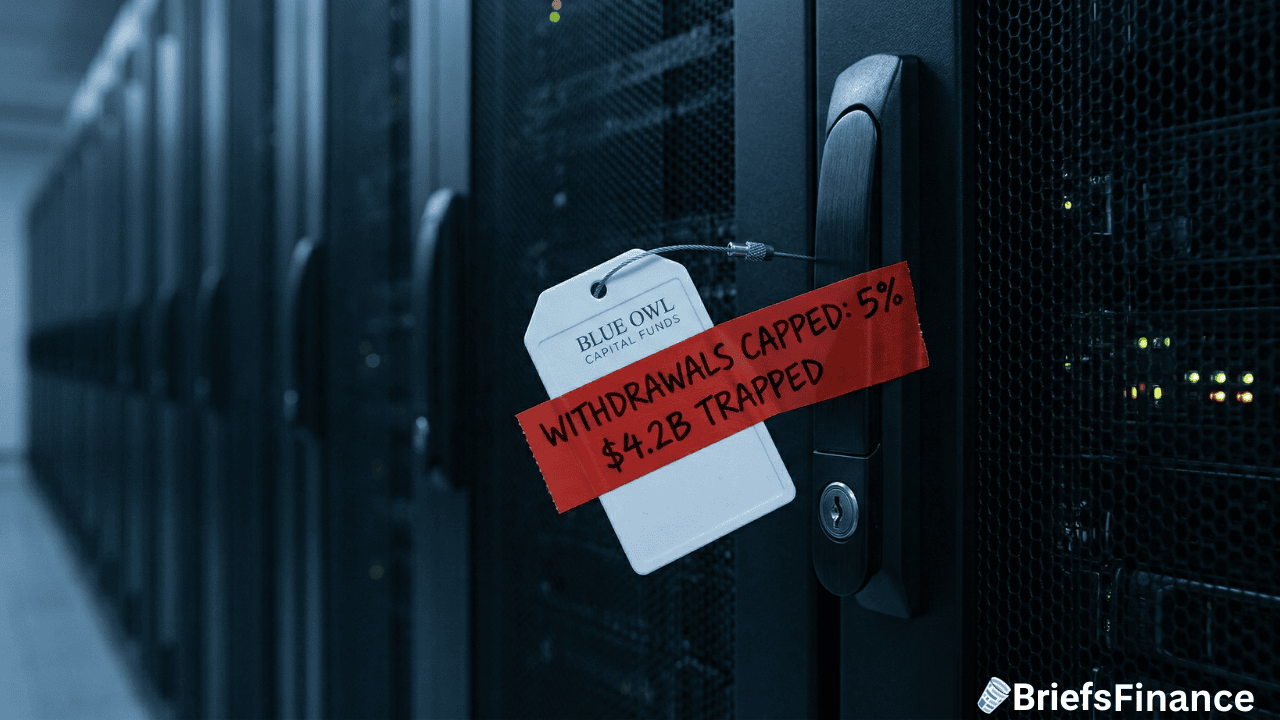
Nearly $4.2 billion in investor money just got trapped inside two Blue Owl Capital funds.
That's the gap between what investors asked to take out and what the firm actually let them withdraw. No other major private credit manager has reported a mismatch this large.
Blue Owl runs two non-traded private credit funds - BDCs, or business development companies - that make loans to private businesses. One is OCIC, a $36 billion flagship. The other is OTIC, a smaller fund focused on tech-sector lending.
During the first three months of 2026, investors in the big fund asked to pull roughly 22% of their shares. That's up from about 5% the quarter before.
The tech fund was worse. Withdrawal requests hit 41% - meaning investors wanted nearly half the fund back.
Blue Owl honored 5% in each fund. That's the built-in cap baked into how these vehicles work.
So OCIC paid out around $988 million while roughly $3.2 billion in requests went unfilled. OTIC paid out $179 million, with about $1 billion left on the table.
The fear is AI.
Private credit funds lend heavily to software companies. That sector makes up about a fifth of total lending across the industry, according to Jefferies.
Investors are worried AI tools could eat into borrowers' revenue - making those loans riskier. And Blue Owl sits right in the middle of that worry because its tech fund lends to the companies most exposed to AI competition.
A few stumbles in the broader private credit world - plus a scrapped merger between two Blue Owl funds late last year - turned the firm into a lightning rod for nervous money.
The firm pushed back on the panic. It said selling pressure came from a concentrated group of shareholders, not a broad rush. Ninety percent of flagship fund investors chose to stay put.
Blue Owl isn't alone. Apollo, Ares, and BlackRock have all stuck to their own 5% caps recently. Cliffwater and Blackstone let a bit more out, but not by much.
The $1.8 trillion private credit market is in the middle of a confidence test. These funds were built to hold investor cash for long stretches - that's the trade-off for higher returns.
But when fear moves fast, the gates meant to protect long-term investors start to feel like traps.
Both Blue Owl funds have posted returns above 9% a year since they started. And OCIC alone has more than $11 billion in available cash and borrowing power to cover what it owes.
Blue Owl shares dropped nearly 9% on the news to a record low around $7.95. The stock has become a stand-in for every fear about private credit - whether those fears match the numbers or not.
You check your portfolio one morning and see red everywhere. […]
Investing is not a one size fits all approach. Some […]
Everyone with an internet connection is using AI to better […]
You just opened your first brokerage account and you’re ready […]
Everyone knows AI needs chips. For a while, investment dollars […]
When you get your first, “real” job, it often comes […]
Most investors hear the word "options" and picture a Wall […]
Most of us grew up being taught the same thing: […]
Gold has been around longer than any stock market, any […]
Most people think the only way to make money in […]