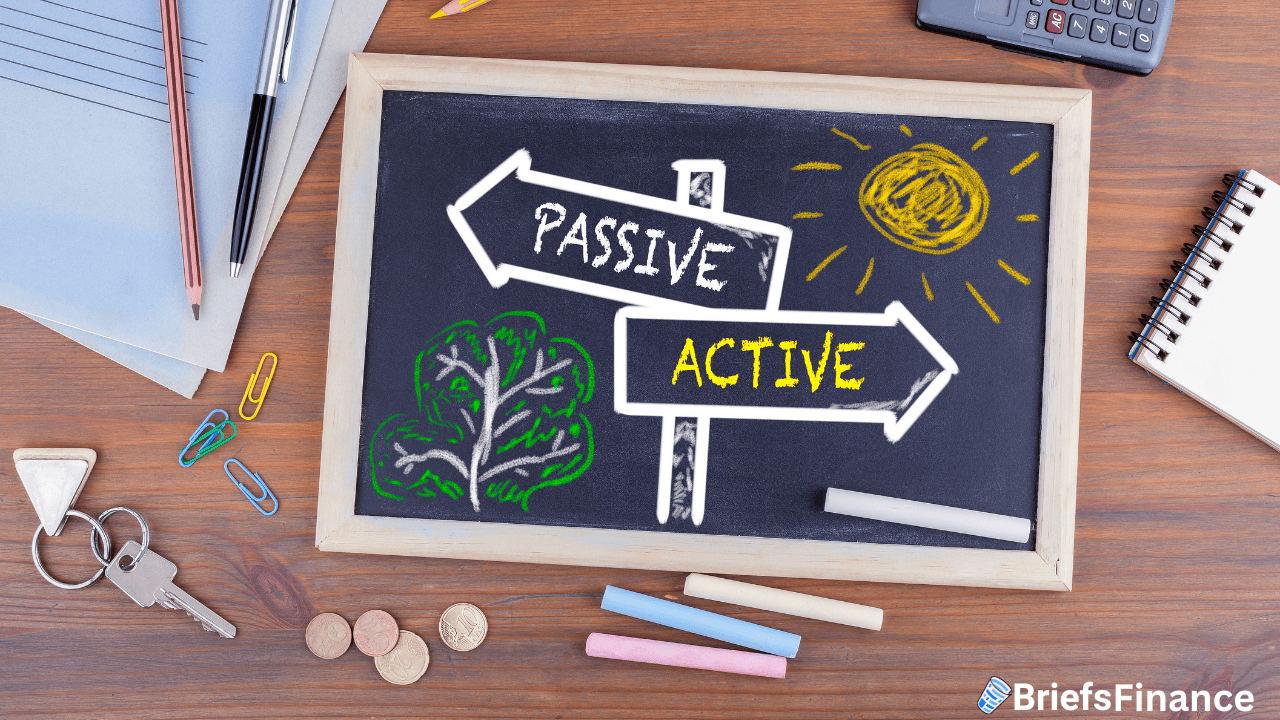
When people talk about investing strategies, two terms always come up: active investing and passive investing.
But what do they actually mean?
Passive investing is about tracking markets and industries. You buy index funds or ETFs that hold hundreds of companies.
The goal: You don't try to beat the market - you match it.
Active investing is about analyzing stocks and picking winners. You research individual companies and sell based on your analysis.
The goal: You're trying to beat the market by finding undervalued opportunities.
Both strategies can be effective ways to build wealth.
But they are different - some investors stick to one strategy over another while others use a combination of the two.
The key is understanding the differences between active investing and passive, so you can make the best decisions with your investments.
Let's break down exactly what each strategy involves, the pros and cons of each, and how you can choose a strategy that makes sense for your portfolio.
But first: Want to hear how our market analysts actually find where the money is moving - before it shows up on CNBC? We broke it all down on our latest podcast.
Watch or listen to the podcast for free right here.
What Is Passive Investing?
Passive investing is a "set it and forget it" strategy.
Simply put: You invest in funds that track entire markets or industries.
This means you're not spending hours analysing specific companies, their businesses, or balance sheets.
How It Works
Instead of picking individual stocks, you buy:
Index Funds: Funds that track major indexes like the S&P 500, NASDAQ 100, or Dow Jones.
Industry ETFs: Funds that track specific sectors like technology, healthcare, or industrials.
Broad Market ETFs: Funds that give you exposure to thousands of companies at once.
When you buy an S&P 500 index fund, you own tiny pieces of all 500 companies in the index. When you buy a technology ETF, you own pieces of all the major tech companies.
Real Example: VOO (Vanguard S&P 500 ETF)
VOO tracks the S&P 500 index. When you buy one share of VOO, you're investing in:
- Apple.
- Microsoft.
- Amazon.
- Nvidia.
- Tesla.
- And 495 more companies.
All in one purchase.
The CDAA Method for Analyzing Passive Investments
No matter the investment, you need to understand what you’re buying.
Our market analysts use a special framework called the CDAA method to evaluate ETFs and index funds.
This stands for:
- Companies.
- Dollars.
- Asset Allocation.
This framework allows you to evaluate the risks and whether the fund is right for you or not.
Let’s break it down:
C - Companies: What kind of companies does this fund invest in?
D - Dollars: What's the fund's assets under management (AUM)?
AA - Asset Allocation: What are the top holdings?
Let's apply this to VOO:
Note: VOO numbers as of Q2 2025.
Companies: VOO invests in the 500 largest U.S. public companies by market cap. It sometimes holds just over 500 companies.
Dollars: $586 billion in assets under management. This massive amount means the fund is highly liquid and stable.
Asset Allocation:
- Apple: 6.73%.
- Microsoft: 6.5%.
- Amazon: 3.8%.
- Nvidia: 3.2%.
- And 499 more companies.
The top 10 holdings make up about 30% of the fund. The remaining 70% is spread across 490+ companies.
Key Features of Passive Investing
| Feature | What It Means |
| Time Required | Minimal - maybe 1 hour per month |
| Research Needed | Basic - understand what the fund tracks |
| Risk Level | Typically lower - diversified across many companies |
| Potential Returns | Match market performance (historically 10% annually) |
| Costs | expense ratios vary from 0.03% to 0.99% |
| Management | Passive - Set it and check it every few months |
What Is Active Investing?
Active investing means you're in the driver's seat.
You research companies, analyze financial statements, evaluate business models and decide which stocks to buy and when to sell them.
You're not following an index. You're building your own portfolio based on your analysis.
How It Works
Active investing involves:
Stock Selection: You pick individual companies to invest in based on research.
Financial Analysis: You read 10-K reports, balance sheets, income statements, and cash flow statements.
Non-Financial Analysis: You evaluate the CEO, business model, competitive advantages, and innovation.
Ongoing Monitoring: You track company news, earnings reports, and market trends.
Buy and Sell Decisions: You decide when to buy, how much to invest, and when to sell.
You’re probably wondering - that sounds like a lot of work. Why would an investor choose active investing over passive investing?
The goal with active investing is to beat the market - this means choosing investments that outpace the S&P 500.
This means you could build wealth faster with active investing - but it does take more work, which is not for everyone.
But that higher opportunity comes with a trade off - more risk.
You’re never guaranteed to beat the market and you could actually underperform and lose money.
To be clear: Active investing is different from day trading.
Day trading involves buying and selling a security in a short period of time - usually between one day and six months.
Active investing means you hold on to your investment for at least six months, but typically around a year.
You’re still doing all of the same research and analysis, but you’re identifying long-term market shifts in order to profit, rather than day-by-day price swings or short-term trends.
Real Example: Analyzing Microsoft
Let's say you're considering Microsoft as an active investment. Here's what you'd analyze:
Note: Microsoft numbers from its 2024 10-K.
Financial Analysis:
- Revenue: $245 billion (growing 16% year-over-year).
- Net income: $88 billion (36% profit margin - excellent).
- Operating cash flow: $118 billion (strong cash generation).
- Total assets: $512 billion.
- Total liabilities: $243 billion.
- Book value: $269 billion.
Non-Financial Analysis:
- Business model: Software (Windows, Office), cloud computing (Azure), gaming (Xbox).
- CEO: Satya Nadella - highly respected, transformed company since 2014.
- Innovation: Leading in AI, expanding cloud infrastructure, continuous new products.
- Moat: Enterprise relationships, switching costs, network effects, massive infrastructure.
Verdict: Based on complete analysis, Microsoft shows strong financial health, proven leadership, continuous innovation, and solid competitive advantages.
The Research Process For Active Investing
Active investing requires analyzing both numbers and business fundamentals:
Step 1: Find Financial Statements
- Go to SEC EDGAR (sec.gov).
- Search for the company.
- Download the latest 10-K (annual report).
Step 2: Analyze the Numbers
- Check revenue growth (is it increasing?).
- Review profitability (positive net income?).
- Examine debt levels (manageable?).
- Study cash flow (generating cash?).
Step 3: Evaluate the Business
- What's the business model?
- Who's the CEO?
- Is the company innovating?
- What's the competitive advantage (moat)?
Step 4: Compare to Competitors
- How does it stack up against others in the industry?
- Are its financial ratios better or worse?
- Is its moat stronger or weaker?
Key Features of Active Investing
| Feature | What It Means |
| Time Required | High - 5-10 hours per week minimum |
| Research Needed | Extensive - deep company analysis |
| Risk Level | Higher - concentrated in specific companies |
| Potential Returns | Can beat the market (but also underperform) |
| Costs | Higher - more trading, potential advisor fees |
| Management | Active, ongoing involvement required |
Passive vs Active Investing: Side-by-Side Comparison
Let's put them head-to-head so you can see exactly how they differ:
| Factor | Passive Investing | Active Investing |
| Primary Goal | Match market returns | Beat market returns |
| Investment Type | Index funds, ETFs | Individual stocks |
| Number of Holdings | Hundreds to thousands | Typically 10-30 |
| Time Commitment | 1-2 hours/month | 5-10+ hours/week |
| Research Required | Minimal (understand the fund) | Extensive (company analysis) |
| Expense Ratios | 0.03% - 0.99% | N/A (but trading costs apply) |
| Risk Level | Lower (diversified) | Higher (concentrated) |
| Volatility | Lower (broad exposure) | Higher (individual stock swings) |
| Tax Efficiency | High (less trading) | Lower (more taxable events) |
| Beginner Friendly | Yes - easy to start | No - requires knowledge |
| Best For | Long-term wealth building | Investors with time and knowledge |
The Pros and Cons of Active Investing vs Passive: What You Need to Know
Every strategy has advantages and disadvantages. Let’s discuss some of them:
Passive Investing Pros
✅ Low Costs
Expense ratios as low as 0.03% mean you keep more of your returns. Over 30 years, this saves hundreds of thousands of dollars compared to higher-fee investments and you only pay taxes when you sell.
✅ Built-in Diversification
One ETF can give you exposure to 500+ companies. If one company fails, you don;t lose your entire investment. Your risk is spread across the entire market or fund.
✅ Minimal Time Required
You only need to check in on your portfolio every so often.. You don't need to monitor individual stocks or read earnings reports.
✅ Historically Strong Returns
The S&P 500 has averaged about 10% annual returns over the long term. Passive investing captures those market returns consistently.
✅ Lower Stress
You're not trying to time the market. You're not worrying if you picked the right stocks. You simply stay invested through ups and downs.
✅ Easy to Understand
Index funds are straightforward: they track an index. That's it.
Passive Investing Cons
❌ You'll Never Beat the Market
By definition, index funds match the market. If the S&P 500 returns 10%, you return 10% (minus small fees). You can't outperform.
❌ Limited Control
You can't choose which companies are in the fund. If the S&P 500 includes a company you don't like, you own it anyway.
❌ Still Affected by Market Crashes
When the market drops 20%, your portfolio drops 20%. Diversification reduces company-specific risk but not market-wide risk.
❌ No Potential for Huge Individual Gains
If you had picked Amazon in 2005, you'd have 9,000%+ returns. Index funds will never give you those explosive individual stock gains.
Active Investing Pros
✅ Potential to Beat the Market
With good research and smart picks, it’s possible to significantly outperform the market. This is where life-changing wealth comes from.
✅ Full Control
You decide exactly what to buy and sell, which puts you in the driver seat. You can choose companies you believe in and avoid the ones you dislike.
✅ Ability to Capitalize on Opportunities
When you spot an undervalued company before everyone else, you can load up on it and profit when others catch on.
✅ More Engaging
If you enjoy research and analysis, active investing is intellectually stimulating. You're learning constantly.
✅ Tax Loss Harvesting
You can strategically sell losing positions to offset gains and reduce your tax bill.
Active Investing Cons
❌ Requires Significant Time
Reading 10-Ks, analyzing companies, monitoring news - it's a part-time job. If you have lots of other responsibilities, this is challenging.
❌ Higher Risk
If you pick wrong, you can lose substantial money. Individual stocks can drop 50%+ or even go to zero (bankruptcy).
❌ Emotionally Difficult
Watching your carefully researched stock drop 30% is painful. Many investors panic-sell at the worst time.
❌ More Expensive
More trades mean more potential taxes. You pay capital gains taxes every time you sell for a profit.
❌ Requires Knowledge
You need to understand financial statements, valuation methods, business analysis, and market dynamics. This takes years to master.
Which Strategy Is Right for You?
The answer depends entirely on your situation. Let's break it down by key factors:
Choose Passive Investing If You:
Have Limited Time
If you work full-time, have a family, or simply don't want investing to consume your life, passive investing is perfect. It requires minimal ongoing effort.
Are Just Starting
Beginners should start with passive investing. Learn the basics. Build wealth steadily. Add active investing later if you want.
Want Lower Risk
If losing 50% of your investment would devastate you financially or emotionally, stick with diversified index funds.
Prefer Simplicity
If analyzing financial statements sounds boring or overwhelming, passive investing lets you build wealth without the complexity.
Have Long-Term Goals
For retirement 20-30 years away, passive investing's steady compounding works beautifully. Time in the market beats timing the market.
Don't Enjoy Research
Some people love digging into companies. Others don't. If research feels like homework, passive investing is your friend.
Choose Active Investing If You:
Have Time to Research
You can dedicate 5-10 hours weekly to reading financial statements, company news, and industry trends.
Enjoy Analysis
You find financial statements interesting and you like evaluating businesses, then activating investment may be for you.
Have Market Knowledge
You understand how to read a 10-K, calculate valuation ratios, and evaluate competitive advantages. Or you're willing to learn.
Can Handle Volatility
You won't panic-sell when your stock drops 30%. You can emotionally handle concentrated risk.
Want Higher Return Potential
You're willing to take on more risk for the possibility of beating market returns significantly.
Have Risk Capital
You're investing money you can afford to lose. Your emergency fund is solid. Your retirement is handled through other investments.
The Hybrid Approach
Here's what most experienced investors actually do: They use both strategies.
For example - an allocation could look like:
- 70-80% Passive: Core holdings in S&P 500, total market, or sector ETFs.
- 20-30% Active: Hand-picked individual stocks you've researched.
This gives you:
- The stability and diversification of passive investing.
- The growth potential and engagement of active investing.
- Reduced risk compared to 100% active investing.
- Better return potential than 100% passive investing.
Example Portfolio:
- 40% S&P 500 index fund (VOO).
- 20% International index fund.
- 10% Bond index fund.
- 20% Individual tech stocks you've researched.
- 10% Individual value stocks you've researched.
This is called a "core and satellite" strategy. Your passive holdings are the core. Your active picks are satellites around it.
Please note: This is an example portfolio that is completely hypothetical and for educational purposes only.
Cost Comparison: The Fee Impact
Whether you invest passively, actively, or choose both strategies, there’s going to be a cost.
Taxes, fees, can eat into your gains over time, so understanding how they impact your bottom line is huge, no matter what investing strategy you choose.
Let's compare the real impact:
Passive Investing Costs
Expense Ratios for Popular ETFs as of Q2 2025:
- VOO (Vanguard S&P 500): 0.03%.
- VTI (Vanguard Total Market): 0.03%.
- QQQ (NASDAQ 100): 0.20%.
- VIG (Dividend Appreciation): 0.06%.
40-Year Cost Example:
Investment: $1,000/month for 40 years Expected return: 10% annually Expense ratio: 0.03%
Results:
- Total invested: $480,000.
- Portfolio value: $6.3 million.
- Fees paid: $18,900.
The fees are barely noticeable.
Active Investing Costs
Potential Costs:
- Trading commissions: $0 (most brokers now free).
- Taxes on gains: 15-20% on profits (when you sell).
- Time cost: Your hourly rate × hours spent.
Tax Impact Example:
Let's say you actively trade and generate $50,000 in gains annually. You pay 15% capital gains tax = $7,500 per year.
Over 10 years: $75,000 in taxes
Compare that to passive investing where you don't sell (no taxes until withdrawal).
The Hidden Cost: Time
If you spend 10 hours per week researching stocks, that's 520 hours per year.
If your time is worth $50/hour (conservative), that's $26,000 annually in opportunity cost.
Over 10 years: $260,000
Could you earn that $260,000 by working instead and just investing passively? That's the question.
How to Get Started With Active Investing And Passive
Starting With Passive Investing
Step 1: Open a Brokerage Account
- Look for commission-free trading and low fees
Step 2: Choose Your Core Index Fund
- Index fund.
- Broad ETF.
- Niche industry ETF.
Step 3: Set it and forget it
- Set it up.
- Check back monthly.
- Don't panic during crashes.
- Stay invested for the long-term.
Starting With Active Investing
Step 1: Build Your Knowledge Foundation
- Learn to read financial statements (balance sheet, income statement, cash flow).
- Understand valuation methods (P/E ratio, P/B ratio, PEG ratio).
- Study business analysis (business models, moats, CEOs).
Step 2: Start Small
- Begin with a small amount of your portfolio in active picks.
- Keep most in passive investments for stability.
- Increase active allocation only as you gain confidence and skill.
Step 3: Create Your Watchlist
- List 10-20 companies you're interested in.
- Track them for 3-6 months.
- Learn their business, read their reports.
- Don't invest yet - just observe.
Step 4: Do Your First Analysis
- Pick one company from your watchlist.
- Complete full financial and non-financial analysis.
- Write down your thesis: Why is this a good investment?
- Set a target price.
Step 5: Keep Learning
- Read investment books.
- Follow successful investors.
- Analyze your wins and losses.
- Continuously improve your process.
Common Mistakes to Avoid With Active Investing vs Passive
Passive Investing Mistakes
❌ Chasing Performance
Avoid investing based on hype - chances are if it’s already making the major headlines, the opportunity has passed.
❌ Checking Too Often
Looking at your portfolio daily creates emotional stress. Check monthly or quarterly at most.
❌ Panicking During Crashes
The market will crash - learn to keep your emotions in check and never invest what you can’t afford to lose.
❌ Ignoring Expense Ratios
A 1% expense ratio costs you hundreds of thousands over a lifetime. Stick to funds under 0.20%.
Active Investing Mistakes
❌ Not Doing Real Research
Reading a headline isn't research. Analyze the actual financial statements.
❌ Falling in Love With Stocks
Don't get emotionally attached. If the fundamentals deteriorate, sell.
❌ Trading Too Much
Every trade has costs (taxes, potential mistakes). Trade only when you have strong conviction.
❌ Following Hot Tips
Your friend's stock tip isn't research. Always do your own analysis.
❌ Ignoring Risk Management
Don’t ignore risks - Learn how to navigate them.
❌ Letting Losses Run
If a stock crashes and the thesis is broken, cut your losses. Don't stick around hoping things turn around.
Final Verdict: Which Should You Choose? Active Investing vs Passive
The choice depends on the type of investor you’d like to be.
Passive investing has many benefits like:
- It requires minimal time and effort.
- The costs are dramatically lower.
- The stress is substantially less.
- You can focus on your career, business, or life.
But here’s the thing about passive investing: You won’t beat the market. This could mean you’re leaving countless opportunities on the table.
You also have little control over your investments, as you’re letting a fund manager call the shots for you. Plus, there’s annual fees.
But active investing has its place too.
If you genuinely enjoy research, have the time, and are willing to develop real expertise, active investing can be rewarding both financially and intellectually.
However, active investing is riskier - you’ve never guaranteed to beat the market.
With both strategies though, you will lose money at some point - that’s the reality of investing.
The goal is to try and build a strategy that minimizes your losses, while maximizing your goals, no matter what is going on in the market or economy.
Remember: The goal isn't to pick the "right" strategy. The goal is to pick the strategy you'll actually stick with for decades.
Whether you're a passive or active investor, you need a strategy that helps you win.
We just dropped a podcast episode on how to think like a Wall Street investor - not a trader.
You don't want to miss this - listen for free by clicking here.
Frequently Asked Questions: Active Investing vs Passive
Is it better to invest in active or passive funds?
It depends on your strategy. Passive investing is a low cost, low risk investment strategy.
However, active investing can work for investors who have significant time, knowledge, and discipline.
What are the disadvantages of passive investing?
The main disadvantages of passive investing are:
(1) You'll never beat the market - you can only match it minus small fees.
(2) You have no control over which companies are in the fund.
(3) You're fully exposed to market crashes when they happen.
(4) You can't capitalize on individual company opportunities.
(5) You miss potential for exceptional returns from picking winning stocks early.
Can you combine active and passive investing?
Yes, and most experienced investors do.
A common approach is to have a large portion of assets in passive index funds for stability and a smaller amount in actively selected individual stocks for growth potential.
This "core and satellite" strategy gives you the reliability of passive investing with the upside potential of active investing.
How much time does active investing really require?
Active investing requires at least 5-10 hours per week minimum if done properly.
This includes reading 10-K and 10-Q reports (2-4 hours), analyzing financial statements (1-2 hours), monitoring company news (1 hour), tracking market trends (1 hour), and making buy/sell decisions (1 hour).
If you can't commit this time consistently, passive investing is more appropriate. Many successful active investors treat it like a part-time job.
What returns can I expect from passive investing?
The S&P 500 has historically returned about 10% annually over the long term (30+ years). Short-term returns vary dramatically - from -30% to +40% in a given year.
Over 10-year periods, returns typically range from 8-12% annually.
Over 20-30 years, the average converges toward 10%.
Remember: past performance doesn't guarantee future results, but passive investing consistently captures whatever the market delivers.