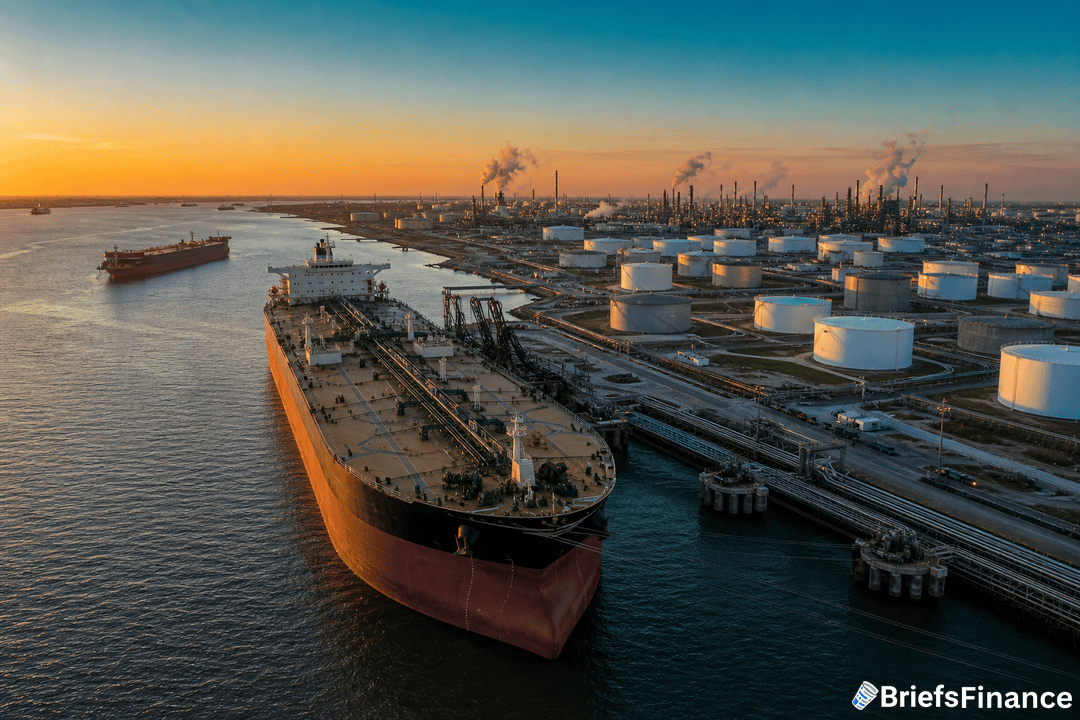
The Strait of Hormuz is closed. Asian refineries that used to load up in the Persian Gulf are now sailing all the way to Texas. About half of every U.S. crude export is moving through one port.
A blockade is doing what no policy ever could. The Gulf Coast is suddenly the busiest oil corridor in the world.
Why The Gulf Coast Is The New Hub
Iran's blockade of the Strait of Hormuz cut off two of the world's biggest oil terminals. Those are Ras Tanura in Saudi Arabia and Basra in Iraq. Both sit upstream of the strait.
Around 20% of global oil supply flowed through that strait before the war. That left buyers in Asia with nowhere to go, and many turned to the U.S. Gulf Coast for crude.
U.S. oil exports climbed to 5.2 million barrels a day in April. That is up from 3.9 million in February before the war started, per data from Kpler. The shift works out to a more than 30% jump in just two months.
Corpus Christi is now handling about half of every barrel the U.S. ships overseas. Houston is picking up most of the rest.
Kpler tracks 50 to 60 very large crude carriers (the supertankers that haul up to 2 million barrels each) heading to U.S. ports on any given day, double last year's volume.
Before the war, Corpus Christi already ranked as the world's third-largest oil export terminal. It sat behind only Ras Tanura and Basra.
Corpus Christi Sets New Records
Port of Corpus Christi CEO Kent Britton said March was the most active month the port has ever logged. The first quarter ranked as its biggest quarter on record.
March's vessel count topped 240. The port's typical monthly count is 200.
"It's a constant parade of tankers coming in and out," Britton said.
Refined fuel shipments to the Middle East have spiked too. Q1 volumes already passed the full-year total from last year.
Asian markets are buying whatever they can get their hands on, taking a lot of light sweet crude off U.S. terminals. That call came from Matt Smith, director of commodity research at Kpler.
What To Watch
The shift to U.S. crude is probably temporary. U.S. light sweet crude does not slot in well at Asian refineries built to process heavier, sour Middle East barrels, Smith said.
There is also a hard ceiling. Dock capacity caps U.S. exports just over 5 million barrels a day. Picture a kitchen sink that can only drain so fast no matter how much water you pour in.
Corpus Christi tops out at roughly 2.6 million bpd. Britton said another 500,000 is possible if pipelines get expanded.
The Middle East still produces too much oil to cover any other way. As Smith put it: "It's a hole that can't be plugged."