Free NewsletterPro Login

Trump Just Picked a Side in the Biggest Fight in Banking

A stylized illustration of a cylindrical cup with blue arrows and lines indicating a swirling or rotational motion inside the cup.
Published Mar 4, 2026
Share:
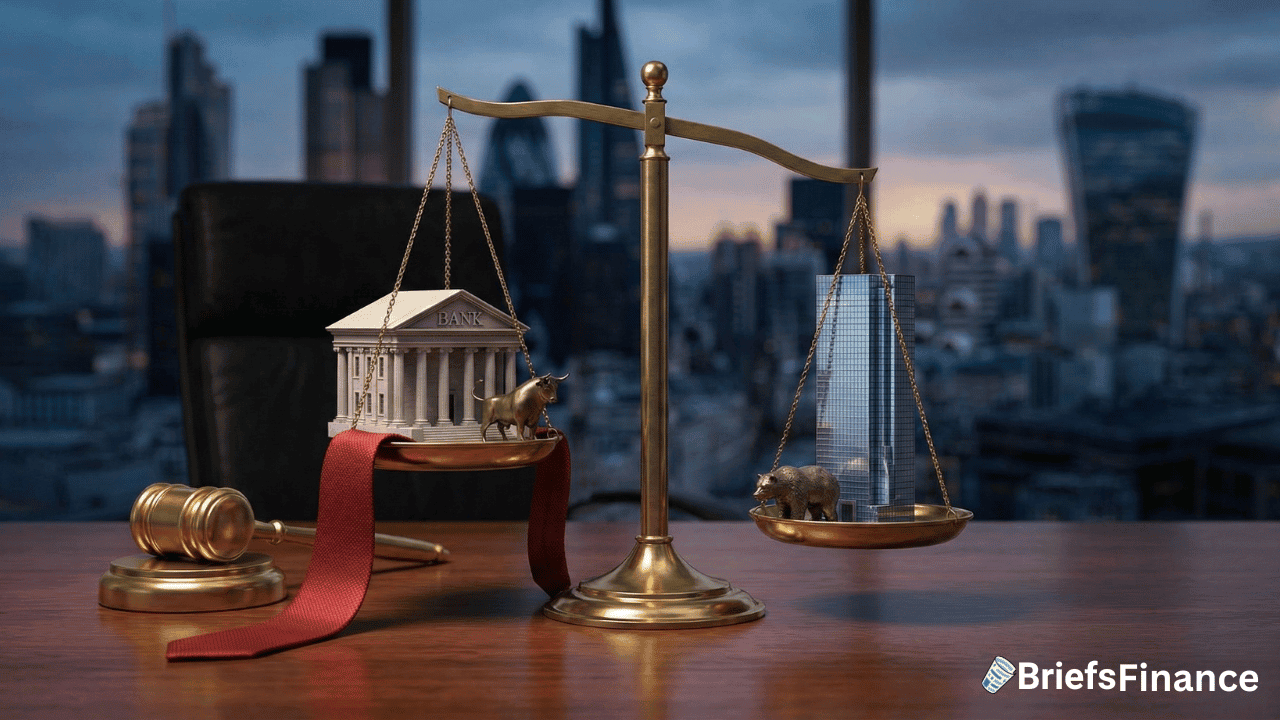
A scale balances a traditional banking model with a bull against a modern glass building featuring a bear, symbolizing the sector's biggest fight; city skyline and BriefsFinance logo in the background.
Summary:

  • Trump posted on Truth Social that banks are "holding the Clarity Act hostage" and must make a deal with the crypto industry.
  • The post came hours after Trump met privately with Coinbase CEO Brian Armstrong, per Politico.
  • Coinbase shares surged as much as 15% Wednesday; JPMorgan and Bank of America each dipped.

The president of the United States just publicly told the biggest banks in America to back off — and the meeting that triggered it happened behind closed doors first.

What Trump Said

In a late-Tuesday Truth Social post, Trump accused banks of trying to undermine two pieces of crypto legislation: the Genius Act, which he signed into law last July to regulate stablecoins, and the Clarity Act, a broader market-structure bill still stalled in the Senate.

"The Banks should not be trying to undercut the Genius Act, or hold the Clarity Act hostage," Trump wrote. "They need to make a good deal with the Crypto Industry because that's what's in the best interest of the American People." He also framed it as a national security issue, warning that inaction would cede ground to China.

Politico reported the post came shortly after Trump met privately with Coinbase CEO Brian Armstrong — though neither the White House nor Coinbase confirmed what was discussed.

What's Actually at Stake

The fight comes down to one question: can crypto platforms pay interest-like yields on stablecoins?

Banks say no — and they have a number. A Treasury study cited by the banking industry estimates that yield-bearing stablecoins could pull as much as $6.6 trillion in deposits out of traditional banks, which rely on those deposits to fund loans. JPMorgan CEO Jamie Dimon has argued that any platform paying yield on stored balances is effectively a bank and should be regulated like one.

The White House's crypto adviser Patrick Witt pushed back, arguing the Genius Act already bars stablecoin issuers from lending out reserves — meaning their tokens aren't deposits and don't need bank-level oversight.

One More Thing That Happened Wednesday

While Trump was attacking the banks publicly, the Kansas City Federal Reserve quietly granted crypto exchange Kraken a "limited purpose" Fed master account — access to the payment rails that underpin the U.S. financial system. Banks have fought for years to keep crypto firms off those rails.

In a single day, the White House and the Fed both moved against the banking industry's position. Whether Congress follows is another question — but the direction of travel just got a lot clearer.

Disclosure

Get Market Briefs delivered to your inbox every morning for free!

No fluff. No noise. No politics. Just finance news you can read in 5 minutes.

Blogs

April 28, 2026
Core-Satellite Portfolio: The Best of Both Worlds
  • A core-satellite portfolio splits investments into stable core holdings and higher-risk satellite picks.
  • The core is usually 60% of the portfolio, with satellites at 40%.
  • It blends passive index investing with active opportunity bets.

Read More
April 28, 2026
Bond Ladder Strategy: The Income Plan With Built-In Flexibility
  • A bond ladder is a series of bonds with staggered maturity dates, often one to five years apart.
  • It gives you regular access to cash, predictable income, and protection from rate changes.
  • It works for Treasuries, corporate bonds, municipal bonds, and CDs.
Read More
April 28, 2026
Silver vs Gold Investing: Which One Belongs in Your Portfolio?
  • Gold is the stable store of value, used as crisis insurance during recessions and conflict.
  • Silver is both a precious metal and an industrial metal, with more volatile pricing.
  • Most investors hold a mix in their alternative investment allocation, often 5% to 12% of portfolio.
Read More
April 28, 2026
What Is a Dividend Reinvestment Plan? The Wealth Snowball Explained
  • A dividend reinvestment plan, or DRIP, automatically uses dividend payments to buy more shares.
  • DRIPs power compound growth - dividends buy shares that pay dividends that buy more shares.
  • Most brokerages offer DRIPs free, and many include fractional shares so every penny goes back in.
Read More
April 28, 2026
How Tariffs Affect the Stock Market
  • Tariffs are extra fees on goods imported into a country, and they hit company profit margins.
  • The S&P 500 dropped over 3% in one day after the 2025 tariff announcement.
  • Tariffs reshape trade flows, creating both losers and unexpected winners.
Read More
April 28, 2026
What Is a 13F Filing? The Smart Money Tracker
  • A 13F filing is a quarterly disclosure of stock holdings from large institutional investors.
  • It shows what hedge funds and asset managers bought, sold, and held last quarter.
  • You can find any 13F free on SEC EDGAR.
Read More
April 28, 2026
Debt-to-Equity Ratio: The Number That Tells You If a Company Is Drowning
  • The debt-to-equity ratio compares what a company owes to what shareholders own.
  • The formula is total liabilities divided by total shareholder equity.
  • Lower ratios mean less risk - one of the value markers Warren Buffett looks for.
Read More
April 28, 2026
Non-Financial Analysis of Stocks: The 4-Step Method
  • Non-financial analysis evaluates a company's business, not its financial ratios.
  • It covers four things: business model, CEO, innovation, and moat.
  • It's how investors find companies with long-term staying power.
Read More
April 28, 2026
SEC EDGAR Tutorial: The Free Tool the Pros Use
  • SEC EDGAR is the official free database of public company filings.
  • You can pull 10-Ks, 10-Qs, 8-Ks, and insider trades by ticker or company name.
  • It's the source journalists and analysts use to write their stock stories.
Read More
April 28, 2026
How to Read a 10-Q (Without Losing Your Mind)
  • A 10-Q is a public company's three-month financial update, filed with the SEC.
  • It shows revenue, profits, debt, and cash flow between yearly reports.
  • You can find any company's 10-Q for free on the SEC's EDGAR site.
Read More
1 2 3 18
Share via
Copy link