Free NewsletterPro Login

Trump Is Rewriting Steel and Aluminum Tariffs. Many Importers Will Pay More, Not Less.

Published Apr 2, 2026
Share:
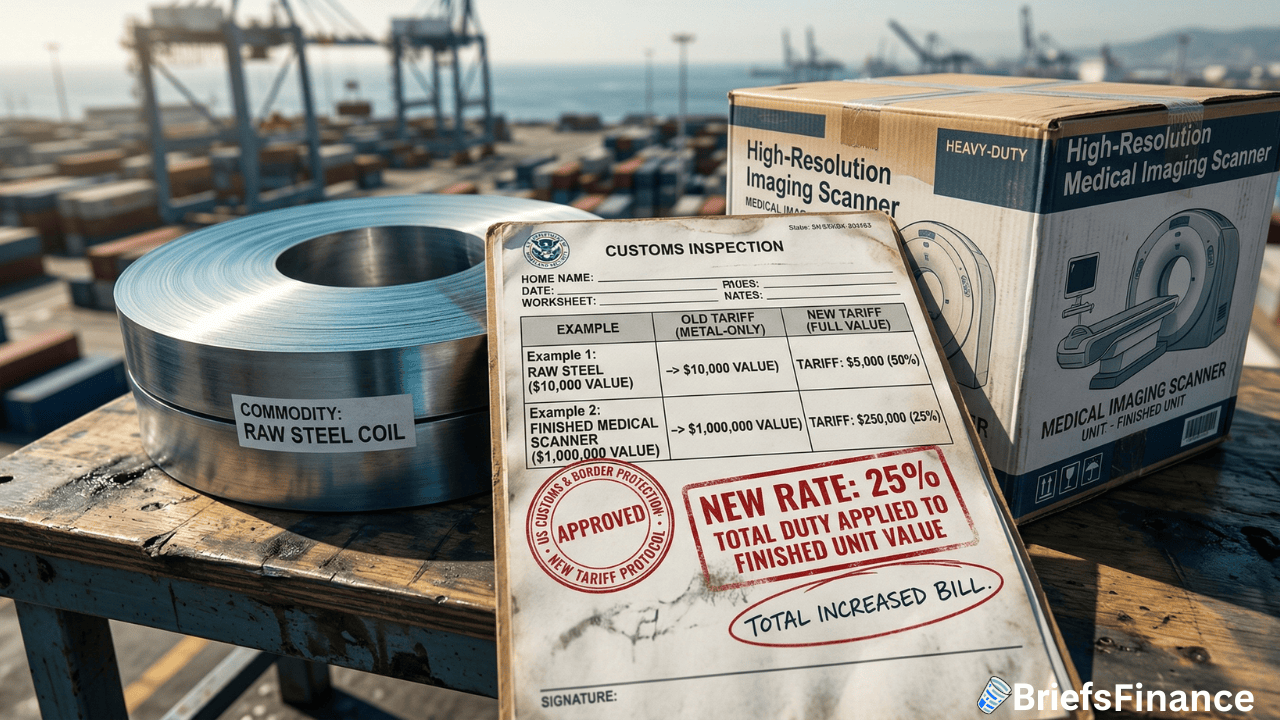
A customs inspection sheet showing a 25% steel tariff rate sits on a table with a raw steel coil and a medical imaging scanner at a shipping port, highlighting challenges faced by importers amid containers in the background.
Summary:
  • The White House is set to cut the tariff rate on finished goods containing steel and aluminum from 50% to 25% - but the tax will now cover the entire product value, not just the metal inside it.
  • Raw steel and aluminum keep their 50% rate, while products with less than 15% metal content could owe nothing at all.
  • Major aluminum stocks fell in after-hours trading after news of the overhaul broke.

A lower tariff rate sounds like relief for importers. For most of them, it won't be.

The White House is getting ready to rewrite the rules on how finished goods made with foreign steel and aluminum get taxed. An announcement could come within days.

The Math That Matters

Right now, a finished product containing imported steel or aluminum gets hit with a 50% duty - but only on the value of the metal itself.

So if you import a $100 piece of equipment with $20 worth of steel inside it, you pay 50% of that $20. That's $10.

Under the new system, that same product would face a 25% tariff on its full $100 price tag. That's $25 - more than double what the old rate cost.

The rate goes down. The bill goes up.

Why the White House Is Doing This

The existing setup has created major problems for companies trying to stay compliant. Pinpointing exactly how much metal sits inside a finished product - anything from car parts to medical equipment - has been a costly guessing game for importers and customs officials.

One case that surfaced in internal discussions: dental floss. There's a tiny metal blade for cutting, but the rest of the product has no steel or aluminum at all.

Trying to calculate a metal-based tariff on something like that was a dead end.

The fix is straightforward - tax the whole product instead of hunting for the metal inside it. Products where steel and aluminum make up less than 15% of the total would owe nothing under the new setup.

Jon Toomey, who leads the Coalition for a Prosperous America - a group representing domestic steel and aluminum producers - said the overhaul should make these tariffs work the way they were designed: backing American manufacturing and its workforce.

What Investors Should Watch

This isn't just a trade policy tweak. It's a revenue play.

The federal government has been pulling in less tariff money since the Supreme Court knocked down several of Trump's country-specific trade penalties earlier this year. Broadening the base for steel and aluminum duties could help plug part of that hole.

Wall Street picked up on the shift fast. Alcoa and Century Aluminum both slid more than 1.5% after the closing bell, and Commercial Metals dropped roughly 1.4%.

Commodity-grade steel and aluminum still carry their 50% rate. Finished goods get a lower percentage on a much bigger number.

The bottom line lower rates = higher rates.

Disclosure

Get Market Briefs delivered to your inbox every morning for free!

No fluff. No noise. No politics. Just finance news you can read in 5 minutes.

Blogs

April 29, 2026
What Is Blockchain? A Plain English Guide For Investors
  • Blockchain is a digital ledger that records every transaction on a public network.
  • Once a transaction is recorded, it cannot be changed or deleted.
  • It is the foundation of Bitcoin, Ethereum, and thousands of other cryptocurrencies.

Read More
April 29, 2026
How To Negotiate Bills: The Script That Saves You Hundreds A Year
  • Most monthly bills are negotiable, even though most Americans never try.
  • A simple phone call with the right script can lower your phone, internet, and utility bills.
  • The key rule is to be nice. Customer service reps have more flexibility than most people realize.
Read More
April 29, 2026
75 15 10 Rule: The Budget That Builds Wealth On Autopilot
  • The 75 15 10 rule is a budgeting plan: spend at most 75% of your income, invest at least 15%, and save at least 10%.
  • It works by making sure you pay yourself before you spend.
  • Once your savings target is hit, you shift the 10% over to investing, becoming a 75/25 plan.
Read More
April 29, 2026
How To Rebalance Portfolio: The Strategy That Forces You To Buy Low And Sell High
  • Rebalancing means adjusting your portfolio back to your target allocation when it drifts too far.
  • The two main methods are time-based (rebalance once a year) and threshold-based (rebalance when allocation drifts more than 5%).
  • If you are still adding money, you can rebalance by directing new money instead of selling.
Read More
April 29, 2026
How To Buy Treasury Bonds: A Beginner's Guide
  • Treasury bonds are loans you make to the U.S. government. They are considered the safest investment in the world.
  • You can buy them at TreasuryDirect.gov directly or through any major brokerage.
  • There are three main types: T-Bills, Treasury Notes, and Treasury Bonds. The longer the term, the higher the interest rate.
Read More
April 29, 2026
Forward Vs Futures Contracts: What's The Real Difference?
  • Both forward and futures contracts are deals to buy or sell something at a set price on a future date.
  • Futures trade on exchanges. Forwards are private deals between two parties.
  • Most regular investors do not use either. They are mostly tools for businesses and big institutions.
Read More
April 29, 2026
Alternative Investments Explained: What They Are And Why They Matter
  • Alternative investments are anything that is not a regular stock or bond.
  • The most common types are precious metals, crypto, real estate, commodities, and collectibles.
  • Most investors should hold 5% to 25% of their portfolio in alternatives, depending on risk tolerance.
Read More
April 29, 2026
How To Buy Bitcoin For Beginners: 3 Simple Ways
  • There are three main ways to buy Bitcoin: directly on an exchange, through a Bitcoin ETF, or through a Bitcoin miner stock.
  • Each has its own pros, cons, and tax setup.
  • Most beginners do best starting small and using dollar cost averaging.
Read More
April 29, 2026
How To Follow Smart Money: The 5 Market Shifts Framework
  • "Smart money" means big investors with deep research teams and fast information.
  • You can follow them by watching for 5 types of market shifts.
  • The goal is to spot where money is moving before it shows up on CNBC.
Read More
April 29, 2026
Insider Trading Meaning: What It Really Is (And Why Some Of It Is Legal)
  • Insider trading means buying or selling a stock based on facts the public does not know yet.
  • Some insider trading is legal. Some is a federal crime that can send people to prison.
  • The SEC tracks every legal insider trade in a public file called Form 4.
Read More
1 2 3 19
Share via
Copy link