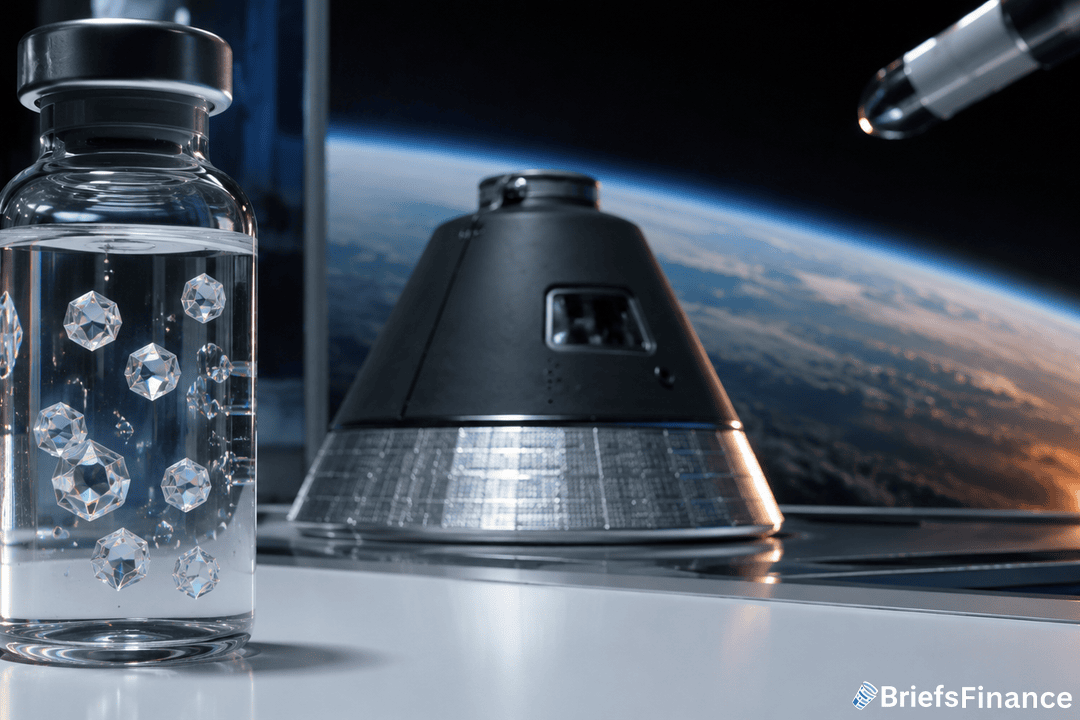
A startup backed by Peter Thiel just got a real drug maker to send drugs to space.
Not for science. For money.
The Deal
Varda signed a deal with United Therapeutics. The two will test small drugs for lung disease in orbit.
The first launch is set for early 2027.
The science is simple. Drugs form crystals. Those crystals form in new ways when there's no gravity to pull on them.
Drug makers think those new crystal forms could lead to drugs that work better. They might be more stable, or get into the body more easily.
If Varda finds a better form for a United Therapeutics drug, the firm can patent it. That could stretch the life of a drug worth billions.
That's the whole pitch.
Every weekday morning, Market Briefs breaks down deals like this and tells you what's hype and what's real. You get a free investing masterclass with it.
Why Space Drug Making Could Work
Launching cargo to space still costs about $7,000 per kilogram. That makes most products too costly to build in orbit.
Drugs are the rare exception. A kilogram of Ozempic is worth more than $100 million at retail. So the launch bill is rounding error next to the value of the drug.
That math is why Varda thinks it can run a real business. Most other space factory pitches are still just a thought game.
Varda's Setup
Varda was started in 2021 by Delian Asparouhov and Will Bruey. Asparouhov is a partner at Peter Thiel's Founders Fund. Bruey is a former SpaceX engineer. He runs Varda as CEO.
Varda has flown six capsules so far. The firm raised $187 million in a Series C round this year.
Each capsule rides into space on a SpaceX Falcon 9. It does its work in orbit. Then it drops back into the atmosphere at about Mach 25. It floats to the ground in the Australian outback under a parachute.
Half of Varda's flights have been drug tests. The other half were paid by the U.S. Air Force. Those flights test gear tied to hypersonic missile tech.
That gives Varda two ways to fund the business.
What To Watch
Merck sent samples of its cancer drug Keytruda to the space station in 2017. The crystals formed in more even sizes in orbit.
But Merck later picked a different way to make the drug. So no drug on the market today came from a space trip.
Varda is betting that changes once a real drug maker pays for the work. United Therapeutics will write the first chapter on whether space drug making turns into a real business.
United is run by CEO Martine Rothblatt. She built the firm around drugs for a rare lung disease. Her daughter has it. So she has a strong reason to test new crystal forms that might work better.
If you want this kind of read on new industries every morning, join Market Briefs. It's free to join. And it comes with a 45-minute investing course.