Pro Login

The Moment the Strikes Hit Iran, $2.8 Million an Hour Started Leaving Its Biggest Crypto Exchange

A stylized illustration of a cylindrical cup with blue arrows and lines indicating a swirling or rotational motion inside the cup.
Published Mar 3, 2026
Share:
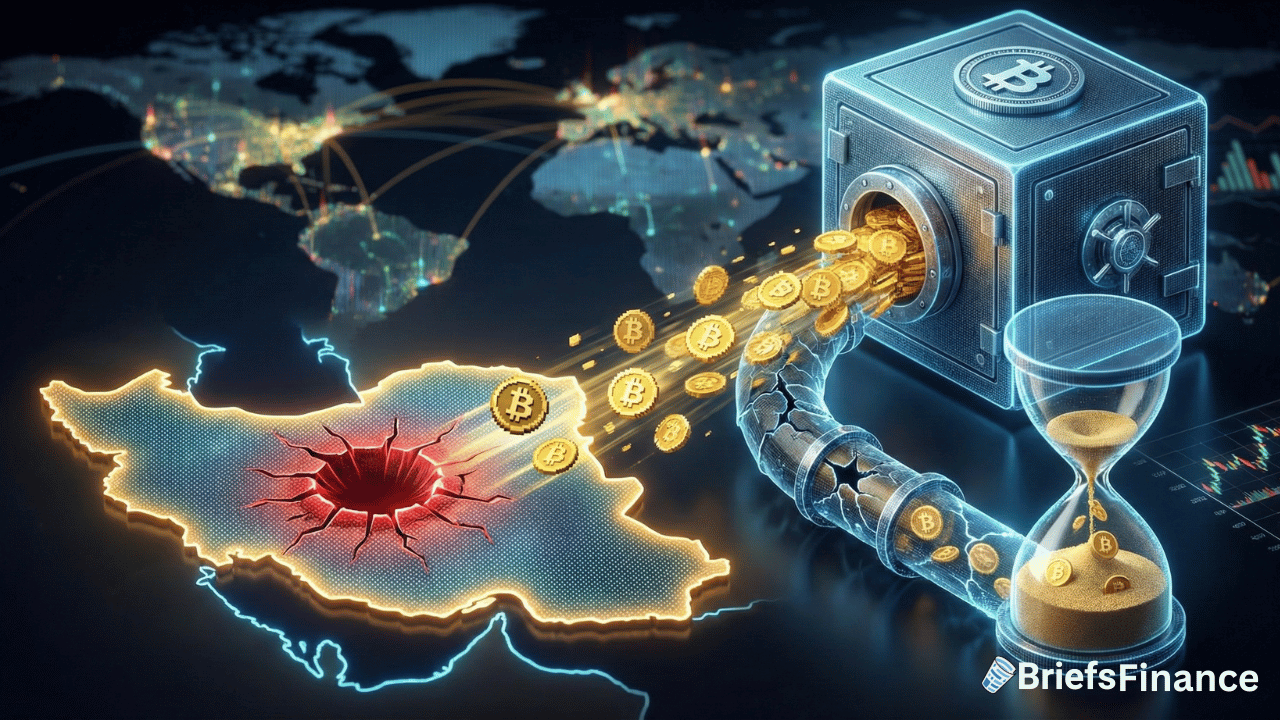
Illustration of bitcoin coins flowing from a glowing map of Iran into a digital safe, with a world map and hourglass in the background, symbolizing how $2.8 million an hour moves through Iran crypto exchange networks.
Summary:

  • Outflows from Iran's largest crypto exchange spiked 700% within minutes of the first US-Israeli strikes.
  • Iran has no access to the global banking system — crypto is one of the only ways to move money out.
  • Blockchain data shows this isn't a one-time reaction. Outflows spike every time Iran faces a major shock.

When bombs start falling, Iranians don't call their bank. They open their crypto app.

What Happened on the Blockchain

Blockchain analytics firm Elliptic tracked outflows from Nobitex — Iran's largest crypto exchange, with more than 11 million users — and found they spiked 700% within minutes of the first US-Israeli strikes on February 28. At the peak, roughly $2.8 million per hour was leaving the platform, compared to a normal baseline of $300,000–$400,000. Initial tracing shows those funds headed to overseas exchanges that have historically received large inflows from Iran.

Nobitex processed $7.2 billion in crypto transactions in 2025. It's not a fringe platform — it's the backbone of Iran's digital economy.

Why Crypto Is Iran's Financial Escape Hatch

Iran has been cut off from the SWIFT international banking system since 1979. Its citizens have almost no way to move wealth abroad through traditional channels. Crypto — particularly USDT, a dollar-pegged stablecoin — has become the primary workaround. Convert rials to USDT, withdraw to a private wallet, send overseas. The whole thing bypasses the global banking system.

Chainalysis noted that "some of these flows are almost certainly ordinary Iranians moving funds in response to rising risk" — not just sanctioned actors. This pattern shows up every time Iran faces a shock: Elliptic identified similar spikes following US sanctions announcements in January and after a government-imposed internet blackout during domestic protests.

Not everyone reads the data the same way. TRM Labs offered a more cautious take, describing the activity as "more indicative of stress than systemic capital flight" — noting that overall crypto trading volume in Iran fell 80% during the internet disruptions, limiting what users could actually do.

The Double-Edged Sword

Crypto gives Iranians a financial lifeline the banking system can't. But it also leaves a trail. Blockchain transactions are public and traceable — which is exactly how Elliptic spotted the spike in the first place. The same transparency that makes crypto a useful evasion tool also makes it visible to regulators and investigators worldwide.

When the bombs fall, the blockchain doesn't lie.
Disclosure

Get Market Briefs delivered to your inbox every morning for free!

No fluff. No noise. No politics. Just finance news you can read in 5 minutes.

Blogs

April 13, 2026
What Is Free Cash Flow? How To Find It & Why It's Important
  • Free cash flow is the cash a company has left after paying its bills and putting money back into the business.
  • Investors use free cash flow to figure out what a company is really worth - and if the stock is a good deal.
  • You can find free cash flow on a company's cash flow report, one of three key reports every public company files.
Read More
April 13, 2026
Non Taxable Income: What It Is and Why Investors Care

Non taxable income is money you earn that the IRS does not tax - like Roth IRA cash, muni bond interest, and certain investment gains. The U.S. tax code taxes workers, investors, and business owners at very different rates. Tools like Roth accounts, muni bonds, and real estate write-offs can help you keep more of what you earn.

Read More
April 11, 2026
Nasdaq Index Fund: A Beginner's Guide to Investing in the Nasdaq 100
  • A Nasdaq index fund lets you invest in the 100 biggest non-bank companies on the stock market all at once.
  • You can access the Nasdaq through index funds, mutual funds, or ETFs like QQQ - each with its own fees, trading rules, and style.
  • Picking the right Nasdaq index fund comes down to three things: who runs it, what is in it, and what it costs.
Read More
April 11, 2026
What Is Wealth? It's Not What Most People Think
  • Wealth is about owning assets that grow and pay you - not just earning a high salary.
  • In a capitalist system, there are two ways to get paid: from your labor and from your capital.
  • Building wealth takes a shift in mindset, a money system, and the habit of investing before you spend.
Read More
April 10, 2026
Micron Stock: The AI Memory Play Most Investors Are Missing
  • Micron (MU) is the only U.S. company that makes HBM chips - the short-term memory layer that AI systems need to run.
  • By early 2026, data centers were using about 70% of all memory chips made in the world, creating an 18-month backlog for new orders.
  • Micron's DRAM - or short-term memory chip - revenue jumped 69% year over year, and the company shifted away from consumer products to focus almost entirely on AI.
Read More
April 10, 2026
What Is Working Capital? What Investors Need To Know
  • Working capital is current assets minus current liabilities - it shows if a business can pay its short-term bills.
  • You find it on a company's balance sheet inside its 10-K report.
  • Changes in working capital show up on the cash flow statement and affect how much cash a business really makes.
Read More
April 9, 2026
What Is a Meme Stock? A Simple Guide for New Investors

You've probably heard the term "meme stock" thrown around on […]

Read More
April 9, 2026
Enterprise Value Formula: What It Is and How to Calculate It
  • Enterprise value (EV) shows what a company is really worth - debt and cash included - not just its stock price
  • The enterprise value formula is: Market Cap + Total Debt - Cash and Cash Equivalents
  • Investors use EV with metrics like EBITDA to compare stocks more fairly than market cap alone
Read More
April 8, 2026
Return on Equity: What It Is and How to Use It
  • Return on equity (ROE) measures how much profit a company earns for every dollar of shareholder equity
  • The formula is simple: net income divided by shareholder equity
  • A higher ROE can signal a company that is good at turning investor money into profit - but it is not the full picture
Read More
April 4, 2026
Personal Finance Books That Actually Teach You to Build Wealth

Most investors grow up hearing the same financial advice. Study […]

Read More
1 2 3 17
Share via
Copy link