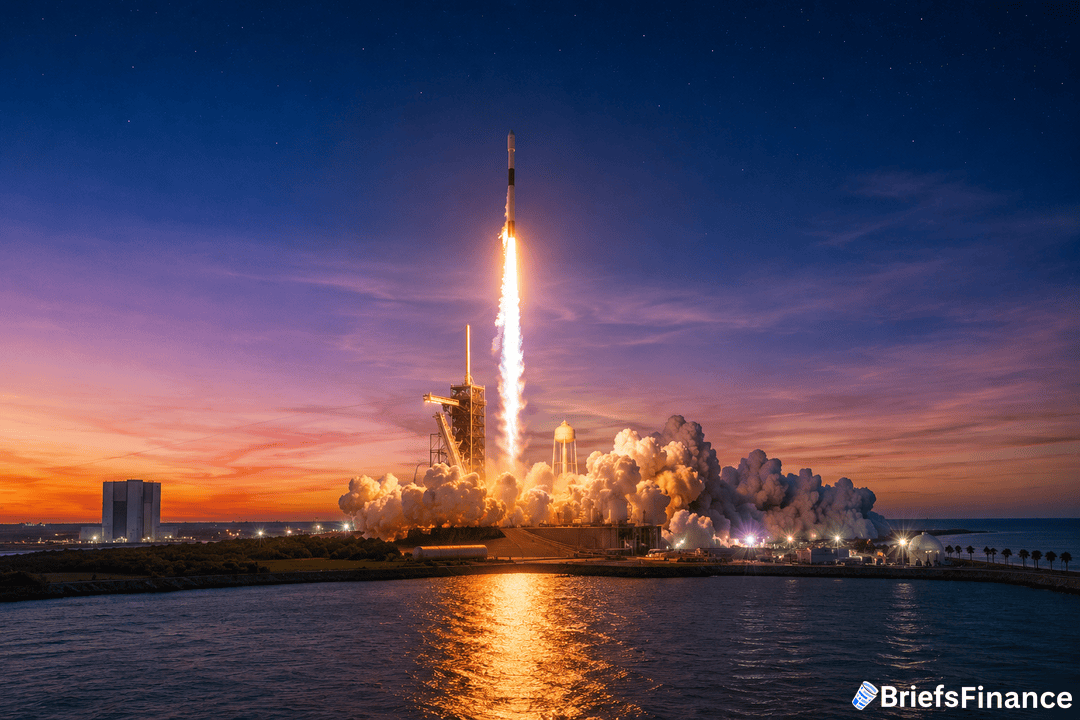
For 23 years, SpaceX has been one of the most private firms in tech.
That changed Wednesday, when Musk's rocket company filed a 277-page report for what could be the biggest IPO ever. The numbers in the filing look nothing like a rocket company.
They look like an AI company that also launches rockets.
The Numbers Behind The Filing
Revenue last year: $18.7 billion, up 33% from 2024.
Total spend: $20.7 billion - the gap that made a $4.9 billion loss after the company turned a $791 million profit in 2024.
Losses ran $4.6 billion in 2023 too, so the swing back to red is less of a surprise and more of a return to form.
The first three months of 2026 don't help the case for a fast turnaround, with SpaceX already losing $4.3 billion on $4.7 billion of revenue. That works out to almost a dollar of losses for every dollar of sales.
The ticker is SPCX. How much SpaceX wants to raise and what value it's targeting come later, just before the stock starts trading.
Curious how Wall Street is sizing up what could be the biggest IPO ever? We break it down for investors every morning in Market Briefs, five minutes a day, plus a free investing masterclass when you join.
Where The Money Is Actually Going
SpaceX broke its 2025 spend into three buckets, and the split reframes the whole company:
- AI: $12.7 billion
- Starlink: $4.2 billion
- Other space work (rockets included): $3.8 billion
AI got more dollars than the rocket arm and the satellite arm combined. Q1 2026 tells the same story.
SpaceX spent $10.1 billion on big projects in the first three months of the year, with $7.7 billion of that going to AI systems.
That spend traces back to February 2026, when SpaceX merged with xAI - Musk's AI and social media firm - in a deal worth $1.25 trillion.
SpaceX now builds rockets, satellites, and the AI data centers Musk wants to put in orbit.
A Trillion-Dollar Pay Package With Strings Attached
Musk's salary at SpaceX has been $54,080 a year since 2019, barely enough to buy a basic Tesla.
That's the only small number in his pay package. The new plan grants him 15 share tranches of about 66.6 million shares each.
But he only collects them if SpaceX hits value targets in $500 billion jumps all the way up to $7.5 trillion. He also has to set up a lasting human colony on Mars with at least one million people.
If those goals land, Musk becomes the world's first trillionaire. His mix of common stock and Class B shares already gives him 85.1% of the voting power, so he's not losing control in the meantime.
Worth Noting
SpaceX is pitching investors on what it calls a $28.5 trillion total market - the biggest, the company says, in human history.
The bulk of that ($26.5 trillion) is AI.
The IPO will test how much of Musk's vision Wall Street is willing to back. The cash burn says one thing - the 277-page promise of Mars cities and AI data centers in orbit says another.
Investors will have to pick which version of SpaceX they're buying.
If you want this kind of read on the market every weekday morning, join 350,000+ investors reading Market Briefs. You'll also get a 45-minute investing course thrown in as a bonus.