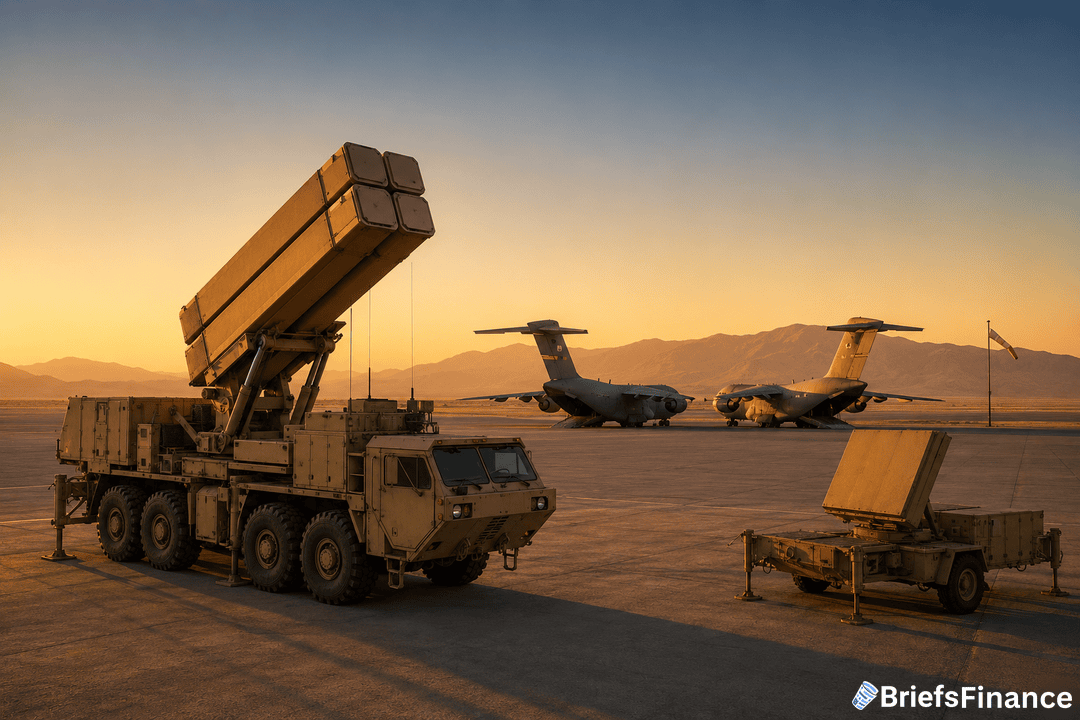
The market is pricing peace at the same time the State Department is shipping weapons.
Both can be true at once, and right now they are.
The Deal
Secretary of State Marco Rubio cleared $25.8 billion in arms sales to four Middle East allies on Thursday, according to Bloomberg News.
The bulk of the deal is air-defense interceptors going to Israel, Kuwait, Qatar, and the UAE.
Rubio cleared it under an emergency provision that lets the State Department skip the normal congressional review window, after formally certifying that an emergency exists requiring the immediate sale.
That's the second fast-tracked package in roughly a week, after a $8.6 billion approval on May 2 covered similar countries.
Why The Rush
The U.S. and its Gulf partners burned through air-defense inventory during the Iran war.
Patriot interceptors and laser-guided rocket systems are the kind of stockpile that takes years to build and weeks to deplete in a real conflict.
Earlier reporting on related approvals identified specific lines, including up to 200 PAC-2 GEM-T and 300 PAC-3 MSE interceptors for Qatar valued at up to $4.01 billion, $992 million in advanced precision kill weapon systems for Israel, and $2.5 billion in battle command systems for Kuwait.
In plain English, the U.S. is replacing the missiles that already got fired and preloading allies for whatever comes next.
Markets Are Pricing The Other Side
The timing is the part investors should sit with.
Stocks rallied to record highs on Wednesday on hopes that a U.S.-Iran deal would end the war, with oil falling roughly 10% on the same hopes.
A $25.8 billion emergency arms push doesn't read like a peace dividend.
It reads like a hedge in case talks fall apart, which means defense names with Middle East exposure benefit either way: a deal still leaves a restocking demand, and a breakdown means more orders.
Democratic lawmakers have criticized the use of the emergency provision, but the deals are already approved.
For an investor lens, the read-through goes straight to the prime contractors who build these systems and the suppliers in the missile defense chain.
What To Watch
Saudi Arabia and Kuwait recently rolled back the limits they had placed on U.S. forces using their bases and airspace, and Washington is weighing whether to restart Project Freedom, the U.S. naval escort operation through the Strait of Hormuz.
The Wall Street Journal reported that the Trump administration paused the operation earlier this week amid Pakistani-mediated talks with Iran, and a restart would mark another step in the U.S. military posture in the region.
If escorts resume, expect more emergency authorizations to follow, since each surge in operational tempo burns through more of the same air-defense and missile inventory the State Department is now rushing to replace.
Defense primes Lockheed Martin and RTX, plus suppliers in the Patriot interceptor and APKWS supply chain, are the names most directly tied to that order flow.
Earlier reporting also pointed to a separate $16.5 billion Mideast weapons fast-track in March, which means the running total of expedited sales since the war began is now north of $50 billion.
Watch the next State Department notification window and the upcoming defense-prime earnings calls for confirmation that this turns into actual orders.