Free NewsletterPro Login

Oil Prices Climb as Trump Considers Strikes on Iran

A stylized illustration of a cylindrical cup with blue arrows and lines indicating a swirling or rotational motion inside the cup.
Published Jan 29, 2026
Share:
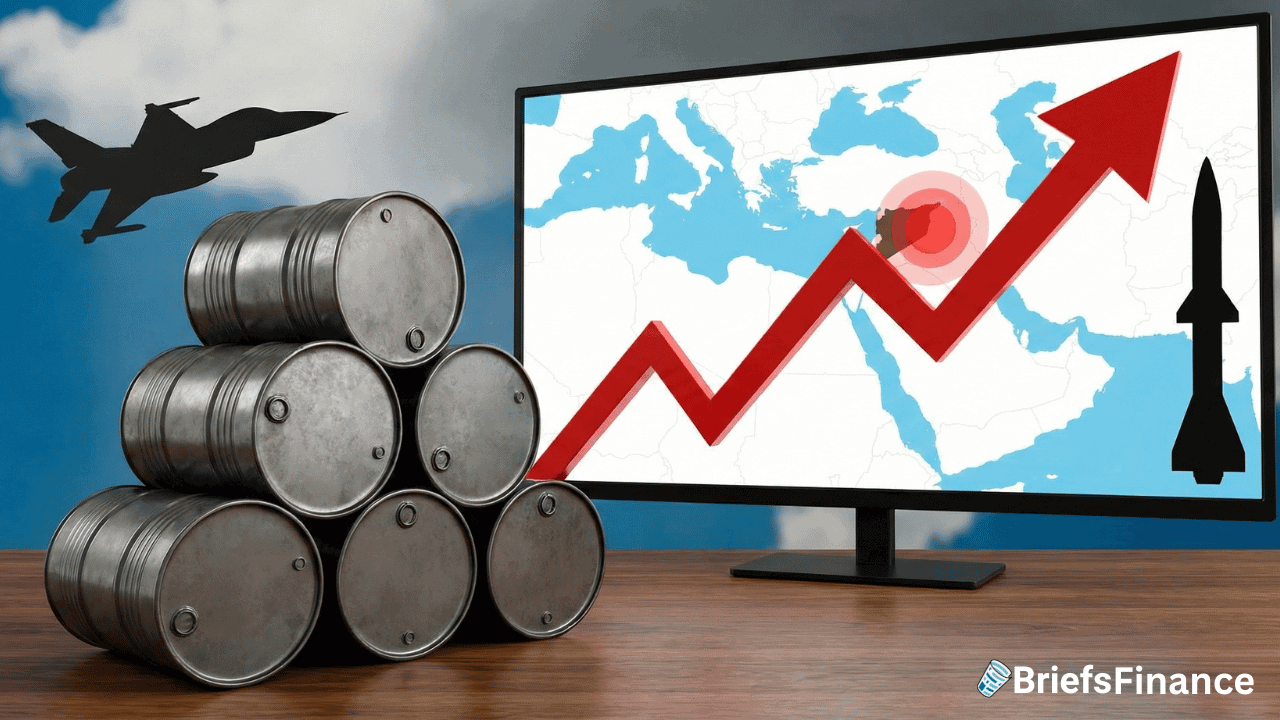
A stack of oil barrels, a rising red graph over a Middle East map on a screen, a fighter jet, and a missile silhouette highlight oil price growth linked to Iran and escalating geopolitical tensions.
Summary:

  • Crude oil prices increased over 2% on Thursday, U.S. crude rising to $64.77 per barrel.
  • Global benchmark Brent crude rose to $69.99 per barrel, reflecting market reactions to geopolitical tensions.
  • President Trump has deployed the Abraham Lincoln Carrier Strike Group to the Middle East amid tensions with Iran.

Crude Oil Prices Surge

On Thursday, crude oil prices experienced a significant rise, with U.S. crude increasing by $1.56, or 2.5%, to $64.77 per barrel.

The global benchmark, Brent crude, also saw an uptick of $1.59, or 2.3%, reaching $69.99 per barrel. This surge in oil prices is attributed to growing geopolitical tensions in the Middle East, particularly regarding Iran.

Trump's Military Posture

President Donald Trump has taken a decisive military stance by deploying the Abraham Lincoln Carrier Strike Group to the Middle East.

This move comes as tensions escalate between the U.S. and Iran, particularly concerning Iran's nuclear program. Trump has issued a warning to Iran, stating that time is running out for the country to negotiate a deal regarding its nuclear ambitions.

Threats of Military Action

In a recent statement, Trump threatened Iran with larger military strikes than those that took place in June 2025. He emphasized that the next attack would be more severe, urging Tehran not to provoke further military action.

His comments were shared in a post on Truth Social, where he warned, "The next attack will be far worse! Don't make that happen again." This rhetoric indicates a potential escalation in U.S.-Iran relations.

Concerns Over Oil Supply

The oil market is closely watching the unrest in Iran, particularly following a recent government crackdown on protests that has resulted in thousands of deaths. Multiple sources have reported that Trump is considering targeted strikes on Iranian security forces.

The intention behind these potential strikes is to inspire anti-government protests within Iran. Market analysts are concerned that any military intervention by the U.S. could disrupt crude oil supplies in the region, affecting global oil prices.

Implications for Investors

As the situation develops, investors are advised to monitor the oil market closely. The potential for military action and the ongoing unrest in Iran may create volatility in oil prices.

The situation underscores the interconnectedness of geopolitical events and financial markets, making it crucial for investors to stay informed about developments in the region.

Disclosure

Get Market Briefs delivered to your inbox every morning for free!

No fluff. No noise. No politics. Just finance news you can read in 5 minutes.

Blogs

April 29, 2026
What Is Blockchain? A Plain English Guide For Investors
  • Blockchain is a digital ledger that records every transaction on a public network.
  • Once a transaction is recorded, it cannot be changed or deleted.
  • It is the foundation of Bitcoin, Ethereum, and thousands of other cryptocurrencies.

Read More
April 29, 2026
How To Negotiate Bills: The Script That Saves You Hundreds A Year
  • Most monthly bills are negotiable, even though most Americans never try.
  • A simple phone call with the right script can lower your phone, internet, and utility bills.
  • The key rule is to be nice. Customer service reps have more flexibility than most people realize.
Read More
April 29, 2026
75 15 10 Rule: The Budget That Builds Wealth On Autopilot
  • The 75 15 10 rule is a budgeting plan: spend at most 75% of your income, invest at least 15%, and save at least 10%.
  • It works by making sure you pay yourself before you spend.
  • Once your savings target is hit, you shift the 10% over to investing, becoming a 75/25 plan.
Read More
April 29, 2026
How To Rebalance Portfolio: The Strategy That Forces You To Buy Low And Sell High
  • Rebalancing means adjusting your portfolio back to your target allocation when it drifts too far.
  • The two main methods are time-based (rebalance once a year) and threshold-based (rebalance when allocation drifts more than 5%).
  • If you are still adding money, you can rebalance by directing new money instead of selling.
Read More
April 29, 2026
How To Buy Treasury Bonds: A Beginner's Guide
  • Treasury bonds are loans you make to the U.S. government. They are considered the safest investment in the world.
  • You can buy them at TreasuryDirect.gov directly or through any major brokerage.
  • There are three main types: T-Bills, Treasury Notes, and Treasury Bonds. The longer the term, the higher the interest rate.
Read More
April 29, 2026
Forward Vs Futures Contracts: What's The Real Difference?
  • Both forward and futures contracts are deals to buy or sell something at a set price on a future date.
  • Futures trade on exchanges. Forwards are private deals between two parties.
  • Most regular investors do not use either. They are mostly tools for businesses and big institutions.
Read More
April 29, 2026
Alternative Investments Explained: What They Are And Why They Matter
  • Alternative investments are anything that is not a regular stock or bond.
  • The most common types are precious metals, crypto, real estate, commodities, and collectibles.
  • Most investors should hold 5% to 25% of their portfolio in alternatives, depending on risk tolerance.
Read More
April 29, 2026
How To Buy Bitcoin For Beginners: 3 Simple Ways
  • There are three main ways to buy Bitcoin: directly on an exchange, through a Bitcoin ETF, or through a Bitcoin miner stock.
  • Each has its own pros, cons, and tax setup.
  • Most beginners do best starting small and using dollar cost averaging.
Read More
April 29, 2026
How To Follow Smart Money: The 5 Market Shifts Framework
  • "Smart money" means big investors with deep research teams and fast information.
  • You can follow them by watching for 5 types of market shifts.
  • The goal is to spot where money is moving before it shows up on CNBC.
Read More
April 29, 2026
Insider Trading Meaning: What It Really Is (And Why Some Of It Is Legal)
  • Insider trading means buying or selling a stock based on facts the public does not know yet.
  • Some insider trading is legal. Some is a federal crime that can send people to prison.
  • The SEC tracks every legal insider trade in a public file called Form 4.
Read More
1 2 3 19
Share via
Copy link