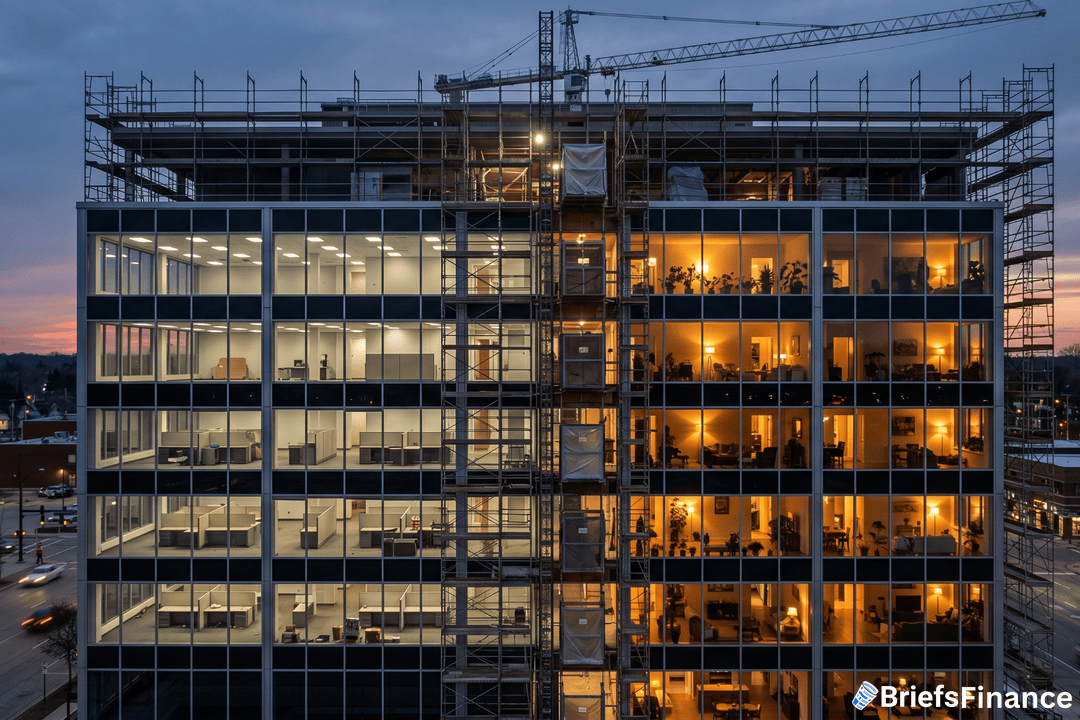
Empty office towers are not becoming rubble. They are becoming bedrooms.
The office-to-apartment conversion pipeline just hit 90,300 units nationwide. Up 28% in one year. Nearly four times what it was in 2022. This is what happens when Kastle's office occupancy barometer is still stuck around 56% and $930 billion in commercial real estate loans come due the same year.
From White-Collar Floors To White-Walled Studios
Nearly half of all planned building conversions in the country - 47% - now come from offices getting stripped and turned into apartments.
The industry calls this "adaptive reuse." In plain English, it means taking an existing building, keeping the bones, and swapping the guts. A conference room becomes a kitchen. A corner office becomes a primary bedroom.
Two things are driving the wave. Loans are coming due, so owners have to do something other than wait. And local governments are sweetening the math with tax breaks and zoning changes to bring empty downtowns back to life.
Where The Work Is Happening
New York tops the list with 16,358 units in conversion. Washington DC comes in second at 8,479. Chicago is third at 4,360.
Denver and Philadelphia both more than doubled their pipelines in a single year. Both cities happen to have older, narrower office buildings - the kind that convert most easily.
Not every office can make the jump. Whether a building can be converted comes down to a few boring but key details. How deep the floors go. Where the windows sit. Whether the structural layout can handle the plumbing and wiring that apartments need. Big, boxy trophy towers often fail the test.
What It Means For Investors
This matters in two directions.
Office landlords with the right kind of building now have an exit that did not exist five years ago. Office landlords with the wrong kind of building have fewer options than ever.
On the apartment side, 90,300 new units is real new supply hitting markets that were already building fast. For investors in REITs - real estate investment trusts, companies that own apartment buildings and pay out rental income - that means rent growth in the top conversion cities may face more competition than the headline numbers suggest.
What To Watch
If the pipeline keeps growing at 28% a year, office-to-apartment stops being a niche play. It starts being a category. Local incentives, construction costs, and loan terms will decide whether it keeps scaling.
The empty tower era is ending. The converted tower era is just getting started.