Free NewsletterPro Login

GE Vernova Just Booked $18.3 Billion In Orders, Most Of It Tied To AI Power

Published Apr 25, 2026
Share:
Summary:
  • GE Vernova reported Q1 2026 orders of $18.3 billion, up 71% from a year ago.
  • Total backlog now sits at $163 billion, up 40% from the same point last year.
  • The gas turbine backlog hit about 80 gigawatts at the end of 2025, with delivery slots booked into 2029.

The fastest way to power an AI data center right now is a natural gas turbine. GE Vernova just posted earnings that show how big that bet has gotten.

The Cambridge-based power gear maker booked $18.3 billion in Q1 2026 orders. That's a 71% jump from a year ago.

Total backlog hit $163 billion, up 40% year over year. The stock jumped 13% on the news.

For investors trying to figure out what the AI race actually pays for, this is the receipt.

Why Gas Turbines Are Suddenly Hot

Solar and wind need the right weather. Nuclear plants take a decade.

Grid hookups take years.

Gas turbines can sit next to a data center and start making power in months. Sometimes days.

That speed is why cloud giants are signing for the gear early. They're locking in supply before site plans are done.

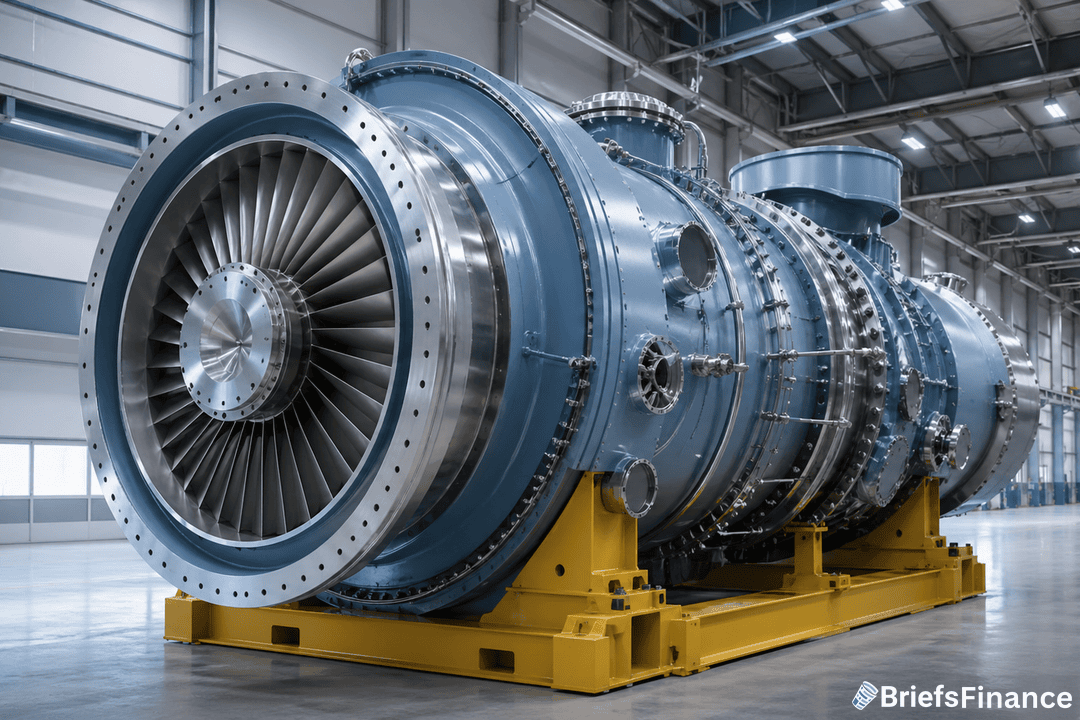
GE Vernova ended 2025 with a roughly 80-gigawatt gas turbine backlog. Slots stretch into 2029.

That's enough power to run about 60 million homes.

The Other Half Of The Story

The other half of GE Vernova's growth is in what it calls grid gear. That's transformers, switches, and high-voltage parts.

They move power from where it's made to where it's used. AI data centers need all of that too.

That unit's sales grew 61% year over year in Q1. Sales hit just under $3 billion. The backlog has grown to about $42 billion.

At the end of 2022, it was just $9 billion.

Prolec GE is the transformer arm GE Vernova fully owns now. It told investors that data centers were 10% of sales in 2024.

That share will hit 20% in 2025.

Who Else Is In The Game

Baker Hughes (BKR) is the other big name. It builds what folks call "energy islands." Those are turbine and engine packs dropped onto data center sites.

The firm hasn't broken out AI-specific sales. But the unit is growing.

The global gas turbine market is set to grow fast. It will go from $24.7 billion in 2026 to $43.5 billion by 2034, per Fortune Business Insights.

GE Vernova's 80-gigawatt backlog says a lot of that growth is already booked.

Why It Matters For Investors

GE Vernova's order book is one of the cleanest reads on AI power demand. As long as the orders keep flowing, the AI buildout is more than just talk.

The firm raised its 2026 sales outlook to $44.5 to $45.5 billion on the latest report. That's up from a prior forecast of $44 to $45 billion.

Investors who want a read on the AI boom can watch the turbine guys. Not just the chip makers.

The AI story shows up there first, and in big numbers.

What To Watch

The next set of quarterly orders is the next checkpoint. If the pace holds, the 2029 backlog could keep stretching out.

That's a long runway for any one firm to have.

For now, the orders keep stacking up. The 80-gigawatt slot list shows there's no near-term ceiling on AI power demand.

That's why the firm has been one of the best-performing power names this year.
Disclosure

Get Market Briefs delivered to your inbox every morning for free!

No fluff. No noise. No politics. Just finance news you can read in 5 minutes.

Blogs

May 30, 2026
Financial Literacy Books That Actually Build Wealth
  • The best financial literacy books don't just teach budgeting, they shift how you think about money.
  • Two classics stand out: The Intelligent Investor for valuing investments, and Rich Dad Poor Dad for the owner's mindset.
  • Reading is only step one. The real wealth comes from acting on what you learn.
Read More
May 30, 2026
What Is a Roth Conversion? A Simple Guide
  • A Roth conversion moves money from a traditional retirement account into a Roth account.
  • You pay taxes on the money now, in exchange for tax-free growth and withdrawals later.
  • It can pay off if you expect higher taxes or more income in the future, but the timing and tax hit matter a lot.
Read More
May 30, 2026
Trailing Stop Loss: How to Protect Your Gains
  • A trailing stop loss is an order that automatically sells a stock if it falls a set percentage from its recent high.
  • As the stock rises, the sell point rises with it, locking in gains while capping losses.
  • It's most useful for active strategies like momentum investing, not for long-term buy-and-hold.
Read More
May 30, 2026
5 Types of Wealth: Why Money Is Only One of Them
  • Real wealth is more than a bank balance. It spans your finances, health, mind, purpose, and freedom.
  • Money is powerful, but it amplifies the life you already have rather than fixing a broken one.
  • True financial wealth means your cash flow covers your expenses, so your money works while you live.
Read More
May 30, 2026
How to Invest in Private Equity: A Beginner's Guide
  • Private equity means investing in companies that aren't listed on the stock market.
  • Traditional private equity is built for experienced, high-net-worth investors with large amounts to invest.
  • New rules have opened more accessible paths, like startup crowdfunding and real estate deals, often starting around $100.
Read More
May 30, 2026
What Is a Call Option? A Simple Guide With Examples
  • A call option gives you the right to buy a stock at a set price by a set date.
  • Investors buy calls when they expect a stock to rise, using less money than buying the shares outright.
  • The most you can lose buying a call is the premium, but time works against you, so it's an advanced tool.
Read More
May 30, 2026
EBITDA Formula: How to Calculate It Step by Step
  • EBITDA stands for Earnings Before Interest, Taxes, Depreciation, and Amortization, a measure of a company's core profit.
  • The formula adds those four items back to net income to show what the underlying business earns.
  • Investors use EBITDA to compare companies and to judge how many times earnings a stock is selling for.
Read More
May 30, 2026
What Is a Stock Option? A Plain-English Guide
  • A stock option is a contract giving you the right, but not the obligation, to buy or sell a stock at a set price by a set date.
  • There are two types: calls (the right to buy) and puts (the right to sell).
  • Options are powerful but risky, so they suit investors who already have the basics down.
Read More
May 30, 2026
Put Option: What It Is and How It Works
  • A put option gives you the right to sell a stock at a set price by a set date.
  • Investors use puts to bet a stock will fall, or as insurance to protect shares they own.
  • The most you can lose buying a put is the premium you paid, which makes it a defined-risk tool.
Read More
May 30, 2026
Operating Margin: What It Is and How to Calculate It
  • Operating margin shows how much profit a company keeps from its core business after paying its running costs.
  • The formula is operating income divided by revenue, shown as a percent.
  • A strong, steady operating margin signals a well-run business that controls its costs.
Read More
1 2 3 22
Share via
Copy link











