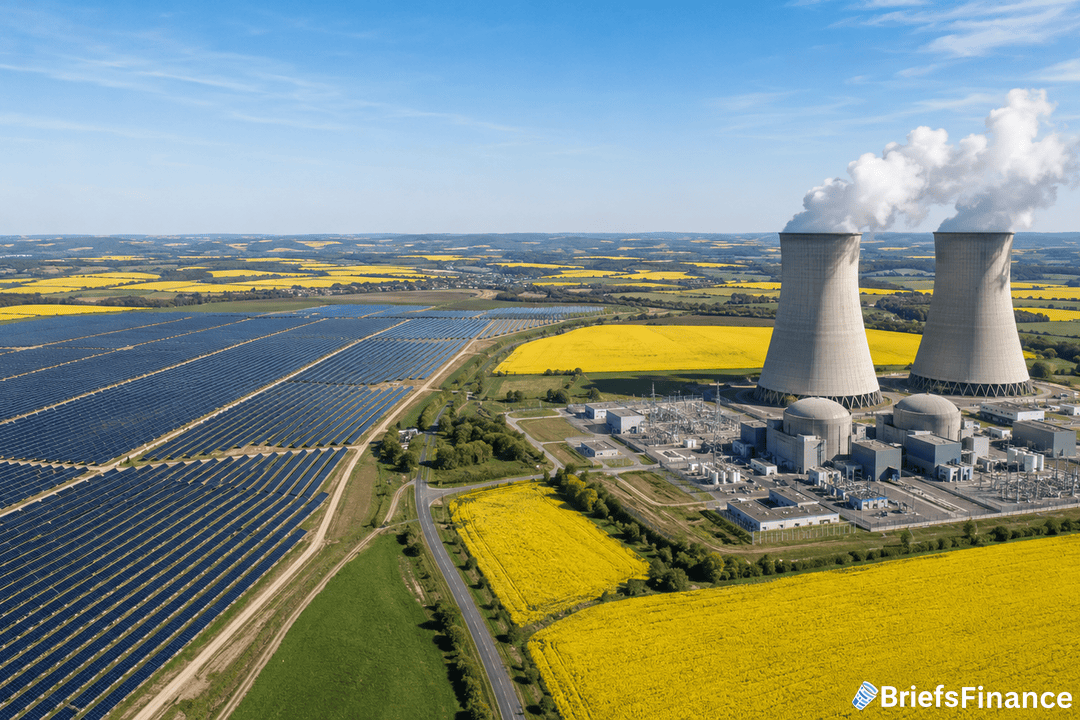
French nuclear used to be Europe's flattest power source, with reactors running near full output all day, every day, only easing back at night.
That pattern has flipped.
In 2025, the same fleet looks like a flexible asset that bends around solar peaks at noon.
The 8x Shift Inside The Fleet
New analysis of hourly ENTSO-E grid data shows the size of the change, with the average swing between midday and evening French nuclear output growing from 582 megawatts in 2019 to 4,426 megawatts in 2025, measured across April to September.
That's close to an 8x jump.
Total modulation last year hit 33 terawatt-hours, more than double 2019's 15 TWh, and about 9% of the fleet's full-year output of 373 TWh.
The trend hasn't paused for winter. Q1 2026 still shows a midday-to-evening swing of roughly 2,500 megawatts, which is large for the season when solar output is normally at its annual minimum.
The driver isn't maintenance. The reactors are bending at midday because surrounding countries are flooding the grid with cheap solar power during those hours.
For five minutes of context every morning on what moves like this mean for energy and rate markets, Market Briefs hits your inbox before the open, with a free 45-minute investing masterclass thrown in.
Why The Old Price Shape Is Gone
France was a net power exporter in 98.5% of hours in 2025, with the annual export balance reaching 92.3 TWh - the highest on record, and roughly equal to Belgium's full-year power use.
In the 129 hours France did import power last year, the reactors averaged 8.7 gigawatts below their normal output, after running an effectively zero gap in 2024.
Import hours used to mean prices were spiking at home. In 2025, they mean Spain or Germany has so much cheap solar that France is buying it instead of running its own reactors flat out.
The average import price in those hours was €33 per megawatt-hour, the lowest reading in the history of the modern European power market, with about half of those hours settling at negative prices.
What To Watch
The diurnal price shape European forecasters expected for the late 2020s is already here in France, which means anyone modeling French nuclear margins on the old "flat baseload" template is using the wrong one.
The clearest cross-border signal showed up at the Spanish border first. Trade between France and Spain landed roughly balanced last year at just 0.2 TWh net, and France's net export months now cluster between February and April, when Spanish solar is already producing hard before summer demand kicks in.
The next test is Italy. France exported 26.2 TWh net to Italy last year, with Italian wholesale power at €116 per MWh against €61 in France - and if Italian solar builds out the way Spain's did, that gap closes fast.
If you want this kind of read on energy markets every weekday, sign up for Market Briefs, and you'll also get a 45-minute investing course as a sign-up bonus.