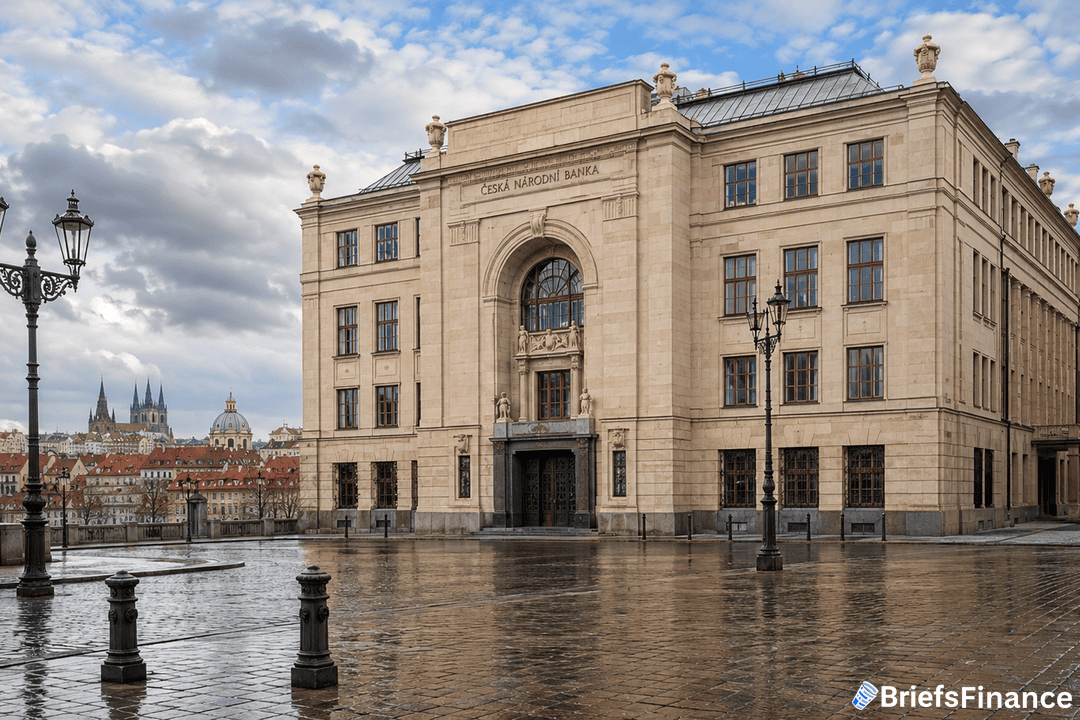
Most of Europe spent the last year cutting interest rates, but the Czech central bank held steady.
On Monday, its top official went a step further by saying hikes are still on the table.
A Hawk Who Isn't Done Hawking
Czech National Bank Governor Ales Michl said the bank is ready to raise rates if global or local risks push core prices higher.
Core inflation strips out food and gas to show the slower-moving price pressure underneath. In the Czech Republic, it runs near 3%.
The bank's target is 2%. That gap is what keeps Michl on edge.
He flagged four triggers that would force the bank to move:
- An uptick in lending to households and the state
- Wage gains running too hot
- Steady price rises in services
- Higher home prices
Anything that looks like price pressure building under the surface gets a response.
The Czech economy is small but tightly linked to Germany. So when German wages or German home prices move, the Czech central bank pays attention too.
Each morning, Market Briefs breaks down central-bank moves like this in five minutes, with a free 45-minute investing masterclass when you join.
Why This Stands Out
The European Central Bank and the Bank of England have both been cutting rates this year. The Federal Reserve cut rates last year and is now weighing its next move.
The Czech central bank is one of the few in the region still talking about going the other way.
That mostly comes down to Michl. He took the top job in 2022 and is known for a "higher for longer" approach.
He has been one of Europe's most hawkish central bankers since taking over.
The bank has kept policy tight and wants real rates to stay above zero. Real rates mean the interest rate minus inflation.
Cutting too soon would risk losing that hard-won win on prices. So would moving with the rest of the pack.
Earlier this year, headline inflation in the Czech Republic jumped to 2.5%, even as the CNB held its main rate at 3.5%. That hold was already a hawkish signal compared to neighbors.
Michl has been clear that pausing is not the same as winning. In a 2024 interview he said "There is a certain degree of satisfaction, but of course it's not a full victory yet," a tone he has kept ever since.
What To Watch
The next bank meeting is the obvious checkpoint. Michl made clear the bank wants proof that price pressure is fading before it considers cutting.
For investors, the bigger sign is what other central banks in Central Europe do next.
Hungary and Poland face the same kind of price picture. If the Czechs hike while neighbors hold or cut, expect currency moves across the region.
A stronger koruna - the Czech currency - would also help cool import prices. So a hike could do double duty.
Most central banks are easing. Michl is still watching the door.
Want the daily read on what central banks are doing to your money? Market Briefs covers it each day, with a free investing masterclass as a bonus when you sign up.