Pro Login

Chinese Energy Stocks Jump On Clean Energy Boom

A stylized illustration of a cylindrical cup with blue arrows and lines indicating a swirling or rotational motion inside the cup.
Published Feb 12, 2026
Share:
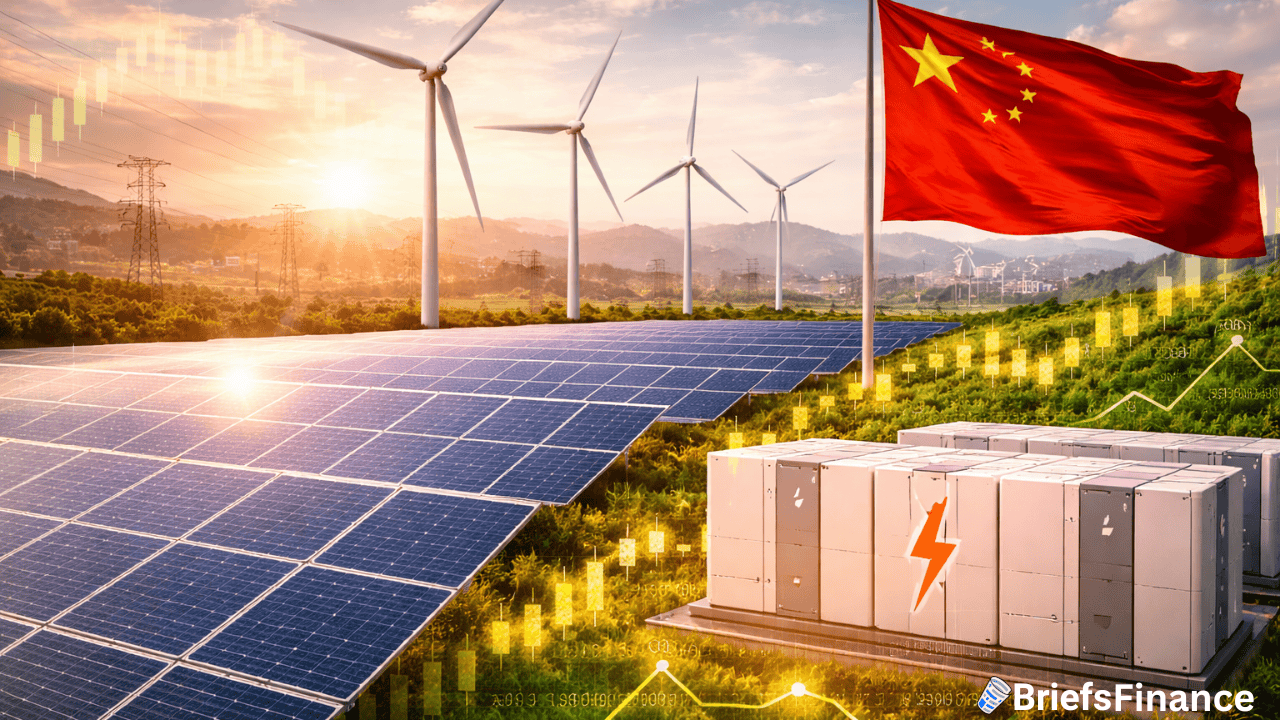
Solar panels, wind turbines, and battery storage set in a green landscape with a Chinese flag, representing clean energy development and the growing impact of Chinese energy stocks in China.
Summary:
  • Historic plateau. China's CO2 emissions have been flat or falling for 21 months, marking the longest decline not driven by economic slowdown.
  • Renewables explosion. Solar output jumped 43% and wind climbed 14% in 2025, meeting all new electricity demand.
  • Storage surge. Energy storage capacity grew by a record 75 gigawatts - roughly equivalent to France's peak winter demand.

Solar power output in China surged 43% year-over-year.

Wind climbed 14%.

Nuclear jumped 8%.

Together, these three sources delivered about 530 terawatt-hours of new clean electricity - enough to cover all of China's 520 TWh growth in electricity demand.

Translation: renewables grew faster than demand. That forced coal generation down 1.9%.

Companies like JinkoSolar - one of China's largest solar manufacturers - are riding this wave.

The country installed 360 gigawatts of wind and solar in 2024 alone, more than half the world's total additions that year.

The Energy Storage Revolution

But solar and wind are unreliable. The sun sets. The wind dies.

That's where storage comes in.

China's energy storage capacity grew by 75 gigawatts in 2025 - a record.

That outpaced the 55 GW rise in peak demand.

Break that down: 75 GW is roughly equivalent to France's peak winter electricity demand of 88-96 GW.

It's a massive amount of capacity that lets China store excess solar and wind power for use when generation drops.

The result? Less need for coal plants to fill the gaps.

Where Emissions Actually Fell

Power sector emissions dropped 1.5% as renewables displaced fossil fuels.

Transport emissions fell 3%, driven by electric vehicle adoption.

Building materials - mainly cement - dropped 7% as construction slowed.

But there's a catch.

The chemicals industry saw emissions jump 12%. That sector is growing fast and could threaten future declines if left unchecked.

Is This Peak Emissions?

China committed to peaking emissions before 2030. Some analysts think they've already hit it.

The 21-month plateau is the longest decline on record not driven by economic slowdown. If it holds, China could beat its 2030 target by years.

But CREA lead analyst Lauri Myllyvirta warns the progress is fragile.

"Because the relative drop is so small, we can't say with certainty yet that it's a fall, therefore the 'flat or falling.'"

A small jump in emissions could push China back above its previous peak. The chemical sector's growth is proof that not every part of the economy is decarbonizing.

What Happens Next

China's next five-year plan drops in March 2026. That document will reveal whether the government plans to keep clean energy additions at current levels—or scale back.

To meet its 2030 climate commitments, China needs to maintain or slightly reduce emissions through the end of the decade.

That requires keeping renewables installations close to 2025 levels.

The trajectory isn't guaranteed.

But right now, the world's biggest polluter is bending its emissions curve downward - and clean energy is doing the heavy lifting.

Disclosure

Get Market Briefs delivered to your inbox every morning for free!

No fluff. No noise. No politics. Just finance news you can read in 5 minutes.

Blogs

April 13, 2026
What Is Free Cash Flow? How To Find It & Why It's Important
  • Free cash flow is the cash a company has left after paying its bills and putting money back into the business.
  • Investors use free cash flow to figure out what a company is really worth - and if the stock is a good deal.
  • You can find free cash flow on a company's cash flow report, one of three key reports every public company files.
Read More
April 13, 2026
Non Taxable Income: What It Is and Why Investors Care

Non taxable income is money you earn that the IRS does not tax - like Roth IRA cash, muni bond interest, and certain investment gains. The U.S. tax code taxes workers, investors, and business owners at very different rates. Tools like Roth accounts, muni bonds, and real estate write-offs can help you keep more of what you earn.

Read More
April 11, 2026
Nasdaq Index Fund: A Beginner's Guide to Investing in the Nasdaq 100
  • A Nasdaq index fund lets you invest in the 100 biggest non-bank companies on the stock market all at once.
  • You can access the Nasdaq through index funds, mutual funds, or ETFs like QQQ - each with its own fees, trading rules, and style.
  • Picking the right Nasdaq index fund comes down to three things: who runs it, what is in it, and what it costs.
Read More
April 11, 2026
What Is Wealth? It's Not What Most People Think
  • Wealth is about owning assets that grow and pay you - not just earning a high salary.
  • In a capitalist system, there are two ways to get paid: from your labor and from your capital.
  • Building wealth takes a shift in mindset, a money system, and the habit of investing before you spend.
Read More
April 10, 2026
Micron Stock: The AI Memory Play Most Investors Are Missing
  • Micron (MU) is the only U.S. company that makes HBM chips - the short-term memory layer that AI systems need to run.
  • By early 2026, data centers were using about 70% of all memory chips made in the world, creating an 18-month backlog for new orders.
  • Micron's DRAM - or short-term memory chip - revenue jumped 69% year over year, and the company shifted away from consumer products to focus almost entirely on AI.
Read More
April 10, 2026
What Is Working Capital? What Investors Need To Know
  • Working capital is current assets minus current liabilities - it shows if a business can pay its short-term bills.
  • You find it on a company's balance sheet inside its 10-K report.
  • Changes in working capital show up on the cash flow statement and affect how much cash a business really makes.
Read More
April 9, 2026
What Is a Meme Stock? A Simple Guide for New Investors

You've probably heard the term "meme stock" thrown around on […]

Read More
April 9, 2026
Enterprise Value Formula: What It Is and How to Calculate It
  • Enterprise value (EV) shows what a company is really worth - debt and cash included - not just its stock price
  • The enterprise value formula is: Market Cap + Total Debt - Cash and Cash Equivalents
  • Investors use EV with metrics like EBITDA to compare stocks more fairly than market cap alone
Read More
April 8, 2026
Return on Equity: What It Is and How to Use It
  • Return on equity (ROE) measures how much profit a company earns for every dollar of shareholder equity
  • The formula is simple: net income divided by shareholder equity
  • A higher ROE can signal a company that is good at turning investor money into profit - but it is not the full picture
Read More
April 4, 2026
Personal Finance Books That Actually Teach You to Build Wealth

Most investors grow up hearing the same financial advice. Study […]

Read More
1 2 3 17
Share via
Copy link