Investing is not a one size fits all approach. Some […]

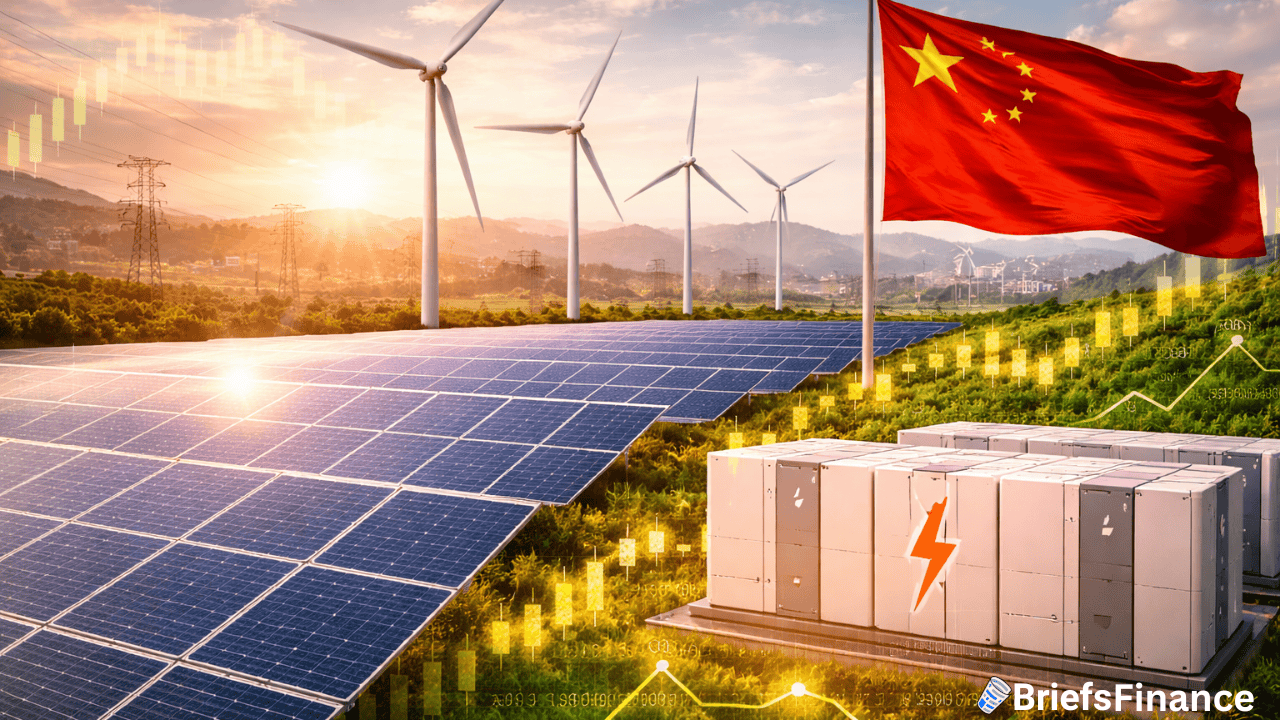
Solar power output in China surged 43% year-over-year.
Wind climbed 14%.
Together, these three sources delivered about 530 terawatt-hours of new clean electricity - enough to cover all of China's 520 TWh growth in electricity demand.
Translation: renewables grew faster than demand. That forced coal generation down 1.9%.
Companies like JinkoSolar - one of China's largest solar manufacturers - are riding this wave.
The country installed 360 gigawatts of wind and solar in 2024 alone, more than half the world's total additions that year.
But solar and wind are unreliable. The sun sets. The wind dies.
That's where storage comes in.
China's energy storage capacity grew by 75 gigawatts in 2025 - a record.
That outpaced the 55 GW rise in peak demand.
Break that down: 75 GW is roughly equivalent to France's peak winter electricity demand of 88-96 GW.
It's a massive amount of capacity that lets China store excess solar and wind power for use when generation drops.
The result? Less need for coal plants to fill the gaps.
Power sector emissions dropped 1.5% as renewables displaced fossil fuels.
Transport emissions fell 3%, driven by electric vehicle adoption.
Building materials - mainly cement - dropped 7% as construction slowed.
But there's a catch.
The chemicals industry saw emissions jump 12%. That sector is growing fast and could threaten future declines if left unchecked.
China committed to peaking emissions before 2030. Some analysts think they've already hit it.
The 21-month plateau is the longest decline on record not driven by economic slowdown. If it holds, China could beat its 2030 target by years.
But CREA lead analyst Lauri Myllyvirta warns the progress is fragile.
"Because the relative drop is so small, we can't say with certainty yet that it's a fall, therefore the 'flat or falling.'"
A small jump in emissions could push China back above its previous peak. The chemical sector's growth is proof that not every part of the economy is decarbonizing.
China's next five-year plan drops in March 2026. That document will reveal whether the government plans to keep clean energy additions at current levels—or scale back.
To meet its 2030 climate commitments, China needs to maintain or slightly reduce emissions through the end of the decade.
That requires keeping renewables installations close to 2025 levels.
The trajectory isn't guaranteed.
But right now, the world's biggest polluter is bending its emissions curve downward - and clean energy is doing the heavy lifting.
Investing is not a one size fits all approach. Some […]
Everyone with an internet connection is using AI to better […]
You just opened your first brokerage account and you’re ready […]
Everyone knows AI needs chips. For a while, investment dollars […]
When you get your first, “real” job, it often comes […]
Most investors hear the word "options" and picture a Wall […]
Most of us grew up being taught the same thing: […]
Gold has been around longer than any stock market, any […]
Most people think the only way to make money in […]
The stock market is like any other business - it’s […]