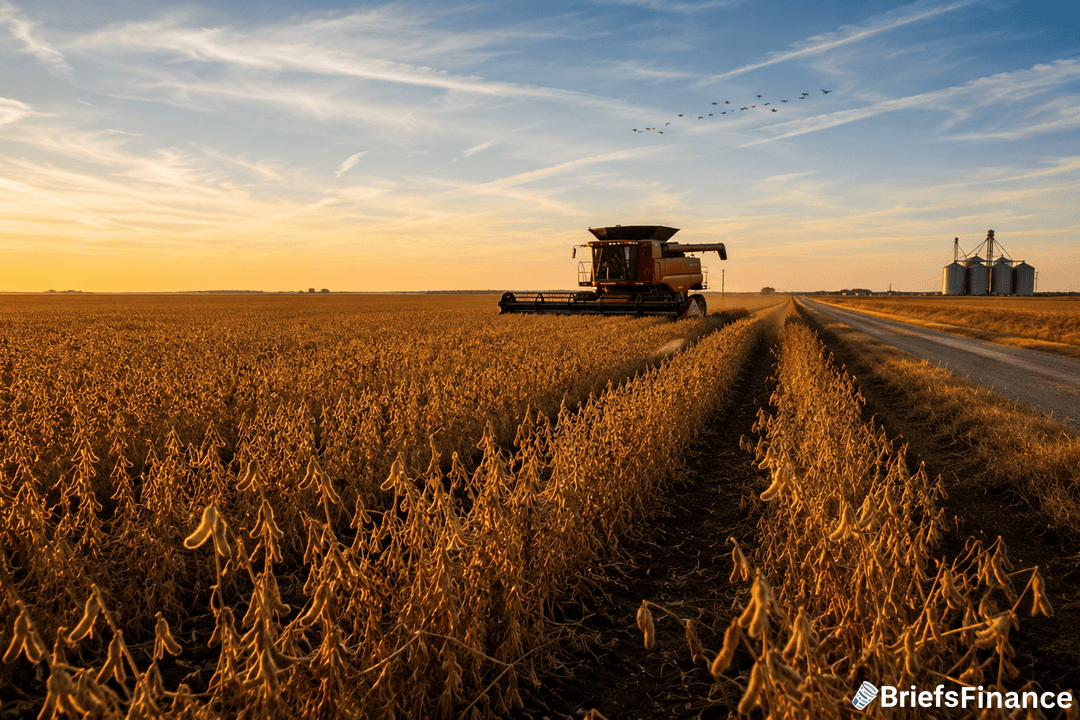
U.S. farm sales to China dropped two-thirds last year, with the trade war doing the damage.
After the Trump-Xi summit in Beijing this week, China just signaled it's ready to ease up, and soybeans and beef are first in line.
The Deal China Is Floating
China's commerce ministry said Saturday that both sides agreed to expand farm trade by cutting tariffs and tackling non-tariff barriers.
The wording matters: the agreements are "preliminary," and they'll be "finalised as soon as possible."
For now, U.S. farm exports to China still face an extra 10% tariff, which is why trade fell 65.7% year over year in 2025 to $8.4 billion, according to USDA data.
Soybean tariffs are the one to watch. Market watchers expect a 10% cut, which would let private Chinese crushers (the companies that turn soybeans into oil and feed) get back in the market.
They've been mostly sidelined since last year's U.S. harvest, when only state buyers were active.
Johnny Xiang at AgRadar Consulting said a cut "would mark a normalization of China-U.S. farm trade, allowing commercial buyers to re-enter the market."
We break down trade moves like this every morning in Market Briefs - five minutes a day, plus a free investing masterclass when you join.
Beef Plants Are Already Back In
Beijing didn't just talk. On Friday, China granted five-year registration extensions to 425 U.S. beef plants that had largely been shut out after their registrations lapsed last year.
China also approved new five-year registrations for 77 more U.S. beef facilities, a move that flows through to U.S. ranchers and the cold-storage chain almost immediately.
Beef has been a sore spot for years, with China limiting which U.S. plants can export and tightening rules whenever trade tensions flare. Friday's move reverses a lot of that in one stroke.
Poultry exports from certain U.S. states are next on the table, with both sides agreeing to "resolve or make substantive progress" on those issues.
The Big Promise
U.S. Trade Representative Jamieson Greer dropped a number on Friday: the U.S. expects China to buy "double-digit billions" worth of U.S. farm goods over the next three years.
That's the headline figure, but there's a catch. No one has released details on specific products, values, or volumes.
So this is the soft launch. China is buying back in, the U.S. is signaling there's real money on the line, and the specifics still have to land in a final agreement.
For Midwest farmers and the export pipeline running through Gulf and Pacific Northwest ports, the size and speed of those specifics will decide how much of 2026 actually shows up on the books.
Worth Noting
China did fulfill an earlier commitment after an October meeting, hitting 12 million metric tons of soybeans by the end of February while also picking up U.S. wheat and large volumes of sorghum.
The track record suggests the new deal will follow. The question is how fast and how big.
If you want a daily read on what trade deals like this mean for your portfolio, sign up for Market Briefs. You'll get a free 45-minute investing masterclass as a bonus.