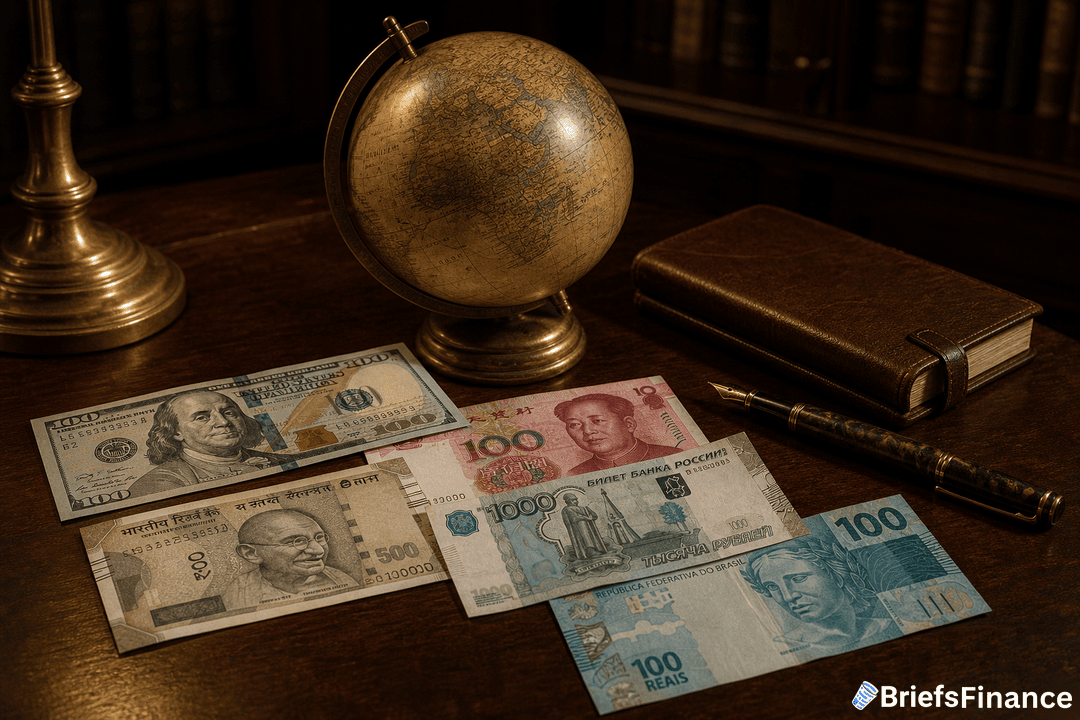
For all the talk about a coming BRICS currency, the actual barrier to dollar replacement is not technical.
It is political, structural, and self-imposed by the very countries supposedly leading the charge.
What India Actually Said
S. Jaishankar, India's External Affairs Minister, was explicit when speaking in London in March 2025, saying "I do not believe we have any policy to have a replacement to the dollar. Global economic stability is pegged on the dollar as the reserve currency."
He went further by adding "I do not believe that there is a coherent BRICS stance to this."
Jaishankar repeated the position into 2026, calling the dollar "the source of global economic stability," which is the stated view of the second-largest BRICS economy. India is also the country chairing BRICS for 2026, with the agenda focused on payment interoperability and local-currency lending rather than common-currency replacement.
Why The Yuan Cannot Replace The Dollar
A reserve currency has to be freely convertible, meaning investors need to be able to move money in and out without permission.
China still runs strict capital controls, which means foreign investors cannot freely move capital in and out of Chinese markets and the yuan is not freely convertible across borders.
That is a hard ceiling on yuan reserve adoption, and the Federal Reserve's 2025 review of dollar dominance flagged this as the single biggest reason the renminbi has failed to gain meaningful reserve share despite more than a decade of Chinese government effort.
Russia has also publicly closed the door on a common BRICS currency. Putin said in October 2024 that the idea is "too early to talk about," and in January 2026 Russia confirmed that talks "have not taken place and are not taking place now," with Brazilian President Lula da Silva echoing the position from the BRICS chair seat in 2025.
The Trump Tariff Threat
President Trump has publicly threatened 100% tariffs on BRICS countries that move to bypass the dollar, repeating the threat in February 2025 when he declared "BRICS is dead."
The Peterson Institute for International Economics has projected that such tariffs would harm both the US and BRICS economies through slower growth and higher inflation. Brad Setser of the Council on Foreign Relations has noted that coercion through tariffs may actually accelerate de-dollarization by giving target countries a stronger reason to build alternatives.
That paradox is the open question Washington has not solved.
What This All Adds Up To
The path away from the dollar is real, but it is diversification rather than replacement.
BRICS members are settling more bilateral trade in their own currencies, central banks are adding gold, and payment systems are getting wired up - none of which requires a single common currency or a coordinated rejection of the dollar.
The dollar's monopoly is shrinking, which is not the same thing as the dollar being replaced.
Worth Noting
The pound's transition out of reserve status took roughly 30 years, which is a useful reminder that currency dominance does not collapse in a quarter.