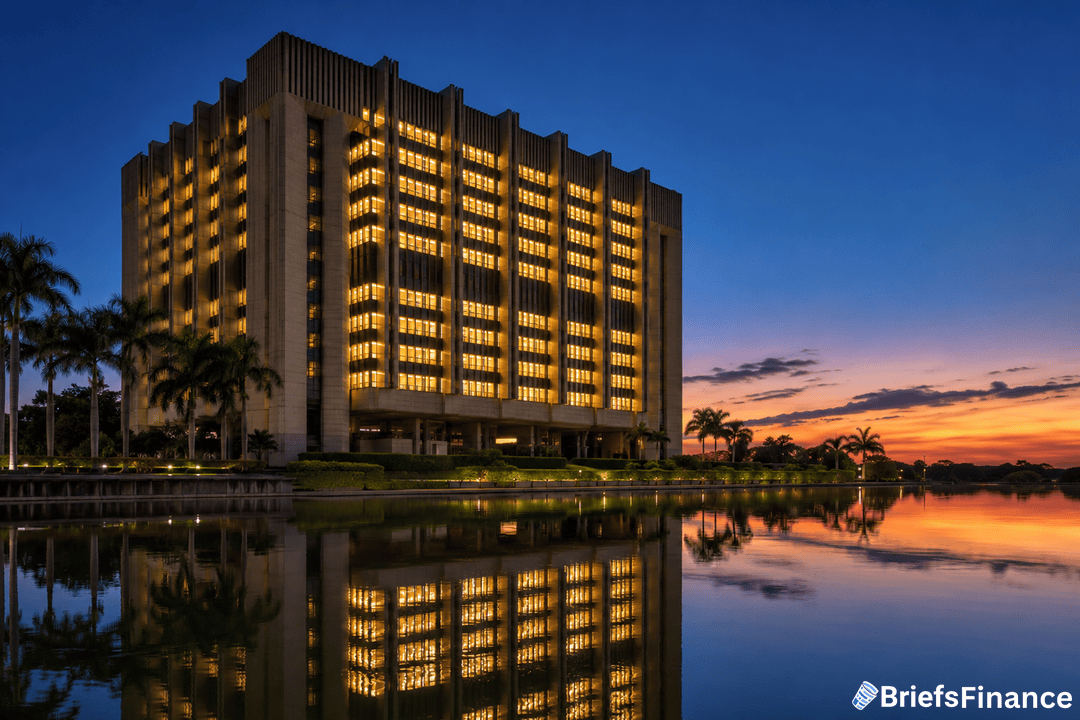
Brazil's central bank started cutting interest rates earlier this year.
Six weeks later, the economists who track its every move are giving up on the idea of deep cuts. They now expect rates to settle higher for longer, with inflation above the official 3% target every year for the rest of the decade.
The fuel behind the shift is the Iran war and the oil price that came with it.
The Focus Survey Move
Brazil's central bank publishes a weekly survey of professional economists called Focus.
Monday's release nudged the 2027 year-end Selic forecast from 11% up to 11.25%. That sounds like a small change, but the signal underneath it matters more: economists are walking back the assumption that the bank will keep cutting at the same pace as the last two meetings.
The same survey shows inflation above the 3% target through 2029. The central bank's own minutes, released last week, lifted its 4Q 2027 inflation forecast to 3.5% from 3.3% while keeping the 2026 reading at 4.6%, above the 4.5% upper edge of the tolerance band.
We unpack the global rate moves that quietly drive returns in Market Briefs, delivered every weekday morning with a free investing masterclass when you join.
Why The Cut Cycle Got Shorter
The Selic is the benchmark interest rate Brazil uses to control inflation.
It currently sits at 14.50% after a 25 basis point cut on April 29, the second straight reduction of that size. A month ago, the same Focus survey saw the rate ending 2026 at 12.50%, implying 200 basis points of further easing.
Now economists see 13%, which is closer to 150 basis points of cuts. The reason is mostly outside Brazil, with Brent crude trading between $110 and $114 during the April Copom meeting window, against the central bank's prior $80 baseline.
Petrobras already raised gasoline, diesel, and aviation fuel prices by 18% on May 1, which feeds straight into Brazilian inflation through transportation and food costs.
What Investors Are Watching
The hawkish read has not hurt Brazilian assets yet.
The Ibovespa, Brazil's main stock index, closed at 186,753.82 on May 5. The real has strengthened more than 10% against the dollar this year, with a Selic at 14.50% restrictive enough to keep carry-trade investors interested (the strategy of borrowing in a low-rate currency to invest in a high-rate one).
Banco do Brasil's chief economist said this week the bank will revise its year-end Selic forecast and oil baseline upward. Suno Research called the central bank minutes "tougher than the communiqué."
What To Watch
The next Copom meeting is June 17 to 18.
The market is currently pricing in another 25 basis point cut, but the bar for a pause has gotten lower. Three things will set the tone: the next monthly inflation print, what oil prices do over the next month, and whether the Iran-US ceasefire holds.
If Brent stays near $110, the cut cycle may already be done.
Sign up for the daily Market Briefs read here for the five-minute morning take on global markets, plus a free 45-minute investing course as a bonus.