Free NewsletterPro Login

America Is the World's Biggest Oil Producer. It Still Can't Fix This.

A stylized illustration of a cylindrical cup with blue arrows and lines indicating a swirling or rotational motion inside the cup.
Published Mar 3, 2026
Share:
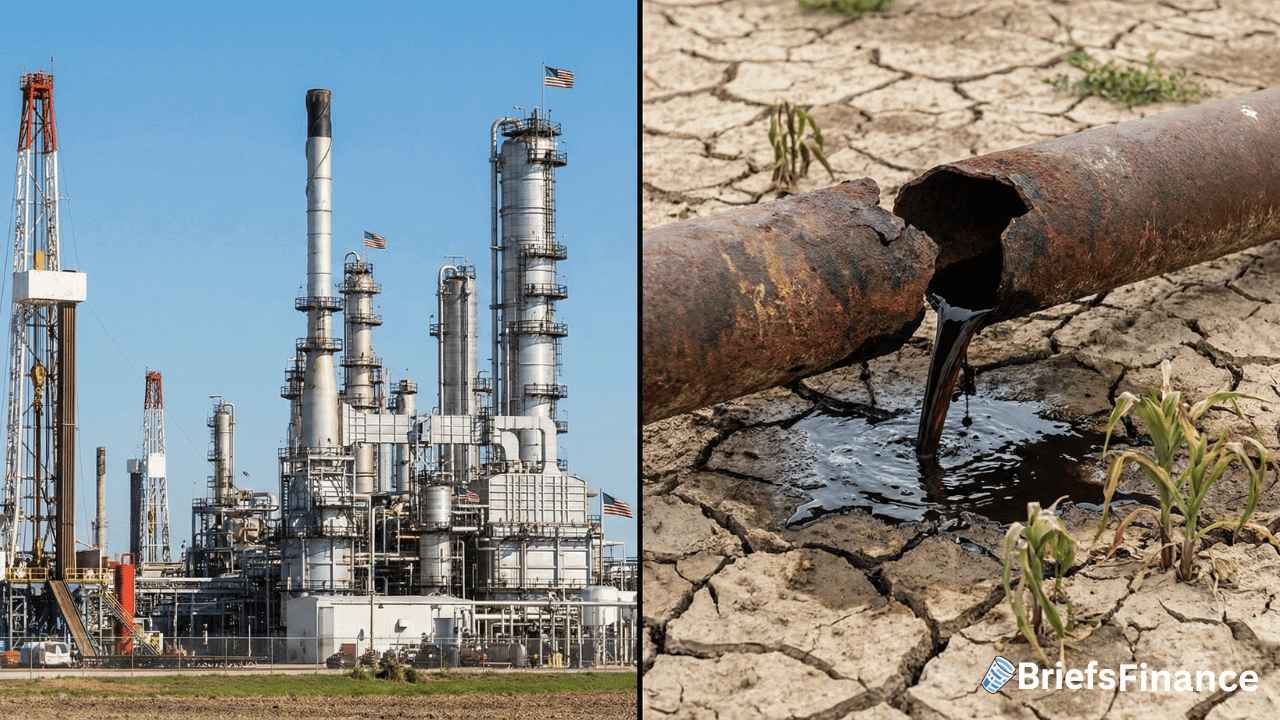
Split image: Left side shows an America oil producer’s refinery with tall towers and pipes; right side reveals a leaking oil pipeline on cracked, dry ground with sparse grass.
Summary:

  • The US leads the world in oil and gas production but is already shipping near full capacity — it can't replace the 20% of global supply bottlenecked at the Strait of Hormuz.
  • Europe's natural gas benchmark surged 90% in two days; Asia's jumped too — regions far more exposed than the US.
  • Trump pledged to insure and escort tankers through the strait, which helped slow the price surge, but the underlying problem remains.

The US is pumping more oil and gas than any country on earth. It won't be enough.

Why America Can't Save the Day

The Strait of Hormuz handles nearly 20 million barrels of oil per day — about 20% of global supply. With tanker traffic effectively halted, that oil isn't moving. Qatar also took its LNG production offline after Iran launched strikes on its neighbors, pulling a huge chunk of global natural gas supply off the market at the same time.

The problem for US exporters isn't willingness — it's capacity. They're already shipping close to their limits. Mathieu Utting, global gas and LNG analyst at Rystad Energy, told Fortune that US exporters will "definitely profit more" from the crisis — but they simply can't increase volumes meaningfully.

Raymond James analyst Pavel Molchanov put the regional divide plainly: "Europe and Asia rely on imported LNG, so they are affected by the disruption. As the world's largest LNG producer, the US doesn't have the same worry — in fact, it could benefit." Europe's gas benchmark surged 90% in two days. The US benchmark rose, but far less.

The Wildcard That Matters Most

Trump's pledge on March 3 to provide political risk insurance and Navy escorts for tankers through the strait helped cool prices — because expensive or unavailable insurance was a key reason ships were staying away, not just the threat of attack.

But Matt Reed of Foreign Reports warned that Iran has so far been restrained in its attacks on energy infrastructure. If Iran and its proxies go after oil production facilities directly, prices could surge well past $100 a barrel — and there's no easy off-ramp from there.

The US oil benchmark is already up nearly 30% since January. The question is whether it stops here.

Disclosure

Get Market Briefs delivered to your inbox every morning for free!

No fluff. No noise. No politics. Just finance news you can read in 5 minutes.

Blogs

April 28, 2026
Core-Satellite Portfolio: The Best of Both Worlds
  • A core-satellite portfolio splits investments into stable core holdings and higher-risk satellite picks.
  • The core is usually 60% of the portfolio, with satellites at 40%.
  • It blends passive index investing with active opportunity bets.

Read More
April 28, 2026
Bond Ladder Strategy: The Income Plan With Built-In Flexibility
  • A bond ladder is a series of bonds with staggered maturity dates, often one to five years apart.
  • It gives you regular access to cash, predictable income, and protection from rate changes.
  • It works for Treasuries, corporate bonds, municipal bonds, and CDs.
Read More
April 28, 2026
Silver vs Gold Investing: Which One Belongs in Your Portfolio?
  • Gold is the stable store of value, used as crisis insurance during recessions and conflict.
  • Silver is both a precious metal and an industrial metal, with more volatile pricing.
  • Most investors hold a mix in their alternative investment allocation, often 5% to 12% of portfolio.
Read More
April 28, 2026
What Is a Dividend Reinvestment Plan? The Wealth Snowball Explained
  • A dividend reinvestment plan, or DRIP, automatically uses dividend payments to buy more shares.
  • DRIPs power compound growth - dividends buy shares that pay dividends that buy more shares.
  • Most brokerages offer DRIPs free, and many include fractional shares so every penny goes back in.
Read More
April 28, 2026
How Tariffs Affect the Stock Market
  • Tariffs are extra fees on goods imported into a country, and they hit company profit margins.
  • The S&P 500 dropped over 3% in one day after the 2025 tariff announcement.
  • Tariffs reshape trade flows, creating both losers and unexpected winners.
Read More
April 28, 2026
What Is a 13F Filing? The Smart Money Tracker
  • A 13F filing is a quarterly disclosure of stock holdings from large institutional investors.
  • It shows what hedge funds and asset managers bought, sold, and held last quarter.
  • You can find any 13F free on SEC EDGAR.
Read More
April 28, 2026
Debt-to-Equity Ratio: The Number That Tells You If a Company Is Drowning
  • The debt-to-equity ratio compares what a company owes to what shareholders own.
  • The formula is total liabilities divided by total shareholder equity.
  • Lower ratios mean less risk - one of the value markers Warren Buffett looks for.
Read More
April 28, 2026
Non-Financial Analysis of Stocks: The 4-Step Method
  • Non-financial analysis evaluates a company's business, not its financial ratios.
  • It covers four things: business model, CEO, innovation, and moat.
  • It's how investors find companies with long-term staying power.
Read More
April 28, 2026
SEC EDGAR Tutorial: The Free Tool the Pros Use
  • SEC EDGAR is the official free database of public company filings.
  • You can pull 10-Ks, 10-Qs, 8-Ks, and insider trades by ticker or company name.
  • It's the source journalists and analysts use to write their stock stories.
Read More
April 28, 2026
How to Read a 10-Q (Without Losing Your Mind)
  • A 10-Q is a public company's three-month financial update, filed with the SEC.
  • It shows revenue, profits, debt, and cash flow between yearly reports.
  • You can find any company's 10-Q for free on the SEC's EDGAR site.
Read More
1 2 3 18
Share via
Copy link