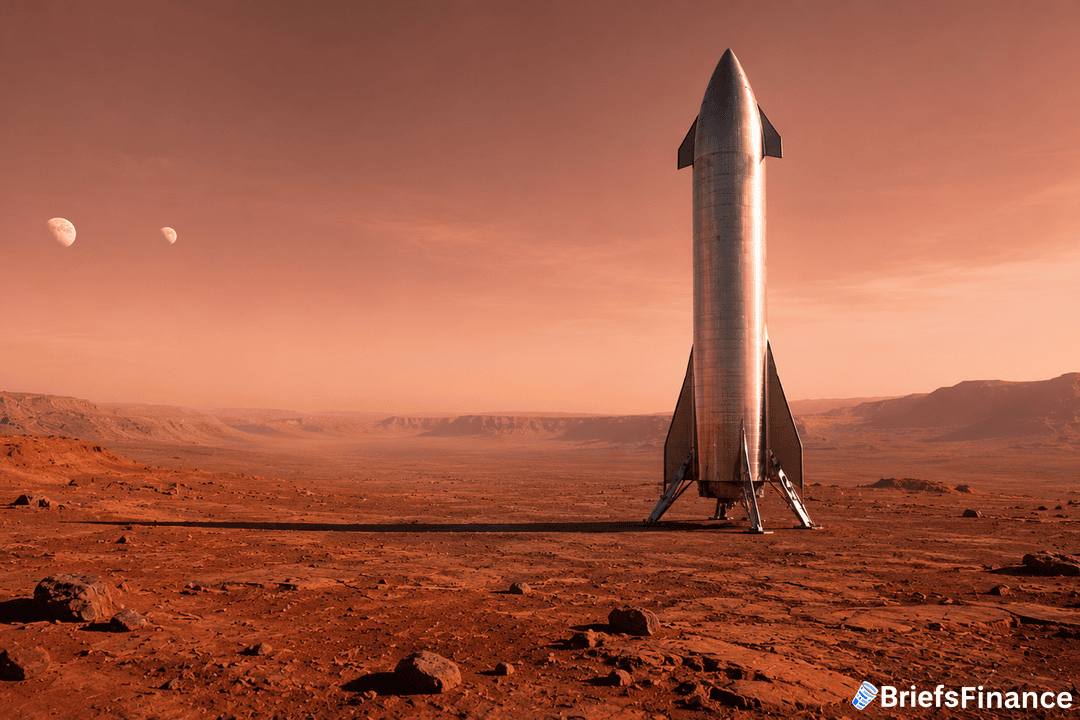
Elon Musk just landed the biggest pay package in corporate history. He does not see a dime of the new portion until one million people live on Mars.
SpaceX's IPO filing dropped this week. It explains why Musk just merged his AI firm xAI and his social media platform X into the rocket company. The whole thing is a Mars play.
The Pay Package
The SpaceX board granted Musk 1 billion restricted shares of Class B common stock. He already holds about 5 billion shares. Those are worth roughly $700 billion at the expected IPO price.
The new shares could be worth another $600 billion or more. But only if two boxes get checked. The company has to reach a market cap of $7.5 trillion. And it has to set up a permanent human colony on Mars with at least one million people living there. "We do not want humans to have the same fate as dinosaurs," the prospectus reads.
Market Briefs covers stories like this through an investor lens every morning in five minutes a day, with a free investing masterclass when you sign up.
Why The Merger Suddenly Makes Sense
The merger looked confusing three months ago. A rocket company, an AI company, and a social network all under one roof.
The Mars plan is the answer.
A Mars colony needs robots to build habitats and grow food. Those robots need AI that can run on Mars itself. The signal delay back to Earth is too long for anything else to work. Building all of it costs an enormous amount of money. That is what the IPO is supposed to fix.
xAI brings the AI. SpaceX brings the rockets. The IPO is supposed to bring in the cash to fund what comes next. That includes orbital data centers. Google and SpaceX are reportedly in talks to put AI data centers in orbit, starting as early as 2028.
The Numbers Tell A Different Story
The combined company is not actually making money right now.
SpaceX posted a $4.3 billion net loss in Q1. Most of that came from xAI, which was folded in during the February merger. xAI brought in $818 million in revenue. It lost $2.5 billion on operations. It spent $7.7 billion on capital costs, mostly on Nvidia chips.
Starlink, which had over $11 billion in revenue last year, stayed in the black. So did the launch business.
The IPO will basically ask public investors to fund the rest of the Mars buildout. That comes as more than 50 researchers have left SpaceXAI since the February merger.
What To Watch
SpaceX says the total market for what it is building is $28.5 trillion. That is roughly the size of the entire US economy. Of that, $26.5 trillion sits in AI.
Whether public market investors actually want to fund a Mars colony is the open question. The Q1 loss is real money. The Mars timeline ranges from "multiple decades" to "never."
The IPO is expected next month.
Get the daily Market Briefs read every weekday in your inbox, with a 45-minute investing course as a bonus.