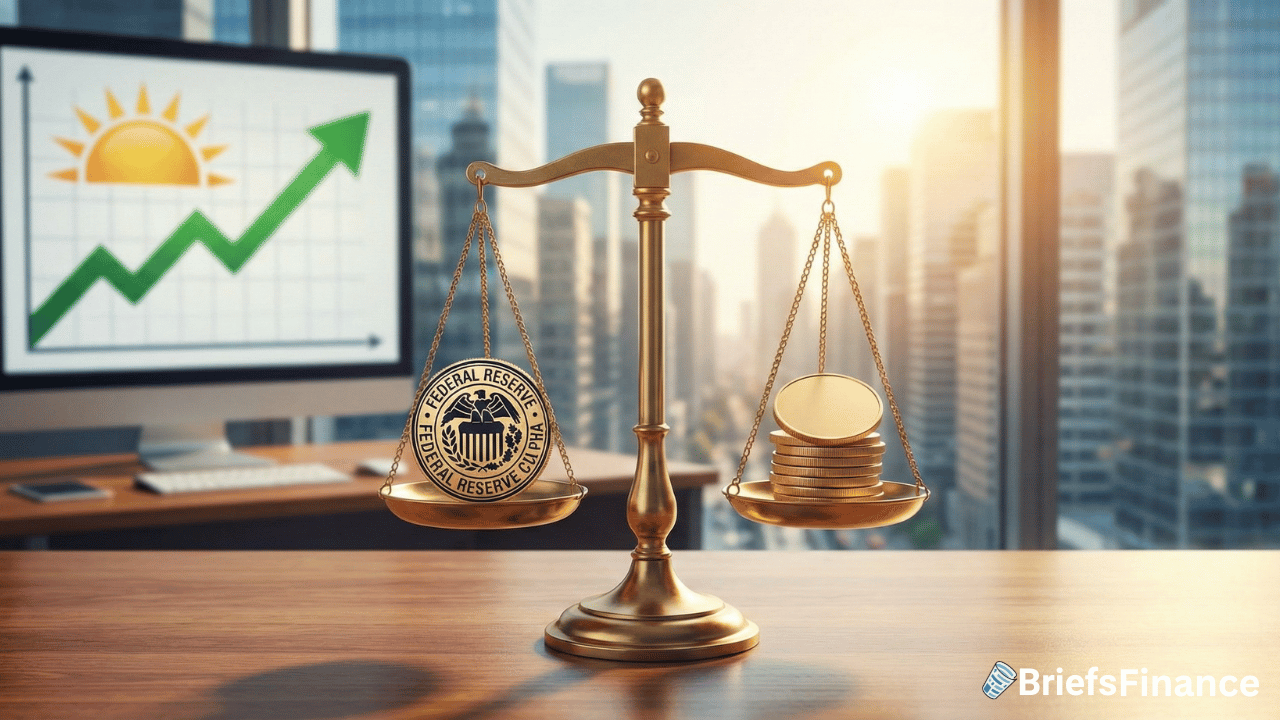
Interest Rate Decision
The Federal Reserve voted on January 27, 2026, to keep its key interest rate steady in a range between 3.5%-3.75%. This decision halted three consecutive quarter percentage point cuts that were aimed at protecting the labor market from potential downturns.
The Federal Open Market Committee (FOMC) assessed that economic growth is expanding at a solid pace.
Economic Growth Assessment
The FOMC stated, "Available indicators suggest that economic activity has been expanding at a solid pace. Job gains have remained low, and the unemployment rate has shown some signs of stabilization."
This reflects a more positive view of the economy, easing previous worries about a weakening labor market compared to inflation.
Market Reactions
Following the Fed's decision, Treasury yields increased, and the S&P 500 index hovered around 7,000. Investors are now looking ahead, with markets expecting the Fed to wait until at least June 2026 before making any further adjustments to its benchmark interest rate.
The FOMC's statement indicated that they will carefully consider incoming data and the balance of risks before making additional changes.
Dissenting Opinions
Notably, two governors, Stephen Miran and Christopher Waller, dissented in the vote. Both officials advocated for another quarter-point cut.
This marks Miran's fourth consecutive dissent; he previously called for a deeper half-point cut. Both officials were appointed during the Trump administration and have differing views on the current economic strategy.
Current Economic Climate
The U.S. economy demonstrated robust growth, with the gross domestic product (GDP) increasing at a 4.4% rate in the third quarter of 2025 and projections for the fourth quarter tracking at a 5.4% rate, according to the Atlanta Fed.
However, inflation is a notable concern, currently running closer to 3% than the Fed's goal of 2%. This has led to caution among some FOMC members regarding the timing of potential rate cuts.
Inflation Concerns and Future Outlook
Inflation has proven to be a challenge for the Fed. While it is down from the 40-year highs seen in 2022, the current rate remains a concern.
The Fed's economists have noted that tariffs from the Trump administration may be adding near-term pressures on inflation, which are expected to ease later in the year. Futures markets indicate that there will likely be at most two rate reductions in 2026, with none expected in 2027, regardless of who succeeds Chair Jerome Powell.
Next Steps for the Federal Reserve
As the Fed navigates this complex economic landscape, Chair Jerome Powell emphasized the need to assess incoming data carefully.
With his term nearing an end, Powell stated, "If you look at the incoming data since the last meeting, there is clear improvement in the outlook for growth." The focus remains on balancing the dual goals of low inflation and full employment as the Fed moves forward.