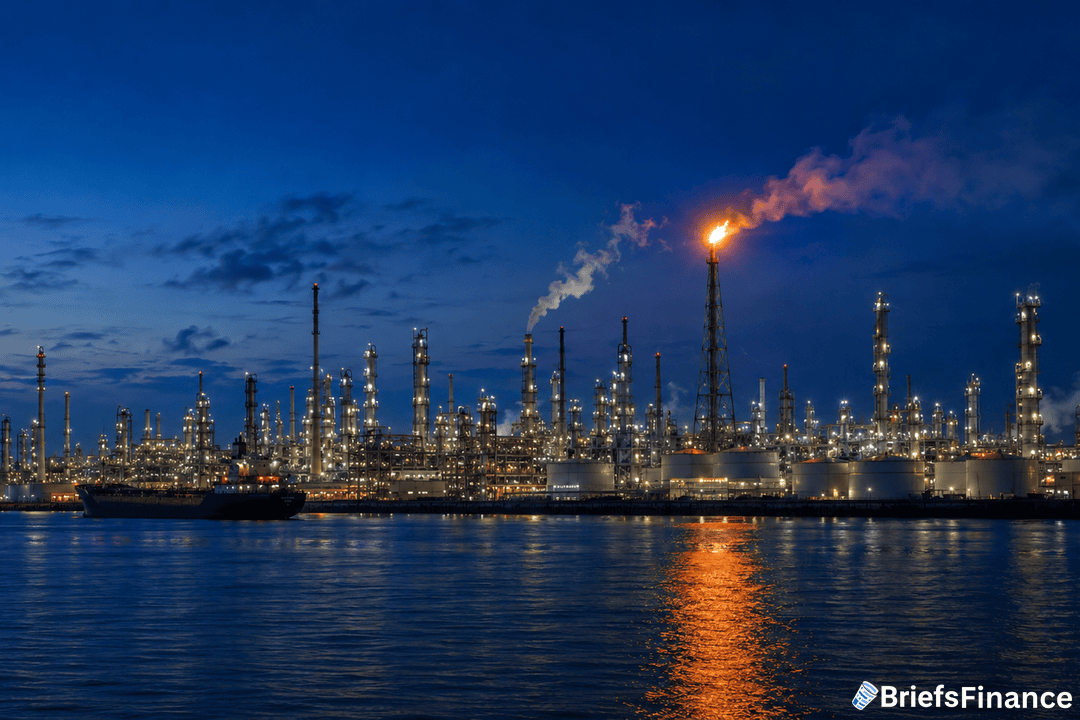
A war in the Middle East shut down a fifth of the world's sea-borne oil. Brent jumped to $106 a barrel. And U.S. refiners are quietly having one of their best years in a long time. Crude costs more now. But fuel costs more too. And the refiners are keeping a bigger slice of the gap.
Why The Margins Got So Good
The Strait of Hormuz has been shut since Feb. 28. That's when the U.S. and Israel launched their war on Iran. The big Gulf states - Saudi Arabia, Iraq, Kuwait, the UAE, Qatar, and Bahrain - shut in 10.5 million barrels a day in April.
That's a big hit to global supply. It pushed Asian refiners to scramble for crude. Their costs went up faster than U.S. costs.
Two tailwinds for U.S. refiners:
- Cheap, heavy crude is still flowing in from Canada and Latin America.
- Global gas, diesel, and jet fuel supply has tightened, lifting sale prices.
If you want a five-minute read every morning on how big moves in oil shift your money, Market Briefs hits your inbox every weekday morning. There's a free investing masterclass when you join.
The Capacity Problem
Here's the catch. The U.S. has been losing refining slots for two years in a row.
LyondellBasell shut its Houston plant in January 2025. Phillips 66 began its LA wind-down last October. Valero's Benicia, California plant shut in April. Together, that's about 550,000 barrels a day gone from the U.S. system.
The first new U.S. refinery in close to 50 years is still in early build. That's America First Refining's Brownsville, Texas plant. So the rest of the refiners are running harder to fill the gap.
What It Means For Investors
Refiner stocks like Marathon, Valero, and Phillips 66 have been some of the best energy names this year. Q1 earnings came in well above the same period last year. Wider fuel margins did the work. The trade is now a bet on whether the Strait of Hormuz stays shut. And on whether U.S. fuel demand holds through driving season.
On the demand side, summer is a make-or-break stretch. Memorial Day kicks off the busy U.S. driving season. The EIA expects gas demand to hold near last year's pace. Diesel demand is more about freight and farming. Both are running steady.
Average pump prices have climbed since the war started. AAA had the U.S. mean near $4.53 a gallon on May 14. That's still below 2022's $5 peak. But it's the first time since 2022 that gas has tested this level.
What To Watch
The EIA expects global oil stocks to draw down by 8.5 million barrels a day in Q2. That's one of the steepest draws on record. If shipping in the Strait of Hormuz picks back up in June, crude prices could ease. That's the agency's working guess. If it stays shut, the margin party keeps going.
For investors who want this kind of plain-English oil read every morning, join 350,000+ investors at Market Briefs. Get a free 45-minute investing course thrown in when you sign up.