Free NewsletterPro Login

The First Meatpacking Strike in 40 Years Just Started. Beef Prices Were Already High.

A stylized illustration of a cylindrical cup with blue arrows and lines indicating a swirling or rotational motion inside the cup.
Published Mar 16, 2026
Share:
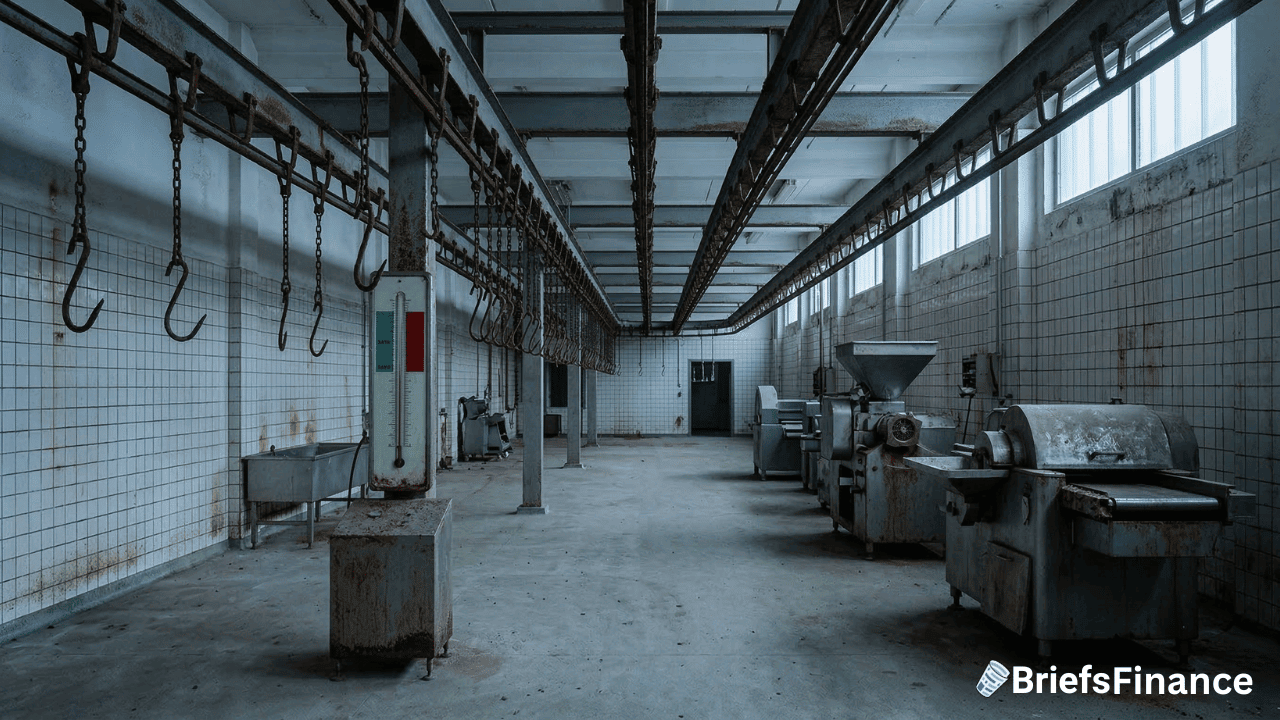
Empty industrial slaughterhouse with hanging meat hooks, tiled walls, metal machinery, and dirty floors—an abandoned reminder of the meat industry, lit by natural light from high windows.
Summary:

  • About 3,800 workers walked off the job Monday at JBS's plant in Greeley, Colorado — the first beef slaughterhouse strike since 1985.
  • Workers are demanding higher wages and better healthcare from JBS, the world's largest meatpacker, after eight months of failed negotiations.
  • Beef prices are already up 15% over the past year, with U.S. cattle herds at a 75-year low.

The timing could not be worse for grocery bills.

What Happened

Workers at JBS USA's Swift Beef plant in Greeley, Colorado began picketing before sunrise Monday, bundled in blankets in 20-degree temperatures. About 3,800 workers are on strike — 99% of them voted to authorize it.

United Food and Commercial Workers Local 7 says JBS has been offering average annual wage increases of less than 2%, well below Colorado's inflation rate, while shifting healthcare costs onto workers and — in many cases — charging them $1,100 or more per year to offset the company's own expenses for required safety equipment.

JBS said it would keep the plant running on two shifts using workers who chose not to strike, and would move some production to other facilities.

Why This Plant Matters

JBS is the largest of the four major beef processors in the U.S. Those four companies together handle 85% of all domestic beef production. The Greeley plant is one of the biggest facilities in the country and the top employer in a city of 114,000 people.

The last strike at a U.S. beef slaughterhouse was at a Hormel plant in Minnesota in 1985. That one lasted more than a year.

JBS in January agreed to pay $83.5 million to settle price-fixing allegations alongside other major meatpackers, and the company has faced separate federal scrutiny over bribery related to its U.S. expansion financing.

What It Means for Beef Prices

Beef prices are already up 15.2% over the past year, driven by the smallest U.S. cattle herd since 1951 — 86.2 million animals as of January. Supply was already tight before this morning.

The Trump administration responded earlier this year by expanding Argentine beef imports by 80,000 metric tons. A prolonged strike at one of the country's largest processing facilities would put more pressure on a supply chain with very little slack left.

Ground beef at the grocery store was already expensive. This doesn't help.
Disclosure

Get Market Briefs delivered to your inbox every morning for free!

No fluff. No noise. No politics. Just finance news you can read in 5 minutes.

Blogs

April 29, 2026
What Is Blockchain? A Plain English Guide For Investors
  • Blockchain is a digital ledger that records every transaction on a public network.
  • Once a transaction is recorded, it cannot be changed or deleted.
  • It is the foundation of Bitcoin, Ethereum, and thousands of other cryptocurrencies.
Read More
April 29, 2026
How To Negotiate Bills: The Script That Saves You Hundreds A Year
  • Most monthly bills are negotiable, even though most Americans never try.
  • A simple phone call with the right script can lower your phone, internet, and utility bills.
  • The key rule is to be nice. Customer service reps have more flexibility than most people realize.
Read More
April 29, 2026
75 15 10 Rule: The Budget That Builds Wealth On Autopilot
  • The 75 15 10 rule is a budgeting plan: spend at most 75% of your income, invest at least 15%, and save at least 10%.
  • It works by making sure you pay yourself before you spend.
  • Once your savings target is hit, you shift the 10% over to investing, becoming a 75/25 plan.
Read More
April 29, 2026
How To Rebalance Portfolio: The Strategy That Forces You To Buy Low And Sell High
  • Rebalancing means adjusting your portfolio back to your target allocation when it drifts too far.
  • The two main methods are time-based (rebalance once a year) and threshold-based (rebalance when allocation drifts more than 5%).
  • If you are still adding money, you can rebalance by directing new money instead of selling.
Read More
April 29, 2026
How To Buy Treasury Bonds: A Beginner's Guide
  • Treasury bonds are loans you make to the U.S. government. They are considered the safest investment in the world.
  • You can buy them at TreasuryDirect.gov directly or through any major brokerage.
  • There are three main types: T-Bills, Treasury Notes, and Treasury Bonds. The longer the term, the higher the interest rate.
Read More
April 29, 2026
Forward Vs Futures Contracts: What's The Real Difference?
  • Both forward and futures contracts are deals to buy or sell something at a set price on a future date.
  • Futures trade on exchanges. Forwards are private deals between two parties.
  • Most regular investors do not use either. They are mostly tools for businesses and big institutions.
Read More
April 29, 2026
Alternative Investments Explained: What They Are And Why They Matter
  • Alternative investments are anything that is not a regular stock or bond.
  • The most common types are precious metals, crypto, real estate, commodities, and collectibles.
  • Most investors should hold 5% to 25% of their portfolio in alternatives, depending on risk tolerance.
Read More
April 29, 2026
How To Buy Bitcoin For Beginners: 3 Simple Ways
  • There are three main ways to buy Bitcoin: directly on an exchange, through a Bitcoin ETF, or through a Bitcoin miner stock.
  • Each has its own pros, cons, and tax setup.
  • Most beginners do best starting small and using dollar cost averaging.
Read More
April 29, 2026
How To Follow Smart Money: The 5 Market Shifts Framework
  • "Smart money" means big investors with deep research teams and fast information.
  • You can follow them by watching for 5 types of market shifts.
  • The goal is to spot where money is moving before it shows up on CNBC.
Read More
April 29, 2026
Insider Trading Meaning: What It Really Is (And Why Some Of It Is Legal)
  • Insider trading means buying or selling a stock based on facts the public does not know yet.
  • Some insider trading is legal. Some is a federal crime that can send people to prison.
  • The SEC tracks every legal insider trade in a public file called Form 4.
Read More
1 2 3 19
Share via
Copy link











