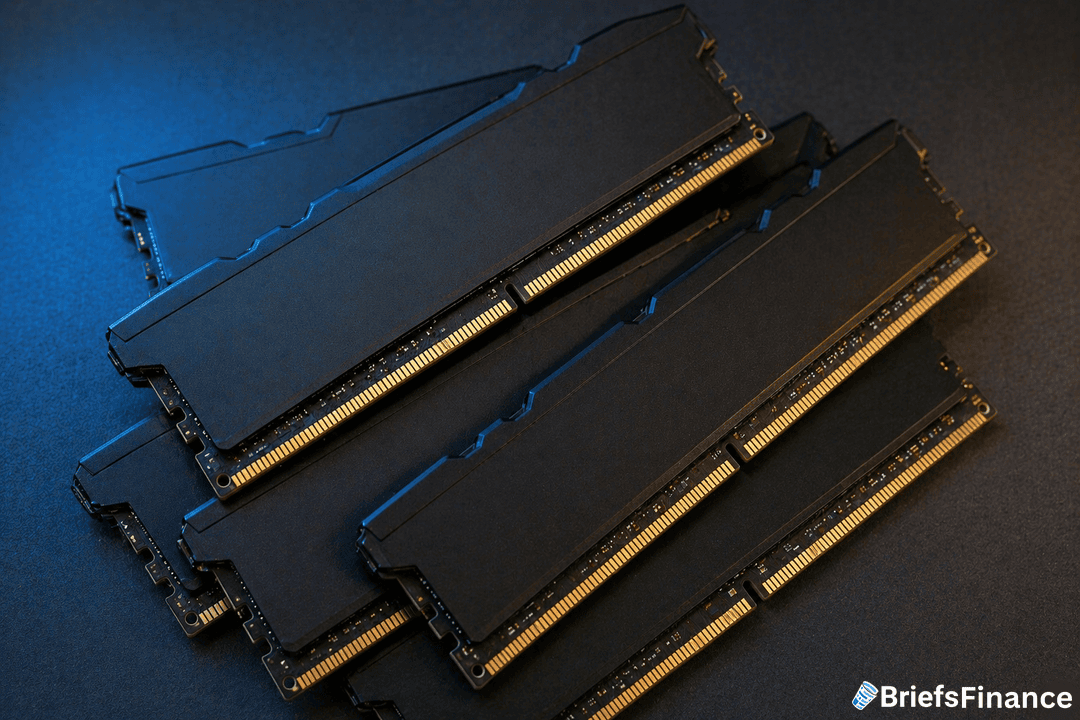
Microsoft's quarter was supposed to be the easy one. Instead, it gave investors the clearest signal yet that the AI build-out has a new bottleneck: memory.
The company hiked its full-year capex to $190 billion on Wednesday, up 61% from last year, citing a $25 billion impact from higher component prices. Memory chips are at the center of the cost story.
The Fiscal Q3 Numbers
Microsoft reported fiscal Q3 EPS of $4.27 adjusted versus a $4.06 estimate, and revenue of $82.89 billion versus $81.39 billion expected. Revenue grew 18% year over year.
Net income hit $31.78 billion, or $4.27 per share, up from $25.82 billion the year before. Adjusted earnings exclude a $14 million decrease in net income tied to Microsoft's OpenAI investment.
Azure revenue grew 40%, ahead of analyst estimates of 39.3% and 38.8%. The Intelligent Cloud segment, which contains Azure plus server and developer products, brought in $34.68 billion, ahead of $34.27 billion expected. Productivity and Business Processes posted $35.01 billion, up 17%.
Why The Capex Hike Hits Different
Microsoft's $190 billion capex figure is well above the $154.6 billion Visible Alpha consensus. Hood explicitly tied $25 billion of the hike to higher component prices.
Memory is the specific pressure point. AI demand has triggered a global memory chip crunch, and infrastructure providers are paying up. Microsoft's gross margin in the quarter, at 67.6%, was the narrowest since 2022, with depreciation costs from data center build-out also weighing.
Hood guided fiscal Q4 revenue to a range of $86.7 billion to $87.8 billion. The midpoint, $87.25 billion, was below the $87.53 billion consensus. Operating margin is expected to tick down to 44%.
The OpenAI Reset
Earlier in the week, Microsoft announced a revision to its OpenAI relationship. Microsoft's revenue share payments to OpenAI are ending. Any cloud provider can now serve OpenAI models, ending years of Azure exclusivity. Microsoft still has a license on OpenAI's intellectual property through 2032, but it is no longer exclusive.
CEO Satya Nadella addressed the shift directly. "We have a frontier model, royalty-free, with all the IP rights that we will have access to all the way to '32, and we fully plan to exploit it," he said.
What The AI Numbers Show
Microsoft now has more than 20 million seats for the 365 Copilot AI add-on, up from 15 million in January. AI-related annualized revenue stands at $37 billion, up 123%. Commercial remaining performance obligations came in at $627 billion.
Worth Noting
Microsoft's stock was down 12% so far in 2026 going into the quarter, its worst quarterly performance since 2008. Two senior executives, Office leader Rajesh Jha and gaming chief Phil Spencer, announced retirements during the quarter. The next data point is the Q4 capex print, which will show whether the memory crunch is easing or getting worse.