Free NewsletterPro Login

Korea's Stock Market Gave Back Half Its Biggest Rally in a Day

Published Apr 2, 2026
Share:
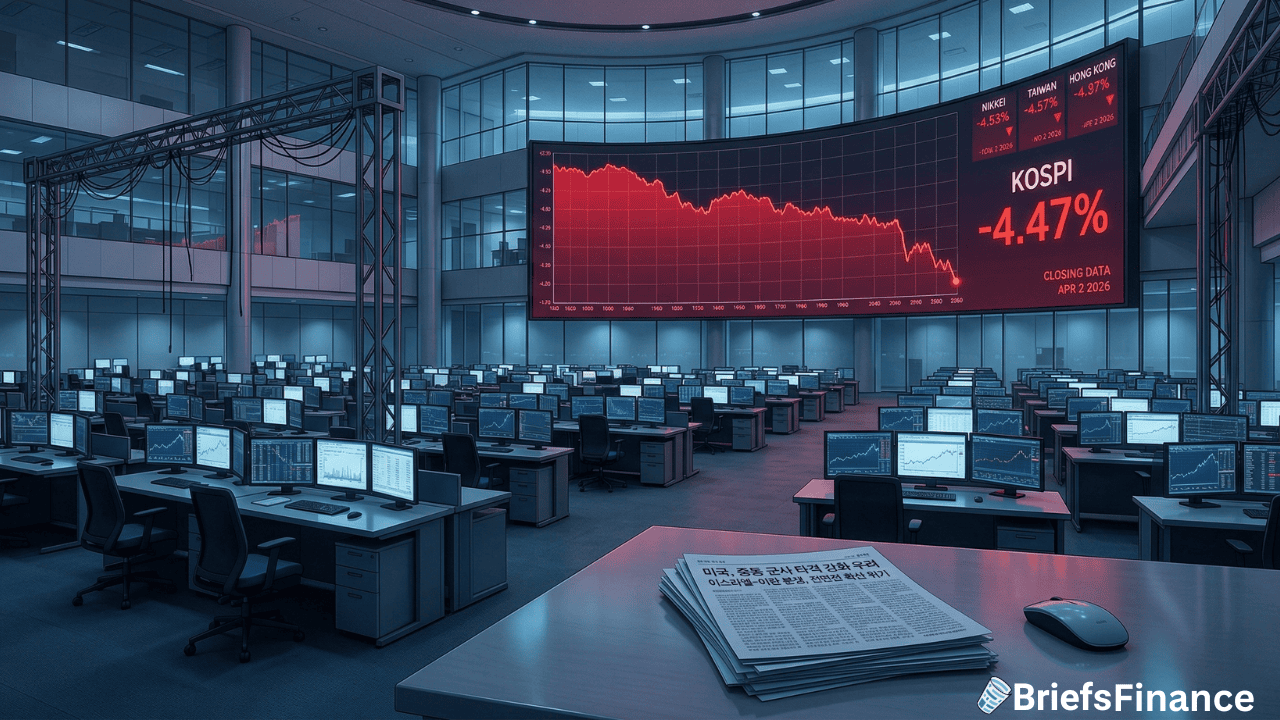
Large trading room with rows of desks and monitors, a big screen showing Korea's stock market KOSPI down 4.47%, and a newspaper on a desk in the foreground.
Summary:
  • The Kospi dropped 4.47% on Thursday after surging 8.44% the day before, erasing over half of that gain in a single session.
  • Samsung Electronics shed 5.91% and SK hynix gave back 7.05% as institutions and foreign funds dumped a combined 1.59 trillion won in shares.
  • Korea's fear gauge has averaged above 60 for the past week - a reading that means full-blown panic.

One day, Korean investors were celebrating the war's possible end. The next day, they were running for the exits.

The Kospi lost 244.65 points on Thursday - landing at 5,234.05 - after President Trump used a national broadcast to warn that the U.S. would hit Iran "extremely hard" over the coming weeks. That wiped out over half of the previous day's 8.44% surge.

The speed of the reversal tells you everything about how thin the optimism really was.

The Selloff Hit Fast

Thursday actually started on a hopeful note. The Kospi opened 1.33% higher as investors bet Trump's speech would bring a ceasefire closer.

It didn't. Once Trump started talking, stocks flipped.

The index blew past its opening gains and kept falling. Sell-side trading curbs kicked in on both the Kospi and the smaller Kosdaq - which lost 5.36% on the day.

Neither market has needed this many emergency stops since the 2008 financial crisis. South Korea has triggered 14 on the Kospi this year alone, and 8 on the Kosdaq.

Who Was Buying and Who Was Selling

Big money headed for the door. Institutions dumped a net 1.45 trillion won - roughly $1.07 billion - while foreign funds sold off 140.6 billion won on top of that.

The only buyers? Everyday traders, who scooped up 1.21 trillion won in shares.

That kept the damage from getting worse, but it wasn't enough to stop the slide. Korea's two biggest chipmakers took the hardest hits - Samsung Electronics shed 5.91% and SK hynix gave back 7.05%.

Everything Else Got Hit

The Korean won lost 18.4 to the dollar, finishing the session at 1,519.7. Investors piled into the greenback looking for safety.

Bitcoin slid 3.56% to $66,640. So much for the "digital gold" theory - investors sold it right alongside stocks.

Gold futures lost 3.75%, dropping to $4,632 an ounce. Climbing oil prices made investors more worried about inflation - and less hopeful about rate cuts coming anytime soon.

Markets across Asia followed the same pattern. 

  • Japan's Nikkei dropped 2.38%. 
  • Taiwan lost 1.82%. 
  • Hong Kong fell 0.78%.

What to Watch

Analysts are split on what comes next. One camp sees Trump's tough talk as a bargaining move to force Iran into negotiations. The other points out that sending a third aircraft carrier to the region doesn't look like someone winding things down.

Korea's fear gauge - the Kospi Volatility Index - sat at an average of 60.77 last week. Anything above 50 means the market is in full panic mode. Until that number starts falling, expect more sessions exactly like this one.

Disclosure

Get Market Briefs delivered to your inbox every morning for free!

No fluff. No noise. No politics. Just finance news you can read in 5 minutes.

Blogs

April 28, 2026
Core-Satellite Portfolio: The Best of Both Worlds
  • A core-satellite portfolio splits investments into stable core holdings and higher-risk satellite picks.
  • The core is usually 60% of the portfolio, with satellites at 40%.
  • It blends passive index investing with active opportunity bets.

Read More
April 28, 2026
Bond Ladder Strategy: The Income Plan With Built-In Flexibility
  • A bond ladder is a series of bonds with staggered maturity dates, often one to five years apart.
  • It gives you regular access to cash, predictable income, and protection from rate changes.
  • It works for Treasuries, corporate bonds, municipal bonds, and CDs.
Read More
April 28, 2026
Silver vs Gold Investing: Which One Belongs in Your Portfolio?
  • Gold is the stable store of value, used as crisis insurance during recessions and conflict.
  • Silver is both a precious metal and an industrial metal, with more volatile pricing.
  • Most investors hold a mix in their alternative investment allocation, often 5% to 12% of portfolio.
Read More
April 28, 2026
What Is a Dividend Reinvestment Plan? The Wealth Snowball Explained
  • A dividend reinvestment plan, or DRIP, automatically uses dividend payments to buy more shares.
  • DRIPs power compound growth - dividends buy shares that pay dividends that buy more shares.
  • Most brokerages offer DRIPs free, and many include fractional shares so every penny goes back in.
Read More
April 28, 2026
How Tariffs Affect the Stock Market
  • Tariffs are extra fees on goods imported into a country, and they hit company profit margins.
  • The S&P 500 dropped over 3% in one day after the 2025 tariff announcement.
  • Tariffs reshape trade flows, creating both losers and unexpected winners.
Read More
April 28, 2026
What Is a 13F Filing? The Smart Money Tracker
  • A 13F filing is a quarterly disclosure of stock holdings from large institutional investors.
  • It shows what hedge funds and asset managers bought, sold, and held last quarter.
  • You can find any 13F free on SEC EDGAR.
Read More
April 28, 2026
Debt-to-Equity Ratio: The Number That Tells You If a Company Is Drowning
  • The debt-to-equity ratio compares what a company owes to what shareholders own.
  • The formula is total liabilities divided by total shareholder equity.
  • Lower ratios mean less risk - one of the value markers Warren Buffett looks for.
Read More
April 28, 2026
Non-Financial Analysis of Stocks: The 4-Step Method
  • Non-financial analysis evaluates a company's business, not its financial ratios.
  • It covers four things: business model, CEO, innovation, and moat.
  • It's how investors find companies with long-term staying power.
Read More
April 28, 2026
SEC EDGAR Tutorial: The Free Tool the Pros Use
  • SEC EDGAR is the official free database of public company filings.
  • You can pull 10-Ks, 10-Qs, 8-Ks, and insider trades by ticker or company name.
  • It's the source journalists and analysts use to write their stock stories.
Read More
April 28, 2026
How to Read a 10-Q (Without Losing Your Mind)
  • A 10-Q is a public company's three-month financial update, filed with the SEC.
  • It shows revenue, profits, debt, and cash flow between yearly reports.
  • You can find any company's 10-Q for free on the SEC's EDGAR site.
Read More
1 2 3 18
Share via
Copy link