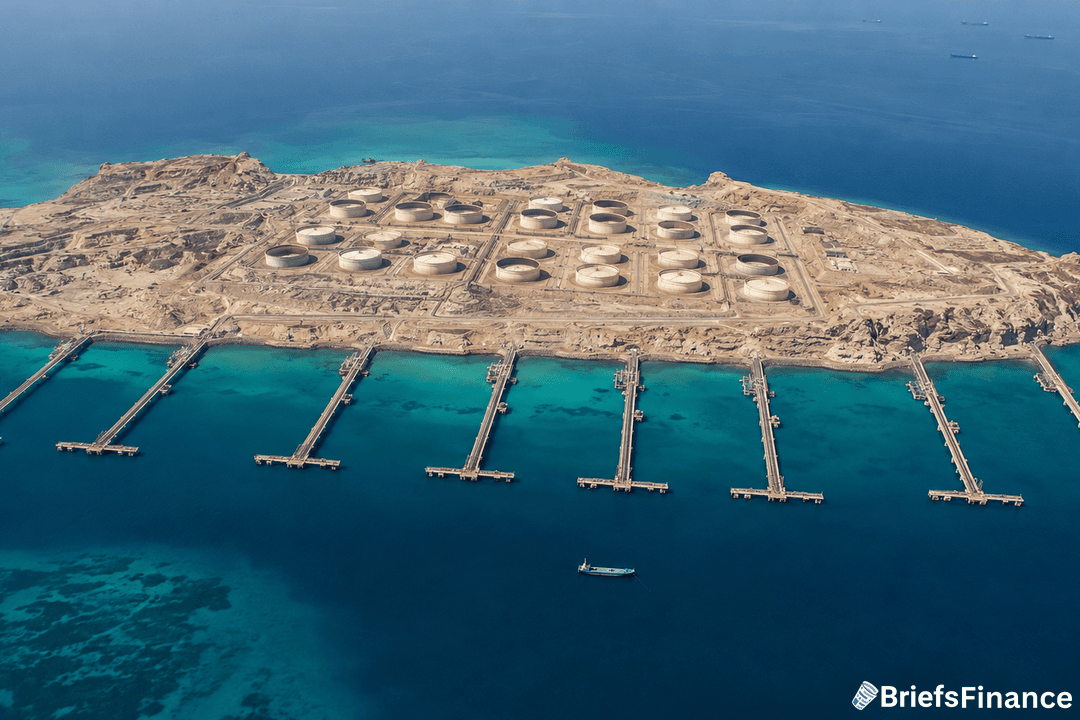
Iran sits on the world's third-largest oil reserves. Right now it cannot sell a barrel by sea.
Satellites show empty jetties at Kharg Island, and tanks are filling up offshore.
What The Satellites Show
Kharg Island handles about 90% of Iran's oil exports. As of mid-May, no ocean tankers had been spotted at the jetties on three days that week.
That is the longest stretch since the war began in late February.
TankerTrackers uses satellite images to follow ships. It says Iran has not shipped any crude by sea for 28 days.
One vessel was berthed at the southeast jetty on May 16. But it has not been tied to a loaded cargo.
There are two stories on the table. The first is that an oil spill earlier this month has gummed up loading.
The second is the one Iran will not say out loud. The US naval block put in place on April 13 is working as designed.
Market Briefs breaks down what oil moves like this mean for portfolios in five minutes a day, plus a free 45-minute investing masterclass when you join.
The Storage Crunch
Iran has about 123 million barrels of land-based storage. Kharg was at 74% full in late April.
Once a system like this hits 80%, it stops working well. Tankers cannot dock safely, and pumps slow down.
Iran is close to that ceiling.
Big crude tankers are now stacked up near Iran. The count went from three on April 11 to at least 18 by May 11.
Tankers are being used as floating tanks, because there is nowhere else to put the oil.
A senior Iranian source told Bloomberg the country is now cutting output at some fields. The cuts could hit as much as 30% of Iran's oil reservoirs.
The Dollar Cost
Treasury Secretary Scott Bessent put a number on it. He said on X that Kharg's storage would be full "in a matter of days" and that Iran's "fragile oil wells will be shut in."
The squeeze could cost Iran about $170 million a day in lost cash. At that pace, the bleed is around $5 billion a month.
Iran is shut out of dollar-based finance. It is also stretched thin by months of fighting.
That kind of bleed forces hard choices. Iran may have to cut output or discount prices to buyers.
It may also try ship-to-ship transfers, which get harder by the day.
Worth Noting
Brent crude has been jumpy but contained. The market has priced in some Iran supply going offline.
It has not priced in all of it. If Iran has to shut wells just to manage storage, that is harder to undo.
It is also bigger to hedge against. And the summer driving season is coming.
A block is not just a story about Iran. It is a story about how long the rest of the oil market can keep pretending nothing changed.
Want this kind of read every morning? Join the daily Market Briefs newsletter and get a free 45-minute investing course as a bonus when you sign up.