Free NewsletterPro Login

Greenland's Prime Minister Rejects Trump's Tariff Threats

A stylized illustration of a cylindrical cup with blue arrows and lines indicating a swirling or rotational motion inside the cup.
Published Jan 19, 2026
Share:
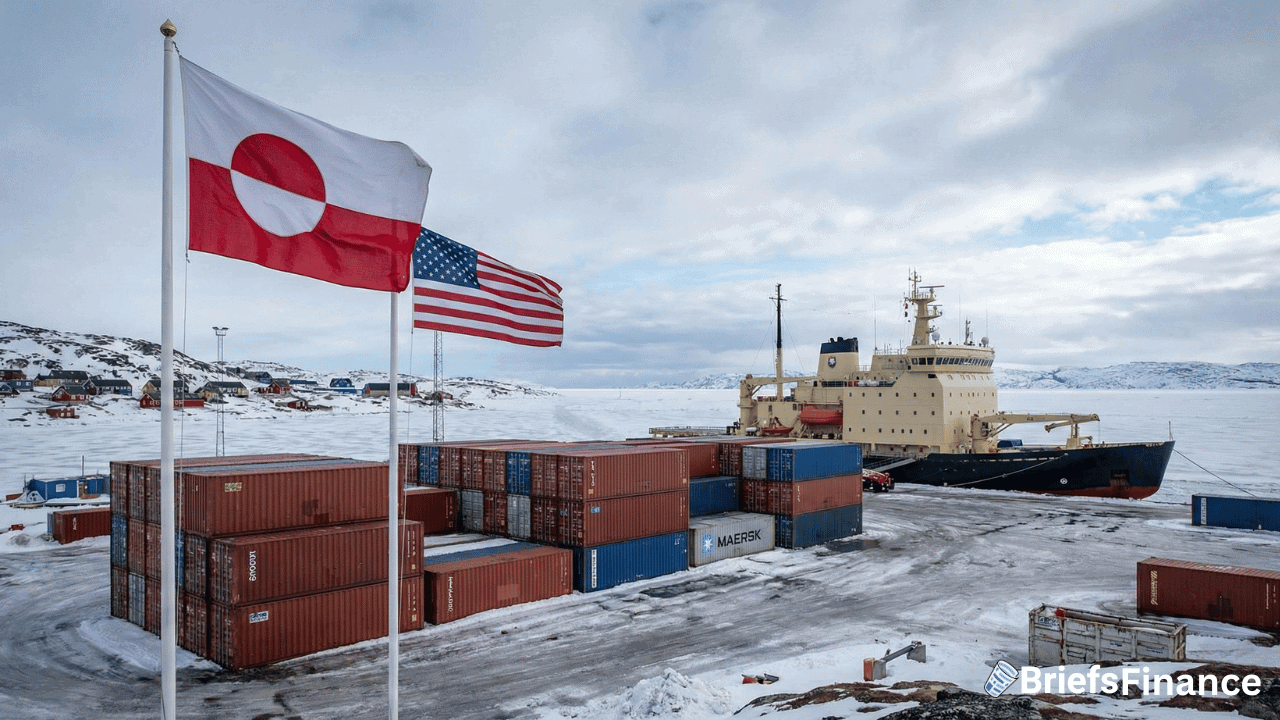
Greenland and U.S. flags near stacked shipping containers and a cargo ship docked in a snowy port, with buildings and ice in the background.
Summary:

  • Greenland's Prime Minister Jens-Frederik Nielsen asserts that the island will not be pressured by U.S. tariffs.
  • President Trump plans to impose a 10% tariff on eight European countries starting February 1, 2026, related to Greenland's status.
  • The tariff will increase to 25% on June 1, 2026, if no agreement is reached regarding Greenland.

Nielsen's Firm Stance

Greenland's Prime Minister Jens-Frederik Nielsen stated that the Arctic island would not yield to pressures from U.S. President Donald Trump's tariff threats.

His remarks were made in response to Trump's announcement of a proposed 10% tariff on eight European countries, which will take effect on February 1, 2026. This tariff is linked to Trump's desire to purchase Greenland.

Escalation of Tariffs

President Trump indicated that if an agreement regarding Greenland is not reached, the tariff will rise to 25% starting June 1, 2026.

This move has drawn significant attention and criticism from European political leaders.

Protests in Nuuk

Over the weekend, Nielsen joined protesters in Nuuk, Greenland's capital, who were demonstrating against Trump's intentions concerning Greenland.

The protests highlighted local opposition to the idea of the U.S. taking control of the self-governing Danish territory.

European Union's Support

In light of Trump's tariff threats, European leaders expressed their strong disapproval, labeling the proposed tariffs as 'unacceptable.'

They voiced their support for Denmark, which oversees Greenland's foreign and defense policies. This solidarity emphasizes a united front against U.S. pressures.

Unity in Response to U.S. Pressure

Nielsen took to social media to acknowledge the protests, stating they demonstrated a "strong and dignified unity."

He emphasized that the latest statements from the U.S. would not alter Greenland's commitment to maintain dialogue, respect, and adherence to international law. He firmly stated, "We will not be pressured," reinforcing Greenland's right to make its own decisions.

Disclosure

Get Market Briefs delivered to your inbox every morning for free!

No fluff. No noise. No politics. Just finance news you can read in 5 minutes.

Blogs

April 15, 2026
What Is a Put Option? A Simple Guide for Investors
  • A put option is a contract that gives you the right to sell a stock at a set price before a set date.
  • Investors use put options to protect their portfolio against losses or to profit when they think a stock will drop.
  • The most you can lose when buying a put option is the premium you paid for the contract.
Read More
April 13, 2026
What Is Free Cash Flow? How To Find It & Why It's Important
  • Free cash flow is the cash a company has left after paying its bills and putting money back into the business.
  • Investors use free cash flow to figure out what a company is really worth - and if the stock is a good deal.
  • You can find free cash flow on a company's cash flow report, one of three key reports every public company files.
Read More
April 13, 2026
Non Taxable Income: What It Is and Why Investors Care

Non taxable income is money you earn that the IRS does not tax - like Roth IRA cash, muni bond interest, and certain investment gains. The U.S. tax code taxes workers, investors, and business owners at very different rates. Tools like Roth accounts, muni bonds, and real estate write-offs can help you keep more of what you earn.

Read More
April 11, 2026
Nasdaq Index Fund: A Beginner's Guide to Investing in the Nasdaq 100
  • A Nasdaq index fund lets you invest in the 100 biggest non-bank companies on the stock market all at once.
  • You can access the Nasdaq through index funds, mutual funds, or ETFs like QQQ - each with its own fees, trading rules, and style.
  • Picking the right Nasdaq index fund comes down to three things: who runs it, what is in it, and what it costs.
Read More
April 11, 2026
What Is Wealth? It's Not What Most People Think
  • Wealth is about owning assets that grow and pay you - not just earning a high salary.
  • In a capitalist system, there are two ways to get paid: from your labor and from your capital.
  • Building wealth takes a shift in mindset, a money system, and the habit of investing before you spend.
Read More
April 10, 2026
Micron Stock: The AI Memory Play Most Investors Are Missing
  • Micron (MU) is the only U.S. company that makes HBM chips - the short-term memory layer that AI systems need to run.
  • By early 2026, data centers were using about 70% of all memory chips made in the world, creating an 18-month backlog for new orders.
  • Micron's DRAM - or short-term memory chip - revenue jumped 69% year over year, and the company shifted away from consumer products to focus almost entirely on AI.
Read More
April 10, 2026
What Is Working Capital? What Investors Need To Know
  • Working capital is current assets minus current liabilities - it shows if a business can pay its short-term bills.
  • You find it on a company's balance sheet inside its 10-K report.
  • Changes in working capital show up on the cash flow statement and affect how much cash a business really makes.
Read More
April 9, 2026
What Is a Meme Stock? A Simple Guide for New Investors

You've probably heard the term "meme stock" thrown around on […]

Read More
April 9, 2026
Enterprise Value Formula: What It Is and How to Calculate It
  • Enterprise value (EV) shows what a company is really worth - debt and cash included - not just its stock price
  • The enterprise value formula is: Market Cap + Total Debt - Cash and Cash Equivalents
  • Investors use EV with metrics like EBITDA to compare stocks more fairly than market cap alone
Read More
April 8, 2026
Return on Equity: What It Is and How to Use It
  • Return on equity (ROE) measures how much profit a company earns for every dollar of shareholder equity
  • The formula is simple: net income divided by shareholder equity
  • A higher ROE can signal a company that is good at turning investor money into profit - but it is not the full picture
Read More
1 2 3 17
Share via
Copy link









