Pro Login

Gold Just Hit $5,400. Here's Why Your Portfolio Should Care.

A stylized illustration of a cylindrical cup with blue arrows and lines indicating a swirling or rotational motion inside the cup.
Published Mar 2, 2026
Share:
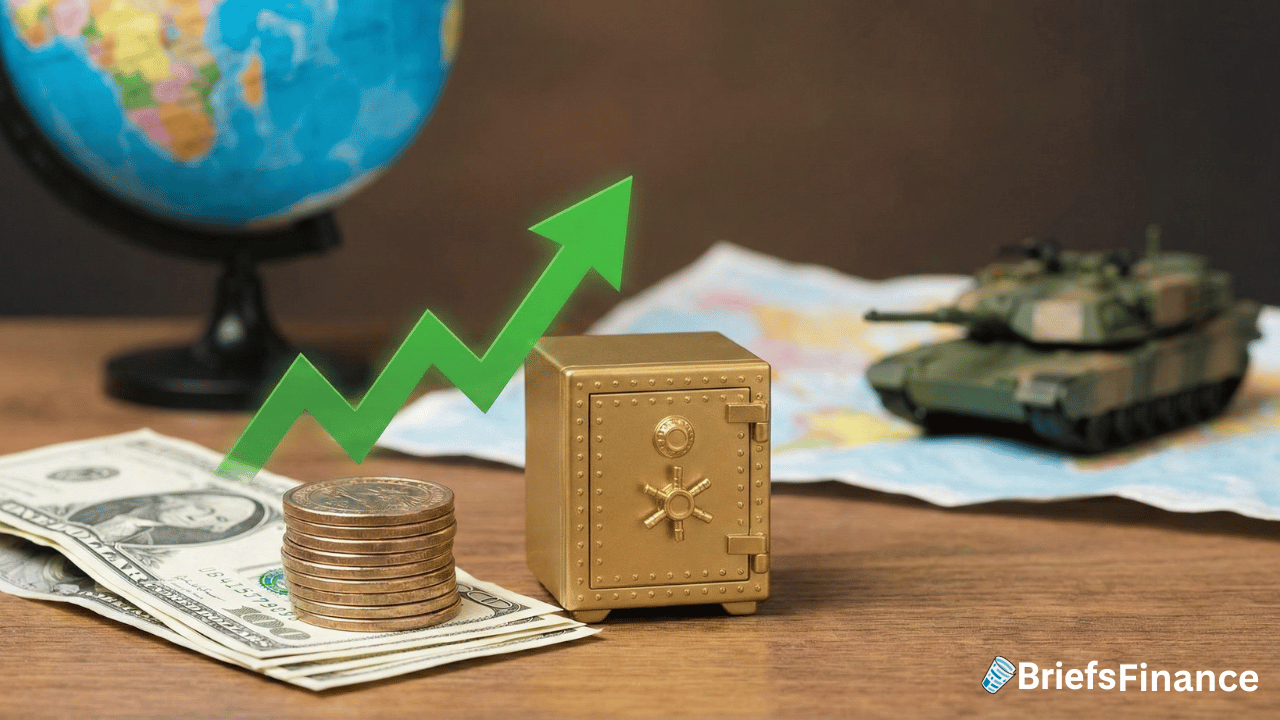
Stack of cash and coins, a gold safe, a rising green arrow, a globe, and a toy tank on a map—illustrating how your portfolio could grow by $5,400; BriefsFinance logo in the corner.
Summary:
  • Gold briefly touched $5,400 per ounce Monday as US-Israel strikes on Iran rattled markets.
  • JPMorgan sees a short-term price spike of 5–10%, but warns gains can fade fast.
  • The bank's year-end target for gold is $6,300 — nearly $1,000 above where it sits now.

Gold hit $5,400 an ounce Monday morning. That's not a typo — and it's not just traders being dramatic.

What Happened

Over the weekend, US and Israeli forces struck Iran. Iran struck back. Markets opened Monday in a full-on scramble for safety, and gold — the world's oldest panic button — got slammed.

Futures briefly touched $5,400 before pulling back. By midday, gold was trading around $5,327, still up more than 1.5% on the day and sitting about $200 below its all-time high set back in January.

It was gold's ninth straight month of gains. Year to date, the metal is up 21%.

Why Gold Moves When the World Gets Scary

Gold is what investors call a "safe-haven" asset. When stocks start dropping and the news gets ugly, people move money into gold because it tends to hold its value when everything else is sliding.

That's exactly what happened Monday. US stocks opened lower. Oil surged. And gold — already riding a months-long rally fueled by central bank buying, falling interest rates, and a weaker dollar — got another big push.

JPMorgan analysts expect the conflict to add a "risk premium" of more than 5% to 10% to gold prices in the near-term. But they added a caveat: geopolitical price spikes "can be sharp but hard to sustain."

If the conflict cools, or if investors need to sell gold to cover losses elsewhere, prices could pull back just as fast.

What Comes Next

The bigger story isn't just this weekend's strikes. JPMorgan is forecasting gold at $6,300 per ounce by the end of 2026 — not because of Iran, but because of structural forces that aren't going away anytime soon.

Central banks are still buying gold at a record pace. The US dollar is weak. Interest rates are falling. And deficits are rising. All of those things tend to push gold higher over time.

Robin Brooks, a senior fellow at the Brookings Institution, put it simply: "2026 is looking like 2025 on steroids."

The short-term spike may fade. The long-term trend may not.
Disclosure

Get Market Briefs delivered to your inbox every morning for free!

No fluff. No noise. No politics. Just finance news you can read in 5 minutes.

Blogs

April 15, 2026
What Is a Put Option? A Simple Guide for Investors
  • A put option is a contract that gives you the right to sell a stock at a set price before a set date.
  • Investors use put options to protect their portfolio against losses or to profit when they think a stock will drop.
  • The most you can lose when buying a put option is the premium you paid for the contract.
Read More
April 13, 2026
What Is Free Cash Flow? How To Find It & Why It's Important
  • Free cash flow is the cash a company has left after paying its bills and putting money back into the business.
  • Investors use free cash flow to figure out what a company is really worth - and if the stock is a good deal.
  • You can find free cash flow on a company's cash flow report, one of three key reports every public company files.
Read More
April 13, 2026
Non Taxable Income: What It Is and Why Investors Care

Non taxable income is money you earn that the IRS does not tax - like Roth IRA cash, muni bond interest, and certain investment gains. The U.S. tax code taxes workers, investors, and business owners at very different rates. Tools like Roth accounts, muni bonds, and real estate write-offs can help you keep more of what you earn.

Read More
April 11, 2026
Nasdaq Index Fund: A Beginner's Guide to Investing in the Nasdaq 100
  • A Nasdaq index fund lets you invest in the 100 biggest non-bank companies on the stock market all at once.
  • You can access the Nasdaq through index funds, mutual funds, or ETFs like QQQ - each with its own fees, trading rules, and style.
  • Picking the right Nasdaq index fund comes down to three things: who runs it, what is in it, and what it costs.
Read More
April 11, 2026
What Is Wealth? It's Not What Most People Think
  • Wealth is about owning assets that grow and pay you - not just earning a high salary.
  • In a capitalist system, there are two ways to get paid: from your labor and from your capital.
  • Building wealth takes a shift in mindset, a money system, and the habit of investing before you spend.
Read More
April 10, 2026
Micron Stock: The AI Memory Play Most Investors Are Missing
  • Micron (MU) is the only U.S. company that makes HBM chips - the short-term memory layer that AI systems need to run.
  • By early 2026, data centers were using about 70% of all memory chips made in the world, creating an 18-month backlog for new orders.
  • Micron's DRAM - or short-term memory chip - revenue jumped 69% year over year, and the company shifted away from consumer products to focus almost entirely on AI.
Read More
April 10, 2026
What Is Working Capital? What Investors Need To Know
  • Working capital is current assets minus current liabilities - it shows if a business can pay its short-term bills.
  • You find it on a company's balance sheet inside its 10-K report.
  • Changes in working capital show up on the cash flow statement and affect how much cash a business really makes.
Read More
April 9, 2026
What Is a Meme Stock? A Simple Guide for New Investors

You've probably heard the term "meme stock" thrown around on […]

Read More
April 9, 2026
Enterprise Value Formula: What It Is and How to Calculate It
  • Enterprise value (EV) shows what a company is really worth - debt and cash included - not just its stock price
  • The enterprise value formula is: Market Cap + Total Debt - Cash and Cash Equivalents
  • Investors use EV with metrics like EBITDA to compare stocks more fairly than market cap alone
Read More
April 8, 2026
Return on Equity: What It Is and How to Use It
  • Return on equity (ROE) measures how much profit a company earns for every dollar of shareholder equity
  • The formula is simple: net income divided by shareholder equity
  • A higher ROE can signal a company that is good at turning investor money into profit - but it is not the full picture
Read More
1 2 3 17
Share via
Copy link