Free NewsletterPro Login

Europe Responds to New 15% Tariff Imposed by Trump Administration

A stylized illustration of a cylindrical cup with blue arrows and lines indicating a swirling or rotational motion inside the cup.
Published Feb 23, 2026
Share:
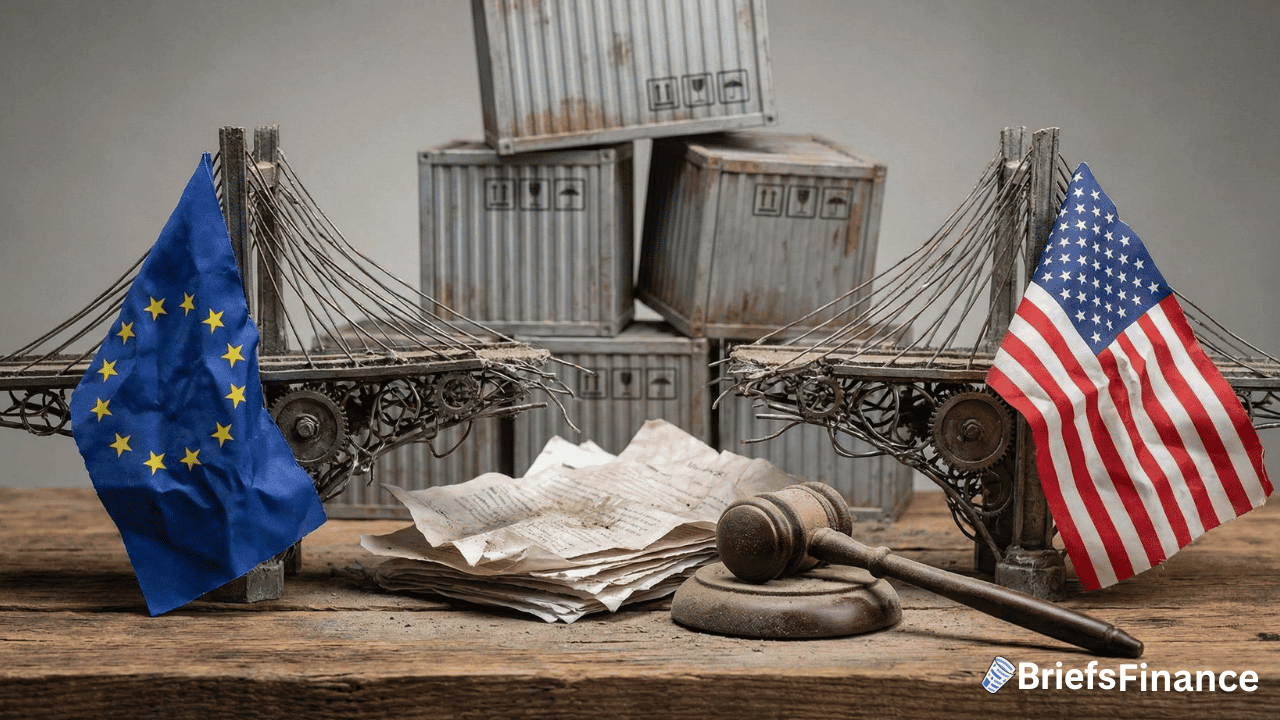
Model bridge with EU and US flags, a gavel, legal documents, and stacked shipping containers symbolize trade negotiations or disputes between the European Union and the United States.
Summary:

  • President Trump announced a 15% global tariff on imports, effective immediately.
  • European officials reacted strongly, calling the situation 'pure tariff chaos.'
  • Emergency meetings are planned to discuss the impact on U.S.-EU trade agreements.

New Tariff Announcement

President Donald Trump announced a new global 15% tariff on all imports, effective immediately. This decision follows a recent ruling by the U.S. Supreme Court that struck down his previous global tariffs policy.

Trump initially proposed a 10% levy before increasing it to the maximum allowable 15%, which can remain in place for 150 days without Congressional approval.

European Officials React

European leaders expressed alarm over the new tariff policy. Bernd Lange, the Chairman of the European Parliament's trade committee, criticized the U.S. administration, calling it 'pure tariff chaos.'

He noted that the sudden changes create uncertainty regarding existing trade agreements between the U.S. and Europe.

Lange stated that there are many unanswered questions about whether the new tariffs breach existing deals. He emphasized the need for clarity and legal certainty before proceeding with any further actions.

Emergency Meetings Scheduled

The European Parliament's trade committee plans to hold an emergency meeting to address the implications of the new tariffs.

Lange intends to propose suspending the implementation of the U.S.-EU trade deal until they receive a comprehensive legal assessment and clear commitments from the U.S. regarding the tariffs.

Response from European Leaders

German Chancellor Friedrich Merz indicated there would be a united European response to the tariffs. He mentioned that he would discuss the matter during his upcoming visit to the White House.

Similarly, French Trade Minister Nicolas Forissier urged EU members to adopt a united strategy against the U.S. trade stance and hinted that Brussels could retaliate.

Impact on the U.K. and Trade Relationships

The U.K. government has also expressed concerns about how the new tariff policy will influence its trade deal with the U.S. Currently, the U.K. has a baseline 10% tariff rate, which may change due to the recent announcement.

On a trade-weighted basis, the U.K. is expected to see a 2.1 percentage point increase in its average tariff rate, while the EU faces a 0.8 point rise, according to analysis from Global Trade Alert.

European Central Bank President Christine Lagarde warned that the trans-Atlantic business relationship might suffer due to the uncertainty surrounding the new tariffs.

She stressed the importance of having clarity about future trade relations, stating that uncertainty can disrupt business.

Looking Forward

As the situation evolves, U.S. Trade Representative Jamieson Greer is tasked with reassuring international partners that existing trade deals are still in place. Greer defended the president's tariff stance, stating, "The president's policy was going to continue.

That's why they signed these deals, even while the litigation was pending. We expect our partners to stand by them." However, many European leaders are still seeking clarity on how the new tariffs will affect trade agreements.

Disclosure

Get Market Briefs delivered to your inbox every morning for free!

No fluff. No noise. No politics. Just finance news you can read in 5 minutes.

Blogs

April 29, 2026
What Is Blockchain? A Plain English Guide For Investors
  • Blockchain is a digital ledger that records every transaction on a public network.
  • Once a transaction is recorded, it cannot be changed or deleted.
  • It is the foundation of Bitcoin, Ethereum, and thousands of other cryptocurrencies.

Read More
April 29, 2026
How To Negotiate Bills: The Script That Saves You Hundreds A Year
  • Most monthly bills are negotiable, even though most Americans never try.
  • A simple phone call with the right script can lower your phone, internet, and utility bills.
  • The key rule is to be nice. Customer service reps have more flexibility than most people realize.
Read More
April 29, 2026
75 15 10 Rule: The Budget That Builds Wealth On Autopilot
  • The 75 15 10 rule is a budgeting plan: spend at most 75% of your income, invest at least 15%, and save at least 10%.
  • It works by making sure you pay yourself before you spend.
  • Once your savings target is hit, you shift the 10% over to investing, becoming a 75/25 plan.
Read More
April 29, 2026
How To Rebalance Portfolio: The Strategy That Forces You To Buy Low And Sell High
  • Rebalancing means adjusting your portfolio back to your target allocation when it drifts too far.
  • The two main methods are time-based (rebalance once a year) and threshold-based (rebalance when allocation drifts more than 5%).
  • If you are still adding money, you can rebalance by directing new money instead of selling.
Read More
April 29, 2026
How To Buy Treasury Bonds: A Beginner's Guide
  • Treasury bonds are loans you make to the U.S. government. They are considered the safest investment in the world.
  • You can buy them at TreasuryDirect.gov directly or through any major brokerage.
  • There are three main types: T-Bills, Treasury Notes, and Treasury Bonds. The longer the term, the higher the interest rate.
Read More
April 29, 2026
Forward Vs Futures Contracts: What's The Real Difference?
  • Both forward and futures contracts are deals to buy or sell something at a set price on a future date.
  • Futures trade on exchanges. Forwards are private deals between two parties.
  • Most regular investors do not use either. They are mostly tools for businesses and big institutions.
Read More
April 29, 2026
Alternative Investments Explained: What They Are And Why They Matter
  • Alternative investments are anything that is not a regular stock or bond.
  • The most common types are precious metals, crypto, real estate, commodities, and collectibles.
  • Most investors should hold 5% to 25% of their portfolio in alternatives, depending on risk tolerance.
Read More
April 29, 2026
How To Buy Bitcoin For Beginners: 3 Simple Ways
  • There are three main ways to buy Bitcoin: directly on an exchange, through a Bitcoin ETF, or through a Bitcoin miner stock.
  • Each has its own pros, cons, and tax setup.
  • Most beginners do best starting small and using dollar cost averaging.
Read More
April 29, 2026
How To Follow Smart Money: The 5 Market Shifts Framework
  • "Smart money" means big investors with deep research teams and fast information.
  • You can follow them by watching for 5 types of market shifts.
  • The goal is to spot where money is moving before it shows up on CNBC.
Read More
April 29, 2026
Insider Trading Meaning: What It Really Is (And Why Some Of It Is Legal)
  • Insider trading means buying or selling a stock based on facts the public does not know yet.
  • Some insider trading is legal. Some is a federal crime that can send people to prison.
  • The SEC tracks every legal insider trade in a public file called Form 4.
Read More
1 2 3 19
Share via
Copy link