Free NewsletterPro Login
S&P 500 6,287 +0.42%
DOW 44,521 -0.18%
NASDAQ 21,103 +0.71%
S&P 500 +12.4%
Briefs Finance Fund +24.8%
JOIN THE FUND →

Europe Responds to New 15% Tariff Imposed by Trump Administration

A stylized illustration of a cylindrical cup with blue arrows and lines indicating a swirling or rotational motion inside the cup.
Published Feb 23, 2026
[tts_player]
Share:
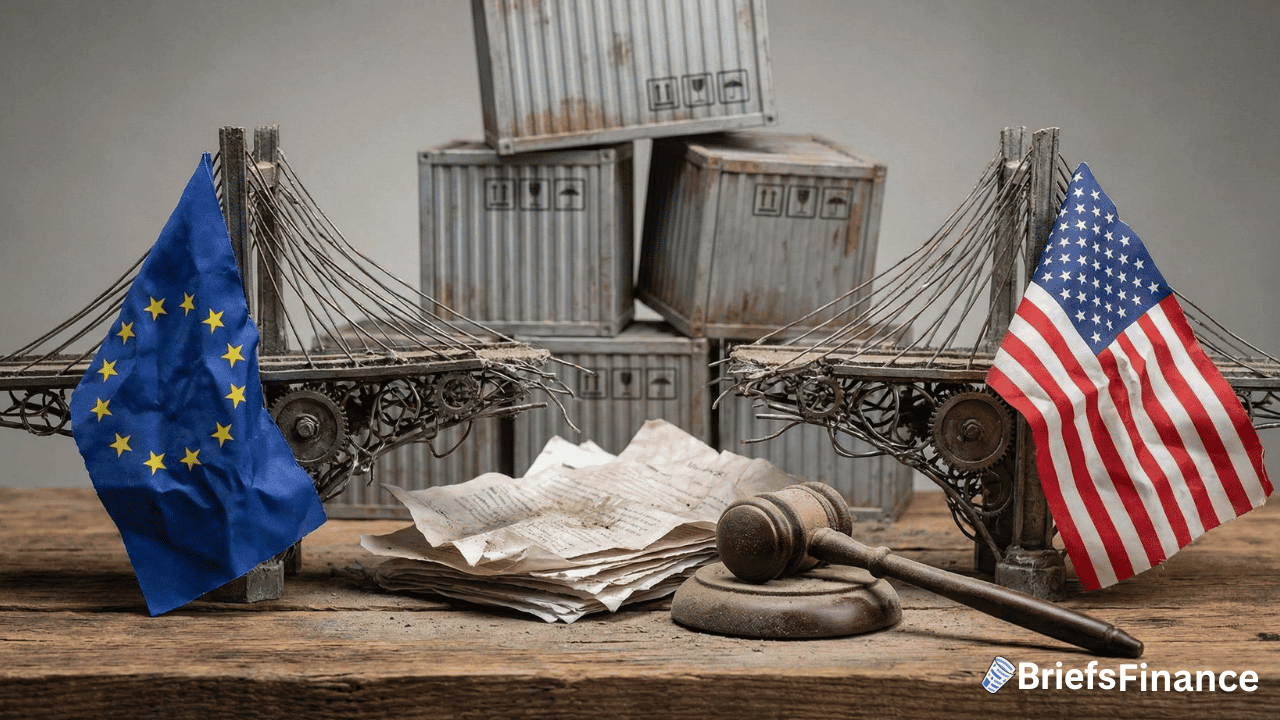
Model bridge with EU and US flags, a gavel, legal documents, and stacked shipping containers symbolize trade negotiations or disputes between the European Union and the United States.
Summary:

  • President Trump announced a 15% global tariff on imports, effective immediately.
  • European officials reacted strongly, calling the situation 'pure tariff chaos.'
  • Emergency meetings are planned to discuss the impact on U.S.-EU trade agreements.

New Tariff Announcement

President Donald Trump announced a new global 15% tariff on all imports, effective immediately. This decision follows a recent ruling by the U.S. Supreme Court that struck down his previous global tariffs policy.

Trump initially proposed a 10% levy before increasing it to the maximum allowable 15%, which can remain in place for 150 days without Congressional approval.

European Officials React

European leaders expressed alarm over the new tariff policy. Bernd Lange, the Chairman of the European Parliament's trade committee, criticized the U.S. administration, calling it 'pure tariff chaos.'

He noted that the sudden changes create uncertainty regarding existing trade agreements between the U.S. and Europe.

Lange stated that there are many unanswered questions about whether the new tariffs breach existing deals. He emphasized the need for clarity and legal certainty before proceeding with any further actions.

Emergency Meetings Scheduled

The European Parliament's trade committee plans to hold an emergency meeting to address the implications of the new tariffs.

Lange intends to propose suspending the implementation of the U.S.-EU trade deal until they receive a comprehensive legal assessment and clear commitments from the U.S. regarding the tariffs.

Response from European Leaders

German Chancellor Friedrich Merz indicated there would be a united European response to the tariffs. He mentioned that he would discuss the matter during his upcoming visit to the White House.

Similarly, French Trade Minister Nicolas Forissier urged EU members to adopt a united strategy against the U.S. trade stance and hinted that Brussels could retaliate.

Impact on the U.K. and Trade Relationships

The U.K. government has also expressed concerns about how the new tariff policy will influence its trade deal with the U.S. Currently, the U.K. has a baseline 10% tariff rate, which may change due to the recent announcement.

On a trade-weighted basis, the U.K. is expected to see a 2.1 percentage point increase in its average tariff rate, while the EU faces a 0.8 point rise, according to analysis from Global Trade Alert.

European Central Bank President Christine Lagarde warned that the trans-Atlantic business relationship might suffer due to the uncertainty surrounding the new tariffs.

She stressed the importance of having clarity about future trade relations, stating that uncertainty can disrupt business.

Looking Forward

As the situation evolves, U.S. Trade Representative Jamieson Greer is tasked with reassuring international partners that existing trade deals are still in place. Greer defended the president's tariff stance, stating, "The president's policy was going to continue.

That's why they signed these deals, even while the litigation was pending. We expect our partners to stand by them." However, many European leaders are still seeking clarity on how the new tariffs will affect trade agreements.

Disclosure

Recent News

1 2 3 39

Get Market Briefs delivered to your inbox every morning for free!

No fluff. No noise. No politics. Just finance news you can read in 5 minutes.

Blogs

June 29, 2026
Portfolio Diversification: Why Putting All Your Eggs in One Basket Destroys Wealth
  • Real diversification means spreading investments across all 11 economic sectors plus bonds, alternatives, and cash so no single bet can sink the portfolio.
  • Different sectors perform at different times, so a diversified portfolio captures upswings while smoothing the brutal drawdowns that wipe out concentrated bets.
  • Total market index funds offer the simplest path to diversification, and annual rebalancing is what keeps the structure working over time.
Read More
June 29, 2026
Non Taxable Income: What It Is and Why It Matters
  • Non taxable income is money you receive that you don't owe income tax on.
  • The tax code treats workers, investors, and business owners very differently, and investors often come out ahead.
  • Learning how income is taxed is a quiet superpower for keeping more of what you earn.
Read More
June 29, 2026
Semiconductor Stocks: A Simple Guide for Investors
  • Semiconductor stocks are companies that design and make computer chips, the brains inside nearly every modern device.
  • The AI boom has turned chips into one of the market's most important and most watched groups.
  • They offer big growth potential, but come with high valuations and a notoriously cyclical history.
Read More
June 25, 2026
How Stocks Work: A Simple Guide for Beginners
  • A stock is a slice of ownership in a company - buy one, and you own a piece of the business.
  • You make money two ways: the share price rising over time, and dividends paid to shareholders.
  • The simplest path for most beginners is buying into the whole market through a low-cost index fund.
Read More
June 25, 2026
Stop Loss vs Stop Limit: What's the Difference?
  • A stop loss order sells your stock once it hits a trigger price, prioritizing getting you out.
  • A stop limit order only sells within a price range you set, prioritizing price over a guaranteed exit.
  • The trade-off: a stop loss almost always executes; a stop limit might not if the price moves too fast.
Read More
June 25, 2026
Energy Stocks: A Simple Guide for Investors
  • Energy stocks are companies that produce and supply the power the world runs on, from oil and gas to newer sources.
  • They make up one of the 11 sectors of the market and tend to move with energy prices and big-picture shifts.
  • Like any sector, the key is diversification and understanding the forces driving demand.
Read More
June 18, 2026
What Is a Stop Loss Order? A Simple Guide
  • A stop loss order automatically sells a stock once it falls to a price you set.
  • It's a tool to cap losses or lock in gains without watching the market all day.
  • It works best for active strategies, and can backfire if used carelessly on long-term holdings.
Read More
June 18, 2026
Best S&P 500 Index Fund: How to Choose One
  • The best S&P 500 index fund for most investors is simply the cheapest, most established one that tracks the index well.
  • Funds like VOO, IVV, and SPY all hold the same 500 companies, so the biggest difference is the fee.
  • Pick one, automate your buys, and let time do the heavy lifting.
Read More
June 17, 2026
What Are Penny Stocks? Risks and Rewards Explained
  • Penny stocks are very low-priced shares of very small companies, often trading for just a few dollars or less.
  • They promise huge gains but carry huge risks: low liquidity, high failure rates, and wild price swings.
  • Most investors are better served by quality companies and funds than by chasing cheap shares.
Read More
June 17, 2026
Best Stocks for Beginners With Little Money
  • The best stocks for beginners with little money usually aren't individual stocks at all - they're low-cost index funds.
  • You can start with $100 or less and use small, regular investments to build wealth over time.
  • Focus on diversification and consistency, not on picking the next big winner.
Read More
1 2 3 24
Share via
Copy link









