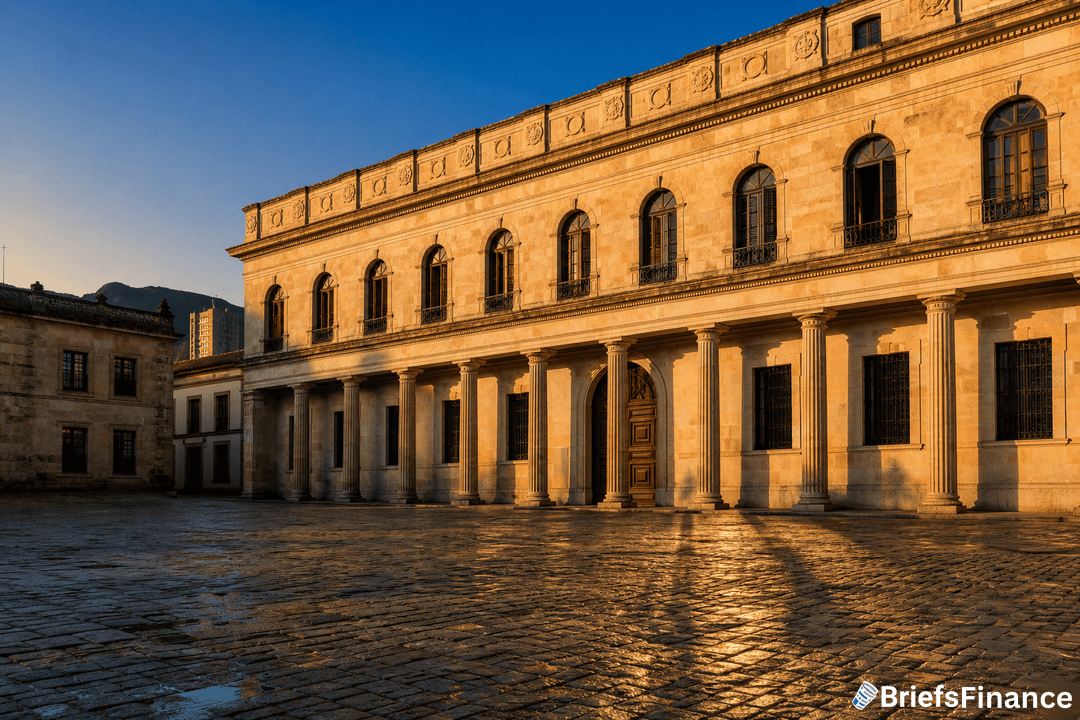
Colombia's central bank just tried to be predictable, and got the opposite. The board voted unanimously on April 30 to hold its key interest rate at 11.25%, in a decision that caught traders off guard and pushed the Colombian peso lower as soon as markets reopened.
This was supposed to be the calm move. Investors read it as the opposite.
The Hold Breaks A Tightening Cycle
The decision ends a tightening cycle that included two hikes earlier this year, with co-director Mauricio Villamizar saying the latest move was designed to avoid market volatility ahead of a politically charged stretch.
Trading desks read the message differently and piled into steepener bets - wagers that long-dated bond yields will rise faster than short-dated ones - while the peso looked set to weaken further when local markets reopened.
The decision also puts Colombia in step with the US Federal Reserve and the European Central Bank, both of which left their benchmark rates unchanged the same week.
Inflation in the country is still well above the bank's 3% target, with Finance Minister German Avila telling reporters that energy and communications costs - rather than December's minimum-wage hike - are doing most of the work.
Avila also announced a new fertilizer subsidy aimed at offsetting the impact of recent heavy rains on Colombian farms, alongside the small gasoline price increase taking effect on May 1 to reflect higher international crude prices.
A Divided Board Heading Into An Election
Governor Leonardo Villar acknowledged the unanimous vote masked real disagreement, with one camp arguing rates should stay restrictive until inflation cools and another camp closer to President Gustavo Petro pushing for cuts to support a recovery as the country heads into a presidential transition.
The hawks see inflation as a real, latent risk in a global economy with up-and-down energy prices and ongoing geopolitical tension from the US-Iran war.
The doves argue the current rate level is squeezing consumption and investment, slowing exactly the recovery they want to protect, while pointing to credit growth and unemployment as evidence the squeeze is biting.
The meeting also marked the return of Avila, who walked out of the previous session and disclosed the bank's decision in advance, breaking an institutional norm and rattling some board members. This time he stayed in his seat, in what looked like a deliberate move to repair relations with the bank's technical staff.
What To Watch
The board next meets at the end of June, in the same window in which Colombians vote in the presidential runoff. Many forecasters had been positioned for another hike going into the meeting, which is a big part of why the unanimous hold landed as a shock.
Until then, every comment from Villar and Villamizar will get parsed by traders for any hint of which side of the board is winning the argument. The bank wanted calm, and it bought a six-week stress test instead.