Free NewsletterPro Login

Chinese Energy Stocks Jump On Clean Energy Boom

A stylized illustration of a cylindrical cup with blue arrows and lines indicating a swirling or rotational motion inside the cup.
Published Feb 12, 2026
Share:
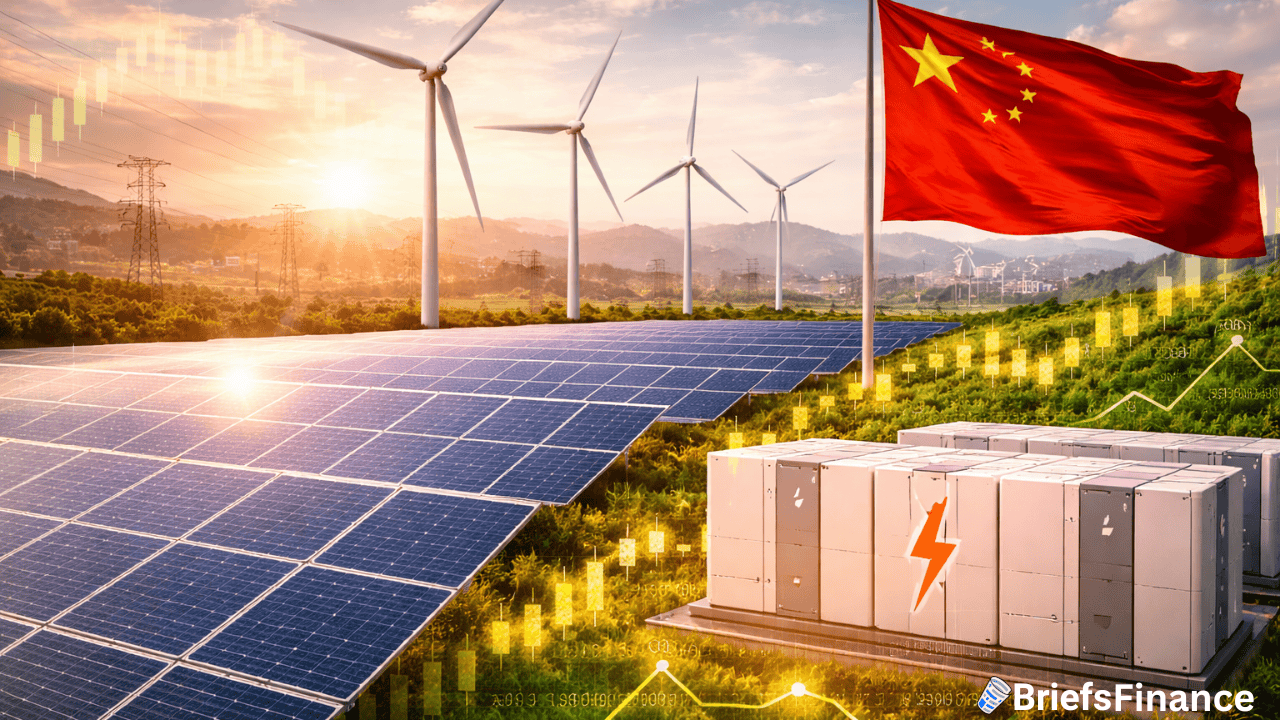
Solar panels, wind turbines, and battery storage set in a green landscape with a Chinese flag, representing clean energy development and the growing impact of Chinese energy stocks in China.
Summary:
  • Historic plateau. China's CO2 emissions have been flat or falling for 21 months, marking the longest decline not driven by economic slowdown.
  • Renewables explosion. Solar output jumped 43% and wind climbed 14% in 2025, meeting all new electricity demand.
  • Storage surge. Energy storage capacity grew by a record 75 gigawatts - roughly equivalent to France's peak winter demand.

Solar power output in China surged 43% year-over-year.

Wind climbed 14%.

Nuclear jumped 8%.

Together, these three sources delivered about 530 terawatt-hours of new clean electricity - enough to cover all of China's 520 TWh growth in electricity demand.

Translation: renewables grew faster than demand. That forced coal generation down 1.9%.

Companies like JinkoSolar - one of China's largest solar manufacturers - are riding this wave.

The country installed 360 gigawatts of wind and solar in 2024 alone, more than half the world's total additions that year.

The Energy Storage Revolution

But solar and wind are unreliable. The sun sets. The wind dies.

That's where storage comes in.

China's energy storage capacity grew by 75 gigawatts in 2025 - a record.

That outpaced the 55 GW rise in peak demand.

Break that down: 75 GW is roughly equivalent to France's peak winter electricity demand of 88-96 GW.

It's a massive amount of capacity that lets China store excess solar and wind power for use when generation drops.

The result? Less need for coal plants to fill the gaps.

Where Emissions Actually Fell

Power sector emissions dropped 1.5% as renewables displaced fossil fuels.

Transport emissions fell 3%, driven by electric vehicle adoption.

Building materials - mainly cement - dropped 7% as construction slowed.

But there's a catch.

The chemicals industry saw emissions jump 12%. That sector is growing fast and could threaten future declines if left unchecked.

Is This Peak Emissions?

China committed to peaking emissions before 2030. Some analysts think they've already hit it.

The 21-month plateau is the longest decline on record not driven by economic slowdown. If it holds, China could beat its 2030 target by years.

But CREA lead analyst Lauri Myllyvirta warns the progress is fragile.

"Because the relative drop is so small, we can't say with certainty yet that it's a fall, therefore the 'flat or falling.'"

A small jump in emissions could push China back above its previous peak. The chemical sector's growth is proof that not every part of the economy is decarbonizing.

What Happens Next

China's next five-year plan drops in March 2026. That document will reveal whether the government plans to keep clean energy additions at current levels—or scale back.

To meet its 2030 climate commitments, China needs to maintain or slightly reduce emissions through the end of the decade.

That requires keeping renewables installations close to 2025 levels.

The trajectory isn't guaranteed.

But right now, the world's biggest polluter is bending its emissions curve downward - and clean energy is doing the heavy lifting.

Disclosure

Get Market Briefs delivered to your inbox every morning for free!

No fluff. No noise. No politics. Just finance news you can read in 5 minutes.

Blogs

April 29, 2026
What Is Blockchain? A Plain English Guide For Investors
  • Blockchain is a digital ledger that records every transaction on a public network.
  • Once a transaction is recorded, it cannot be changed or deleted.
  • It is the foundation of Bitcoin, Ethereum, and thousands of other cryptocurrencies.

Read More
April 29, 2026
How To Negotiate Bills: The Script That Saves You Hundreds A Year
  • Most monthly bills are negotiable, even though most Americans never try.
  • A simple phone call with the right script can lower your phone, internet, and utility bills.
  • The key rule is to be nice. Customer service reps have more flexibility than most people realize.
Read More
April 29, 2026
75 15 10 Rule: The Budget That Builds Wealth On Autopilot
  • The 75 15 10 rule is a budgeting plan: spend at most 75% of your income, invest at least 15%, and save at least 10%.
  • It works by making sure you pay yourself before you spend.
  • Once your savings target is hit, you shift the 10% over to investing, becoming a 75/25 plan.
Read More
April 29, 2026
How To Rebalance Portfolio: The Strategy That Forces You To Buy Low And Sell High
  • Rebalancing means adjusting your portfolio back to your target allocation when it drifts too far.
  • The two main methods are time-based (rebalance once a year) and threshold-based (rebalance when allocation drifts more than 5%).
  • If you are still adding money, you can rebalance by directing new money instead of selling.
Read More
April 29, 2026
How To Buy Treasury Bonds: A Beginner's Guide
  • Treasury bonds are loans you make to the U.S. government. They are considered the safest investment in the world.
  • You can buy them at TreasuryDirect.gov directly or through any major brokerage.
  • There are three main types: T-Bills, Treasury Notes, and Treasury Bonds. The longer the term, the higher the interest rate.
Read More
April 29, 2026
Forward Vs Futures Contracts: What's The Real Difference?
  • Both forward and futures contracts are deals to buy or sell something at a set price on a future date.
  • Futures trade on exchanges. Forwards are private deals between two parties.
  • Most regular investors do not use either. They are mostly tools for businesses and big institutions.
Read More
April 29, 2026
Alternative Investments Explained: What They Are And Why They Matter
  • Alternative investments are anything that is not a regular stock or bond.
  • The most common types are precious metals, crypto, real estate, commodities, and collectibles.
  • Most investors should hold 5% to 25% of their portfolio in alternatives, depending on risk tolerance.
Read More
April 29, 2026
How To Buy Bitcoin For Beginners: 3 Simple Ways
  • There are three main ways to buy Bitcoin: directly on an exchange, through a Bitcoin ETF, or through a Bitcoin miner stock.
  • Each has its own pros, cons, and tax setup.
  • Most beginners do best starting small and using dollar cost averaging.
Read More
April 29, 2026
How To Follow Smart Money: The 5 Market Shifts Framework
  • "Smart money" means big investors with deep research teams and fast information.
  • You can follow them by watching for 5 types of market shifts.
  • The goal is to spot where money is moving before it shows up on CNBC.
Read More
April 29, 2026
Insider Trading Meaning: What It Really Is (And Why Some Of It Is Legal)
  • Insider trading means buying or selling a stock based on facts the public does not know yet.
  • Some insider trading is legal. Some is a federal crime that can send people to prison.
  • The SEC tracks every legal insider trade in a public file called Form 4.
Read More
1 2 3 19
Share via
Copy link