Free NewsletterPro Login

America Is the World's Biggest Oil Producer. It Still Can't Fix This.

A stylized illustration of a cylindrical cup with blue arrows and lines indicating a swirling or rotational motion inside the cup.
Published Mar 3, 2026
Share:
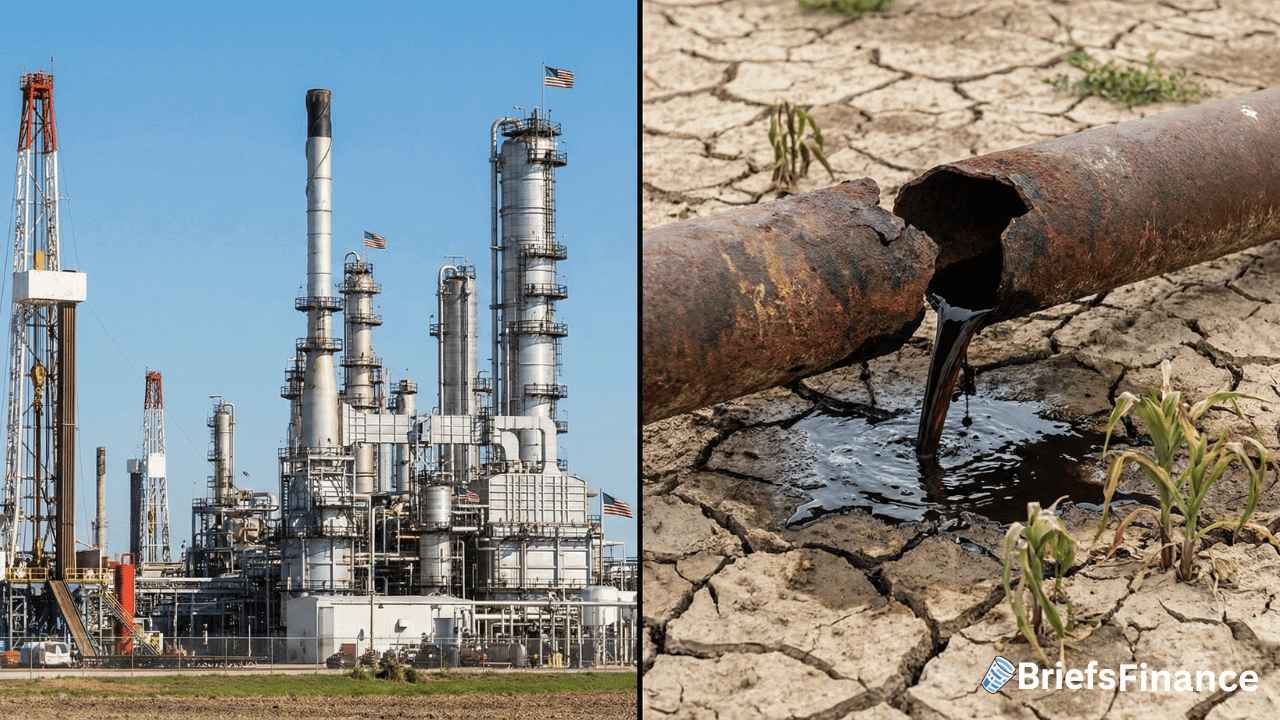
Split image: Left side shows an America oil producer’s refinery with tall towers and pipes; right side reveals a leaking oil pipeline on cracked, dry ground with sparse grass.
Summary:

  • The US leads the world in oil and gas production but is already shipping near full capacity — it can't replace the 20% of global supply bottlenecked at the Strait of Hormuz.
  • Europe's natural gas benchmark surged 90% in two days; Asia's jumped too — regions far more exposed than the US.
  • Trump pledged to insure and escort tankers through the strait, which helped slow the price surge, but the underlying problem remains.

The US is pumping more oil and gas than any country on earth. It won't be enough.

Why America Can't Save the Day

The Strait of Hormuz handles nearly 20 million barrels of oil per day — about 20% of global supply. With tanker traffic effectively halted, that oil isn't moving. Qatar also took its LNG production offline after Iran launched strikes on its neighbors, pulling a huge chunk of global natural gas supply off the market at the same time.

The problem for US exporters isn't willingness — it's capacity. They're already shipping close to their limits. Mathieu Utting, global gas and LNG analyst at Rystad Energy, told Fortune that US exporters will "definitely profit more" from the crisis — but they simply can't increase volumes meaningfully.

Raymond James analyst Pavel Molchanov put the regional divide plainly: "Europe and Asia rely on imported LNG, so they are affected by the disruption. As the world's largest LNG producer, the US doesn't have the same worry — in fact, it could benefit." Europe's gas benchmark surged 90% in two days. The US benchmark rose, but far less.

The Wildcard That Matters Most

Trump's pledge on March 3 to provide political risk insurance and Navy escorts for tankers through the strait helped cool prices — because expensive or unavailable insurance was a key reason ships were staying away, not just the threat of attack.

But Matt Reed of Foreign Reports warned that Iran has so far been restrained in its attacks on energy infrastructure. If Iran and its proxies go after oil production facilities directly, prices could surge well past $100 a barrel — and there's no easy off-ramp from there.

The US oil benchmark is already up nearly 30% since January. The question is whether it stops here.

Disclosure

Get Market Briefs delivered to your inbox every morning for free!

No fluff. No noise. No politics. Just finance news you can read in 5 minutes.

Blogs

April 29, 2026
What Is Blockchain? A Plain English Guide For Investors
  • Blockchain is a digital ledger that records every transaction on a public network.
  • Once a transaction is recorded, it cannot be changed or deleted.
  • It is the foundation of Bitcoin, Ethereum, and thousands of other cryptocurrencies.

Read More
April 29, 2026
How To Negotiate Bills: The Script That Saves You Hundreds A Year
  • Most monthly bills are negotiable, even though most Americans never try.
  • A simple phone call with the right script can lower your phone, internet, and utility bills.
  • The key rule is to be nice. Customer service reps have more flexibility than most people realize.
Read More
April 29, 2026
75 15 10 Rule: The Budget That Builds Wealth On Autopilot
  • The 75 15 10 rule is a budgeting plan: spend at most 75% of your income, invest at least 15%, and save at least 10%.
  • It works by making sure you pay yourself before you spend.
  • Once your savings target is hit, you shift the 10% over to investing, becoming a 75/25 plan.
Read More
April 29, 2026
How To Rebalance Portfolio: The Strategy That Forces You To Buy Low And Sell High
  • Rebalancing means adjusting your portfolio back to your target allocation when it drifts too far.
  • The two main methods are time-based (rebalance once a year) and threshold-based (rebalance when allocation drifts more than 5%).
  • If you are still adding money, you can rebalance by directing new money instead of selling.
Read More
April 29, 2026
How To Buy Treasury Bonds: A Beginner's Guide
  • Treasury bonds are loans you make to the U.S. government. They are considered the safest investment in the world.
  • You can buy them at TreasuryDirect.gov directly or through any major brokerage.
  • There are three main types: T-Bills, Treasury Notes, and Treasury Bonds. The longer the term, the higher the interest rate.
Read More
April 29, 2026
Forward Vs Futures Contracts: What's The Real Difference?
  • Both forward and futures contracts are deals to buy or sell something at a set price on a future date.
  • Futures trade on exchanges. Forwards are private deals between two parties.
  • Most regular investors do not use either. They are mostly tools for businesses and big institutions.
Read More
April 29, 2026
Alternative Investments Explained: What They Are And Why They Matter
  • Alternative investments are anything that is not a regular stock or bond.
  • The most common types are precious metals, crypto, real estate, commodities, and collectibles.
  • Most investors should hold 5% to 25% of their portfolio in alternatives, depending on risk tolerance.
Read More
April 29, 2026
How To Buy Bitcoin For Beginners: 3 Simple Ways
  • There are three main ways to buy Bitcoin: directly on an exchange, through a Bitcoin ETF, or through a Bitcoin miner stock.
  • Each has its own pros, cons, and tax setup.
  • Most beginners do best starting small and using dollar cost averaging.
Read More
April 29, 2026
How To Follow Smart Money: The 5 Market Shifts Framework
  • "Smart money" means big investors with deep research teams and fast information.
  • You can follow them by watching for 5 types of market shifts.
  • The goal is to spot where money is moving before it shows up on CNBC.
Read More
April 29, 2026
Insider Trading Meaning: What It Really Is (And Why Some Of It Is Legal)
  • Insider trading means buying or selling a stock based on facts the public does not know yet.
  • Some insider trading is legal. Some is a federal crime that can send people to prison.
  • The SEC tracks every legal insider trade in a public file called Form 4.
Read More
1 2 3 19
Share via
Copy link