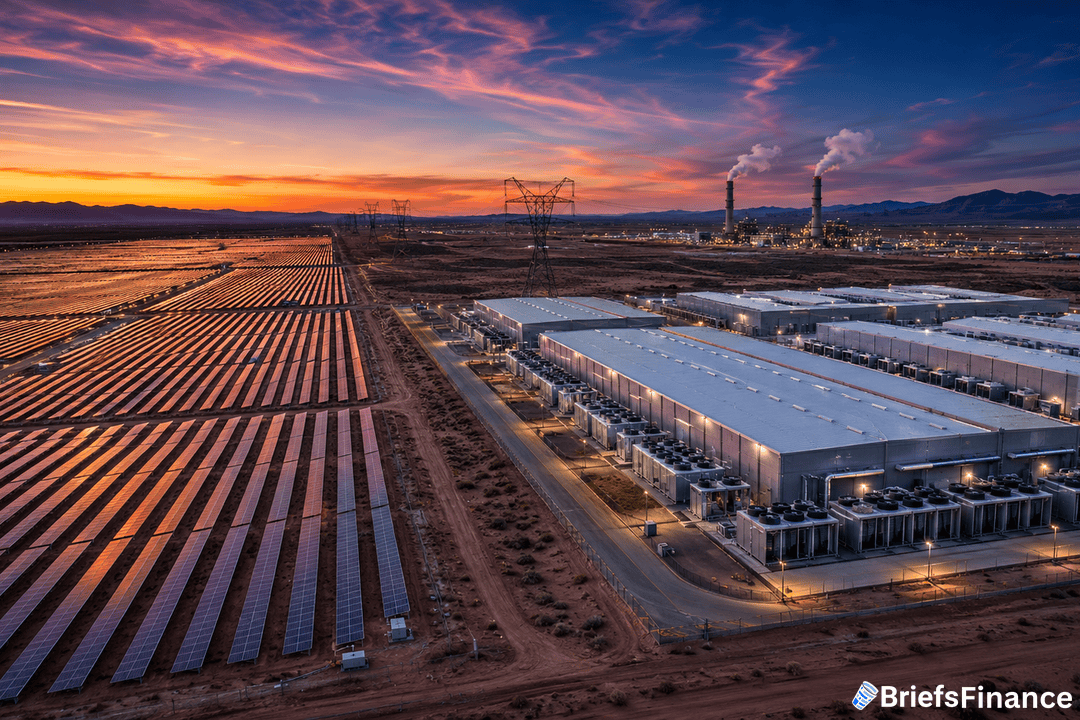
Solar is about to win the race for cheapest power on Earth.
But the AI boom is keeping fossil fuels alive anyway.
A new BloombergNEF report says solar will soon pass coal, oil, and natural gas. Within ten years, it will be the world's biggest source of power.
The shift is driven by money, not climate rules. Solar is just too cheap to skip.
That's the part that should reshape every energy bet on Wall Street.
Why Solar Is Winning
Two things have pushed solar costs into freefall.
The first is China. The country has spent years paying its solar makers and flooding the world with cheap panels.
The second is mass production. Each time the world doubles its installed solar capacity, prices fall again.
"In the case of solar, it has gone even faster than that," said Matthias Kimmel, head of energy economics at BloombergNEF.
The firm sees another 30% drop in solar prices by 2035. By 2050, solar will make more than twice the power that gas does.
Pakistan is the early proof. The country added 25 gigawatts of solar in two years. That came after gas prices spiked from the Russia-Ukraine war. When gas got pricey, solar got built fast.
If you want a five-minute read on what moves markets each morning, Market Briefs has you covered - and you get a free investing masterclass when you join.
Why Fossil Fuels Aren't Going Anywhere
Here's the catch. AI data centers run all day and night. Solar panels do not.
BloombergNEF says gas and coal will supply 51% of new power for data centers through 2050. The reason is simple - those plants can run without stopping.
Solar still needs backup when the sun goes down. That hands tech firms and data center builders a huge say in which power sources stay alive this century.
Other tech is circling for a piece of the pie. Google just bought $1 billion of long-life batteries from Form Energy.
Two more names had big IPOs this month. Geothermal startup Fervo Energy and nuclear firm X-energy both came out hot, which gives data center builders more options past solar and gas.
What To Watch
The battery market today looks like solar did in 2020.
Last year, 112 gigawatts of grid-scale batteries got built worldwide. BloombergNEF sees that number nearly tripling by 2035.
In Spain and Italy, standalone solar farms are no longer profitable. Too much daytime supply has crashed power prices. So builders are pairing solar with batteries to sell power at night.
The next big energy trade isn't picking solar over gas. It's figuring out who pairs them best.
One wild card the report didn't catch. The Iran War kicked off after BloombergNEF locked in its data, and higher oil and gas prices tend to push more countries toward solar - the same shift that drove Pakistan's recent build when gas prices spiked.
For data center builders, the message is the same. Pair solar with batteries, lean on gas and coal for round-the-clock power, and watch geothermal and nuclear gain ground as new options.
For investors, the next decade of energy money is being built right now - join 350,000+ readers getting Market Briefs every weekday morning, and a free 45-minute investing course is included as a bonus.