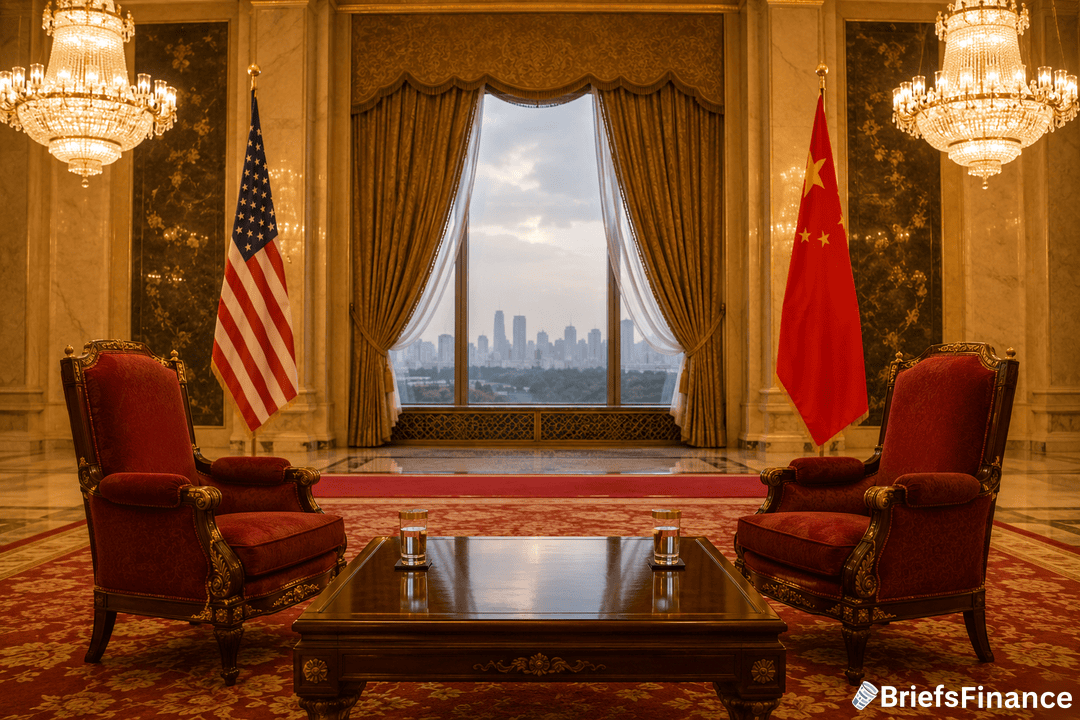
Investors waiting for big trade news from the Trump-Xi summit just got bad news, and Iran is taking up most of the room.
Treasury head Scott Bessent said the war is on the table - days after China hosted Iran's foreign minister in Beijing for the first time since fighting began in late February. That visit pushed oil lower and stocks higher on early hopes for a peace deal.
The CEO Trip Got Cut In Half
Trump's first China trip in 2017 brought close to 30 US CEOs, who together signed deals worth more than $250 billion.
This time the list could be half that size, per a person with direct knowledge of the planning. The White House also turned down a Chinese offer to set up CEO meetings, worried it would look too cozy with Beijing.
That's a sharp shift from Trump's Saudi trip last May, when more than 30 US CEOs went along.
Boeing CEO Kelly Ortberg is still on the list, with the planemaker chasing its first big China order in nearly a decade.
Citigroup's Jane Fraser said she'll go too, calling China a market where Citi has been around for 124 years.
Other world leaders have had bigger welcomes this year. Xi has hosted a dozen heads of state from places like the UK and South Korea, often with large business teams in tow. The shrunken US group will stand out.
What Could Still Get Done
Even with Iran in the spotlight, smaller wins are likely - Scott Kennedy at CSIS, a US think tank, expects deals on Chinese soybean and Boeing plane buys.
Trump may also pitch new bilateral trade and investment "boards" to handle big issues going forward.
What probably gets less time: tariffs, Taiwan, and US limits on selling chips to China. Those are Beijing's top three asks, and they look like they'll have to wait.
Why? China was the first big country to hit back when Trump rolled out his April 2025 tariffs, so any thaw on trade taxes was always going to take time.
China's tight grip on rare earth exports also looks safe at this meeting. Those rules hit every major economy, not just the US, and Beijing has little reason to ease up before the talks.
Both sides are also easing up on recent fights over tech, while looking at a deal on AI safety, per reports.
Why The Tone Could Still Shift
Even without big policy wins, the optics still matter. Michael Hart of the American Chamber of Commerce in China said US business has grown more cautious there since US strikes on Iran, and a handshake on stage could quietly reset that mood.
Ending the Iran war would be its own kind of trade win. Hai Zhao at the Chinese Academy of Social Sciences said it would be "a great relief to global business" - the kind of result that would define the summit.
What To Watch
The two countries traded fire in the Strait of Hormuz again this week, and a Chinese-owned oil tanker was reportedly hit a few days earlier. If the summit gives any path to peace, oil and stocks will react first.
The trade talks can wait their turn.