Free NewsletterPro Login

Saudi Arabia Just Posted Its Biggest Deficit Since 2018

Published May 6, 2026
Share:
Summary:
  • Saudi Arabia's first-quarter fiscal gap blew out to the widest level since 2018 after the Strait of Hormuz closure forced oil export cuts.
  • The Yanbu pipeline cap holds Saudi crude exports at about 5 million barrels a day, less than half its normal level.
  • Goldman Sachs already pegs the 2026 deficit at 6 to 6.6% of GDP, almost twice the official $44 billion plan.

Saudi Arabia has two ways to fix a tight budget. It can pump more oil. Or it can wait for prices to rise.

Brent is up. Saudi cannot ship enough barrels to take advantage. The Hormuz blockade caps how much oil the Kingdom can move out.

So the volume hit is what is breaking the budget.

The 5 Million Barrel Cap

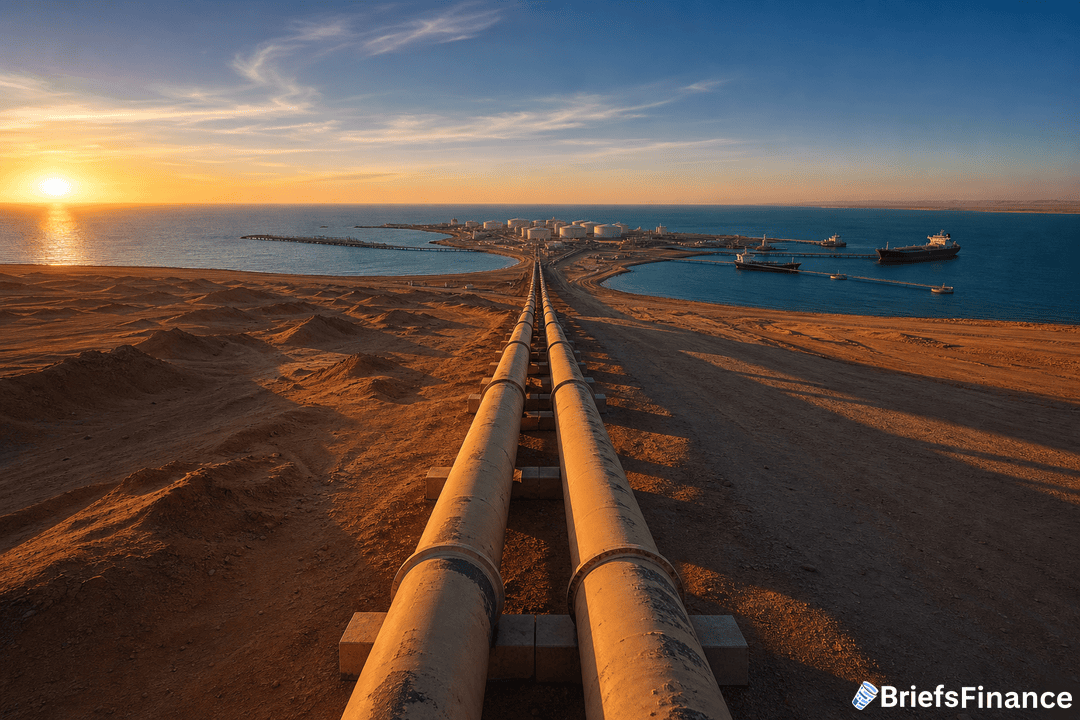
Saudi Arabia has only one working oil export route. The East-West pipeline runs from the Eastern Province to Yanbu on the Red Sea coast.

The pipeline can move about 7 million barrels a day at full tilt. Local refineries soak up about 2 million of that.

That leaves a hard cap of 5 million barrels for export. The Kingdom's OPEC+ quota is 10.2 million.

So half of Saudi Arabia's allowed output has nowhere to go. That stays true even if Riyadh wanted to flood the market.

The shipping data shows the squeeze. Saudi Aramco cut crude supply to Asian buyers by almost 39% from February to March, with shipments dropping from 7.1 million barrels a day down to 4.4 million.

The Breakeven Math

The IMF puts Saudi Arabia's fiscal breakeven at $86.60 a barrel. That is the oil price the Kingdom needs to balance the books.

Bloomberg Economics says the real number is closer to $94. That is once Public Investment Fund spending is added in.

With full PIF spending, the number climbs above $110.

Brent has been volatile, falling as low as $65 in early April before climbing back above $113 by early May. Higher prices help, but the Yanbu cap means Saudi cannot ship enough barrels to fully capture them.

Riyadh entered 2026 with a borrowing plan of about $58 billion. That plan was sized for a world where Hormuz was open.

The plan now looks too small. Goldman Sachs pegs the real deficit at 6 to 6.6% of GDP. That works out to roughly $80 to $90 billion.

Vision 2030 Megaprojects Slow

The big projects that define Vision 2030 were built around $250 billion of yearly oil money. NEOM, the Red Sea Project, and New Murabba all sit inside that pipeline.

None of those projects pencil out with capped exports and ongoing budget gaps. NEOM's The Line was paused in September 2025 with just 2.4 of its planned 170 kilometers built.

The Red Sea Project is also slowing builds by year-end. PIF's liquid cash had fallen to about $15 billion by late 2024, the lowest level in years.

Aramco then cut its 2025 dividend by about a third to $84.5 billion. That cut directly trimmed PIF's income.

What To Watch

Saudi Arabia entered 2026 with $438 billion in foreign cash reserves. That sounds like a lot.

The Kingdom burned through $109 billion of those reserves in under a year during the 2015 oil crash. It could still export at full capacity back then.

This time it cannot. The Yanbu cap is the new ceiling, and it does not lift on its own.

Saudi sovereign debt is also already past $300 billion. The pre-crisis plan put it on a path toward $350 billion by year-end.

Aramco's 2025 dividend cut and the slow pace at NEOM both add to the squeeze. Vision 2030 was the long bet. The short-term cash question is now more urgent.

Disclosure

Get Market Briefs delivered to your inbox every morning for free!

No fluff. No noise. No politics. Just finance news you can read in 5 minutes.

Blogs

May 5, 2026
How to Create Multiple Income Streams: A Beginner's Playbook
  • Most people rely on a single income stream from their job - which is also the most heavily taxed.
  • Multiple income streams come from a mix of cash flow, dividends, side businesses, real estate, and royalties.
  • The fastest path for most beginners is starting with one extra stream - usually dividends or a side hustle - and stacking from there.
Read More
May 5, 2026
The 60/40 Portfolio Explained: A Beginner's Guide
  • A 60/40 portfolio holds 60% in stocks and 40% in bonds (or other fixed income).
  • It's designed to balance growth from stocks with stability from bonds.
  • Your "right" mix depends on age, time horizon, income needs, and how well you sleep when markets drop.
Read More
May 5, 2026
How to Invest in Silver: A Beginner's Guide
  • Silver is both a precious metal and an industrial metal, used in solar panels, electronics, and medical tech.
  • Investors can buy silver four main ways: physical bars and coins, ETFs, mining stocks, or futures contracts.
  • Most beginners are best served by allocating a small slice of their portfolio to silver - usually between 1% and 3%.
Read More
May 1, 2026
Asset Allocation by Age: The Right Portfolio Mix at Every Stage of Life
  • Younger investors should hold mostly stocks because they have decades to recover from crashes and benefit from compounding.
  • Allocations gradually shift toward bonds and stable income as retirement approaches, but stocks remain important even past age 65 to outpace inflation.
  • Annual rebalancing is essential - it forces you to buy low and sell high while keeping your portfolio aligned with your actual life stage.
Read More
April 30, 2026
Stablecoin Explained: Why Some Cryptocurrencies Actually Aren't Volatile
  • Stablecoins are cryptocurrencies pegged to stable assets like the US dollar, giving crypto-style speed and access without the volatility of Bitcoin or Ethereum.
  • Fiat-backed stablecoins like USDC are the safest option, while algorithmic stablecoins have failed spectacularly and should generally be avoided.
  • Stablecoins fit a portfolio as cash reserves with better yields, a hedge against crypto volatility, and a fast, cheap rail for international transactions.
Read More
April 30, 2026
Buy Now, Pay Later Risks: Why This "Easy" Payment Method Is Dangerous to Your Wealth
  • Buy now, pay later services like Klarna, Affirm, and Sezzle are debt products designed to feel harmless while keeping users in a cycle of overspending.
  • BNPL exploits psychological debt blindness, triggers late fees, and damages credit scores without helping users build positive credit history.
  • Building real wealth means waiting 30 days, paying upfront when you have the cash, and avoiding systems built to extract money from your future income.
Read More
April 30, 2026
Dividend Payout Ratio: The Secret Metric That Shows If a Stock Is Safe or Risky
  • Dividend payout ratio is total dividends paid divided by net income, showing the percentage of earnings a company returns to shareholders.
  • A 20-50% payout ratio is generally safe and sustainable, while ratios above 75% often signal a dividend cut is coming.
  • High dividend yields can be warning signs, not opportunities - safety and dividend growth matter more than the headline yield number.
Read More
April 30, 2026
Ethereum for Beginners: What It Is and Why Smart Investors Are Paying Attention
  • Ethereum is a blockchain platform that runs smart contracts, while Ether (ETH) is the cryptocurrency that powers the network.
  • Use cases include decentralized finance, NFTs, gaming, supply chain tracking, and digital identity - many still experimental.
  • Most investors should treat Ethereum as a small allocation hedge using dollar-cost averaging, not a get-rich-quick lottery ticket.
Read More
April 30, 2026
Dollar Cost Averaging Strategy: How to Beat Emotion and Build Wealth Steadily
  • Dollar cost averaging means investing the same amount at regular intervals regardless of what the market is doing.
  • The strategy automatically buys more shares when prices are low and fewer when prices are high, lowering your average cost over time.
  • DCA removes emotion, eliminates the need to time the market, and turns volatility into a mathematical advantage for long-term investors.
Read More
April 30, 2026
The BRRRR Strategy: How to Build Real Estate Wealth Without Big Money Down
  • BRRRR stands for Buy, Rehab, Rent, Refinance, Repeat - a five-step framework for scaling real estate without saving for big down payments.
  • The strategy works by buying distressed properties below market value, adding value through smart renovations, and pulling out equity through refinancing.
  • Tax advantages like depreciation and mortgage interest deductions make BRRRR a powerful tool for owners willing to manage tenants and contractors.
Read More
1 2 3 20
Share via
Copy link












