Free NewsletterPro Login
Free Live Investors Workshop
Seats limited
Tue, Sep 29.
The dollar is losing value.
Here’s how investors can still profit.
Hosted By
Jaspreet Singh
Founder, Briefs Finance
X

Warning: Undefined variable $stocks in /var/www/briefs.co/htdocs/wp-content/plugins/oxygen/component-framework/components/classes/code-block.class.php(133) : eval()'d code on line 448

Warning: foreach() argument must be of type array|object, null given in /var/www/briefs.co/htdocs/wp-content/plugins/oxygen/component-framework/components/classes/code-block.class.php(133) : eval()'d code on line 448

Warning: Undefined variable $funds in /var/www/briefs.co/htdocs/wp-content/plugins/oxygen/component-framework/components/classes/code-block.class.php(133) : eval()'d code on line 472

Warning: foreach() argument must be of type array|object, null given in /var/www/briefs.co/htdocs/wp-content/plugins/oxygen/component-framework/components/classes/code-block.class.php(133) : eval()'d code on line 472
/* the link was here */

Elon Musk Just Told A Jury That Most Crypto Coins Are Scams

Published May 1, 2026
Share:
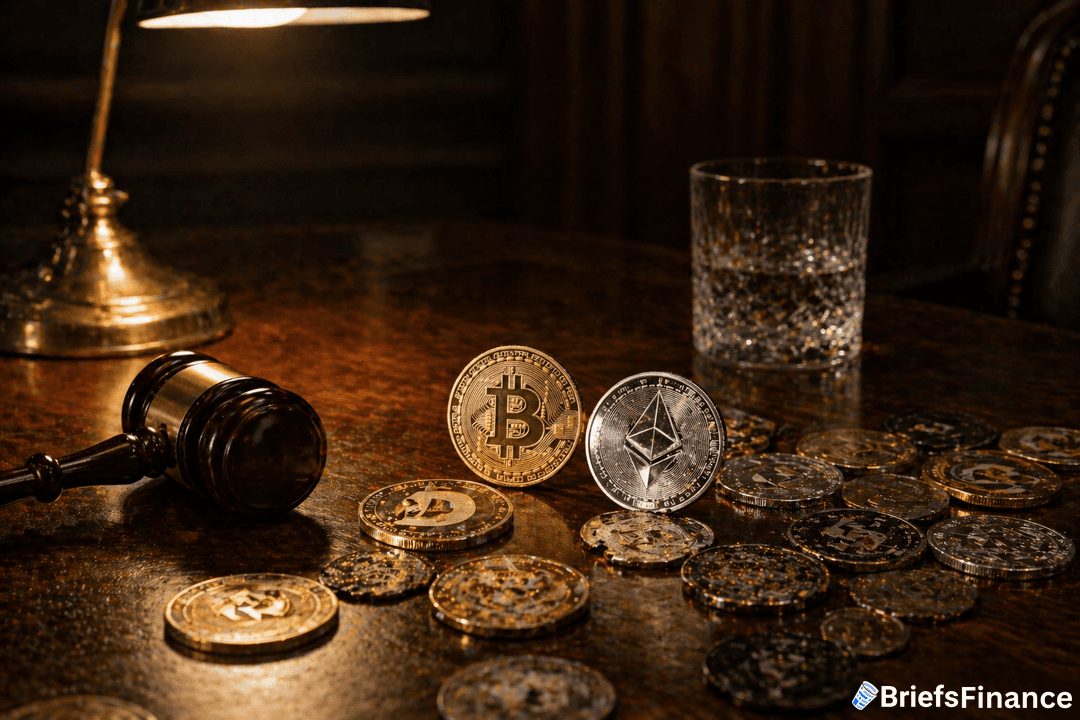
Assorted cryptocurrency coins, including Bitcoin and Ethereum, are scattered on a wooden table near a gavel, a glass of water, and a lamp in a dimly lit room.
Summary:
  • Elon Musk testified that most cryptocurrencies are scams during the OpenAI trial.
  • The case revealed that OpenAI once thought about raising money through a crypto ICO.
  • Tesla still holds 11,509 Bitcoin. Musk personally owns Bitcoin, Ethereum, and Dogecoin.

Elon Musk took the stand in the OpenAI trial. He explained crypto to the jury.

His take: "Some of them have merit, but most of them are scams."

That is a striking line. Musk owns Bitcoin, Ethereum, and Dogecoin himself. His firm Tesla still holds more than 11,000 Bitcoin on its books.

The OpenAI Side Of The Story

The crypto line came up in talk about OpenAI's early days. Court files showed the firm once thought about its own ICO to raise money.

ICOs, or initial coin offerings, were a hot tool at the time. They have since fallen out of favor.

OpenAI never went through with the plan. Instead, it shifted to a for-profit model tied to Microsoft. That shift is the heart of Musk's lawsuit.

Musk says CEO Sam Altman and OpenAI broke their founding non-profit deal. OpenAI says Musk agreed to the change at the time.

The trial in California is set to run about three weeks. Musk wants leadership changes at OpenAI. He also wants damages above $134 billion. The firm is preparing for a possible IPO.

Jury selection turned up generally negative views of Musk. The jurors said they could be fair.

Why It Matters For Crypto

Musk's words tend to move crypto markets. A single Dogecoin tweet has done it before.

Telling a jury most coins are scams is a bigger swing than a tweet. It does not change his actual holdings, but the message lands hard.

Tesla has not changed its Bitcoin position since early 2025. It sold 75% of its stash back in 2022.

The current stash is worth about $1 billion at recent prices. It dipped closer to $786 million when Bitcoin slid 22% in the first quarter.

Musk's crypto take on the stand also lined up with new heat on Sam Altman's own crypto project. That project is Worldcoin. It has drawn fresh claims of unfair token rules in recent days.

That backdrop matters. The trial sits inside a much bigger fight over the future of OpenAI itself. The firm has been prepping for a stock listing. The last private round priced it at $852 billion.

What To Watch

The OpenAI verdict will shape one of the most valuable private firms in the world. A future IPO and the firm's non-profit roots are both on the line.

If the jury sides with Musk, OpenAI may have to unwind parts of its for-profit setup. That would change how Microsoft and other backers get paid. If it sides with OpenAI, the IPO path likely speeds up.

For crypto, the more interesting moment was a one-line aside about scams. It landed inside a separate lawsuit. When the loudest tech founder draws a line between Bitcoin and "everything else," investors tend to listen.

Coin prices held steady on the day of the testimony. But trial moments like this often show up later in flow data and altcoin pricing. That is true for projects with thin volume and heavy retail interest.

For now, the headline news is the trial. The crypto angle is the side story.

But the side story may matter more for retail buyers. The man who runs Tesla just told a U.S. jury most coins are scams. That is the kind of line that sticks.

Disclosure

Recent News

1 2 3 … 88

Get Market Briefs delivered to your inbox every morning for free!

No fluff. No noise. No politics. Just finance news you can read in 5 minutes.

Blogs

September 29, 2026
Why Is Gold Going Down? A 5.2% Treasury Yield Just Took Its Job
  • President Trump rejected Iran's deal to reopen the Strait of Hormuz, oil prices jumped back up, and gold fell instead of rising.
  • Treasury yields hit their highest level in more than 20 years, so investors sold gold and bought Treasuries that pay interest.
  • Higher Treasury yields make the national debt, mortgages, car loans, and credit cards more expensive, with the Fed's next rate decision due October 28.
Read More
September 28, 2026
The Strategic Bitcoin Reserve: Why the Government Wants Bitcoin to Explode
  • The US government holds about 328,000 Bitcoin, worth roughly $25 billion, and since a 2025 executive order it keeps seized coins instead of selling them.
  • Washington wants a bigger pile of assets so its $40 trillion national debt looks smaller next to them, which lets it keep borrowing and spending.
  • Bitcoin's wild price swings, and a government holding a coin built to escape governments, are the two risks investors need to watch.
Read More
September 25, 2026
BRIEFS EXCLUSIVE: 43% Of Respondents Say Bills Outran Their Income Over Past Two Years
  • 43% of the 494 Market Briefs readers surveyed said their bills grew faster than their income over the past two years, even though 79% could cover a surprise $5,000 expense tomorrow.
  • Half of readers own gold or crypto, the two classic bets against a weaker dollar, and only 13% bought nothing at all in the last 12 months.
  • The median reader says it takes $150,000 a year to feel financially secure, about $62,000 above the U.S. median household income.
Read More
September 25, 2026
The Economy Is Booming. So Why Did Stocks and Bonds Fall Together?
  • S&P Global says the US economy is growing at its fastest rate since 2021, with corporate profits up 28.9% in a year, almost four times the historical average.
  • Stocks and bonds fell at the same time, which is not how the two markets normally behave, because Treasury yields above 5% now compete with stocks for investors' money.
  • Jaspreet Singh lays out three ways to invest through a shift like this: always be buying, buy the crash, or follow the money before it hits the headlines.
Read More
September 24, 2026
The 2026 Economic Reset Is Starting: Are We in a Recession, or Is the Pain Still Ahead?
  • The Federal Reserve has flipped from stimulating the economy to fighting inflation with higher interest rates, while the White House still wants growth at almost any cost.
  • The national debt tops $40 trillion, has outgrown the entire U.S. economy, and its interest payments are now the government's fastest-growing expense.
  • Higher rates bring pain for private equity, private credit, and speculative assets, but they open opportunities for investors holding cash, treasuries, and value assets.
Read More
September 23, 2026
Are We in a Recession? Without AI, America Might Already Be in One - and Washington Knows It
  • The White House attributes about three quarters of U.S. economic growth to AI, and many believe the economy would already be in a recession without it.
  • Washington has three reasons it cannot let the AI boom slow down: staying the world's superpower, outgrowing $40 trillion in national debt, and protecting a government stock portfolio worth billions.
  • Every market goes through booms and busts, and investors who understand the cycle get to buy the downturn instead of panic-selling with the crowd.
Read More
September 22, 2026
Will Interest Rates Go Down in 2026? Where the Money Moves Either Way
  • The Fed is leaning toward higher rates to fight 4% inflation, while the White House and a cracking job market push the other way.
  • If rates rise, money has tended to move toward short-term Treasuries, floating-rate loans, energy, banks and dividend payers.
  • If rates fall, it has tended to move toward gold, silver and Bitcoin, real estate, small caps, the S&P 500 and speculative bets.
Read More
September 21, 2026
How the Federal Reserve Makes Money - and Why It Just Posted Its Biggest Loss Ever
  • For 109 years the Federal Reserve created money, lent it to the U.S. government and handed the interest it collected back to Washington - almost $1 trillion in the decade starting in 2011.
  • Pandemic-era lending locked the Fed into earning about 2% on trillions of dollars while it now pays banks around 4%, producing a record loss of hundreds of billions in 2026.
  • The Fed covers its losses by creating money and the government covers its lost revenue by borrowing, and both feed the inflation that eats at the dollars in your account.
Read More
September 18, 2026
Kevin Warsh Just Defied Trump: What the Fed Rate Hike Means for Your Money
  • The Fed raised rates for the first time since 2023 in a unanimous vote led by Kevin Warsh, the chairman President Trump appointed to cut them.
  • Higher rates make the $40 trillion national debt, business loan resets and mortgages more expensive, but they strengthen the dollar and pay investors holding cash.
  • The war with Iran is pushing up oil, grocery and chip prices, another hike is likely in 2026, and recession talk is about to get louder.
Read More
September 17, 2026
Why America Bailed Out the Yen: The Japan Carry Trade, the Dollar and Your Mortgage Rate
  • In July 2026 the US sent money to steady the yen because Japan is the largest foreign owner of US debt, and Washington needs Japan to keep lending.
  • For decades the Japan carry trade let Wall Street borrow yen at essentially 0% and pour it into US stocks, real estate and Treasuries, and rising Japanese rates are shutting that off.
  • A weaker yen means fewer buyers for the dollar and for US debt, which pushes Treasury rates up and drags mortgage, car loan and credit card rates up with them.
Read More
1 2 3 … 27
Share via
Copy link












