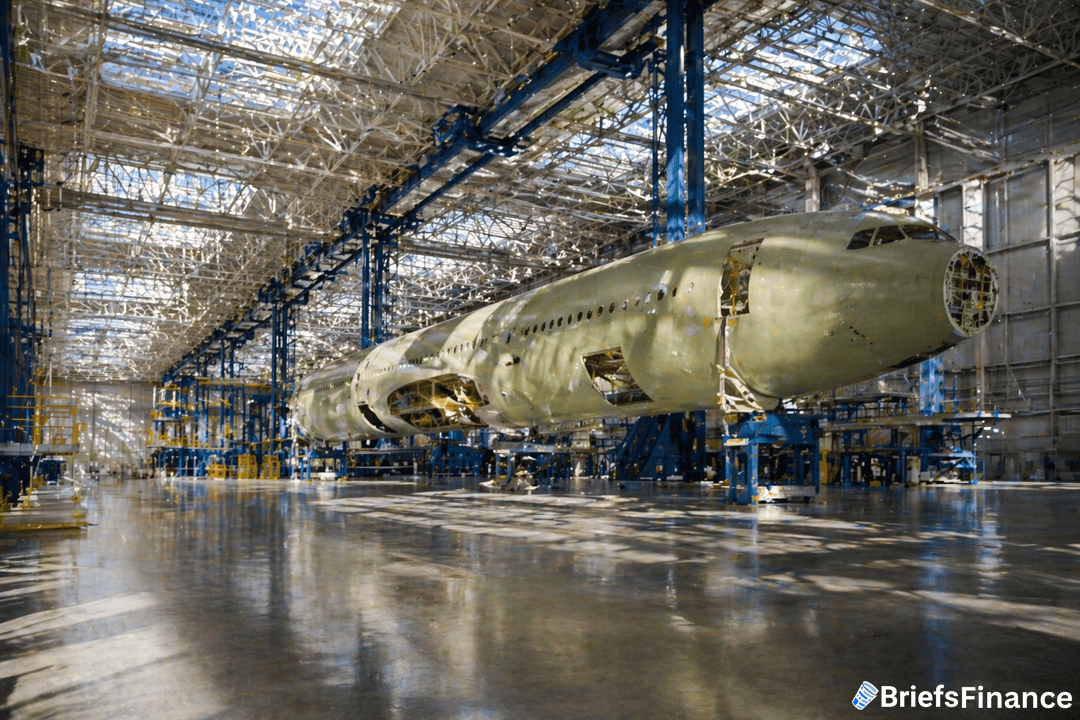
Boeing (BA) posted a much smaller Q1 loss than Wall Street expected on Wednesday morning, sending shares about 3% higher in premarket trading. CEO Kelly Ortberg also confirmed that 737 Max production is ramping from 42 to 47 planes per month this summer.
The adjusted loss came in at $0.20 per share, far narrower than the $0.83 loss analysts were modeling. Revenue climbed 14% year over year to $22.22 billion, ahead of the $21.78 billion consensus.
Production Is Finally Moving Up
Boeing has been stuck at 42 Max aircraft per month since the January 2024 door-plug blowout, when the FAA capped output while safety reviews played out. That cap has been one of the biggest pressure points on earnings, because every aircraft over breakeven is almost pure gross profit.
Moving to 47 per month this summer is a meaningful unlock, though any further increases will still need FAA approval. Boeing also said it still expects to certify the 737 Max 7 and Max 10 later this year, with deliveries starting in 2027.
Segment Breakdown
Commercial planes delivered 143 aircraft in Q1, up 10% year over year, with commercial revenue at $9.2 billion. The unit still posted an operating loss, but the trend line is finally pointing the right way.
Defense and services:
- Defense revenue hit $7.6 billion, up 21%.
- Services revenue was $5.37 billion, up 6%.
- Net loss narrowed to just $7 million from $31 million a year earlier.
What Ortberg Is Seeing
Despite the Iran war and the resulting shock to global travel demand, Ortberg said Boeing has not seen any slowdown in aircraft orders. He told employees he is proud of how the team has "pulled together" and kept the company on plan through another bumpy quarter.
Airlines are still placing long-dated orders because aircraft take years to deliver, and fleet planning runs on decade-long cycles. Current fuel pressure is not yet reshaping that pipeline, which gives Boeing a rare window of visibility into 2027 and 2028 deliveries.
The Quality Narrative
Ortberg has spent most of his first year stabilizing the manufacturing process after the door-plug episode, and quality metrics are finally moving the right way. Boeing's own internal defect rates on Max fuselages are back near pre-pandemic levels, which is part of why the FAA is open to lifting the production cap.
Supply chain health also looks steadier, with Spirit AeroSystems delivering on its post-acquisition integration timeline. That reduces a major risk factor hanging over 737 Max output into the second half.
What to Watch
The next key marker is whether Boeing actually hits 47 Max planes per month by August without running into new quality issues. Any slip there would push full-year deliveries down and pull cash flow with them.
Certification of the Max 7 and Max 10 is the other milestone traders are watching most closely this year.