Pro Login

Higher Rates Are Quietly Reshaping Who Builds Wealth in America

Briefs Media Newspaper Logo Market Briefs
Nate Gregory
Published Apr 11, 2026
Share:
Summary:
  • Moody's chief economist Mark Zandi called the spending gap between rich and poor a deep, lasting shift - not a passing phase.
  • Investors who own income-producing assets like rental homes and dividend stocks are thriving in a high-rate world while borrowers get squeezed.
  • Top earners now drive a record share of all spending, which means any drop in their confidence could shake the broader economy.

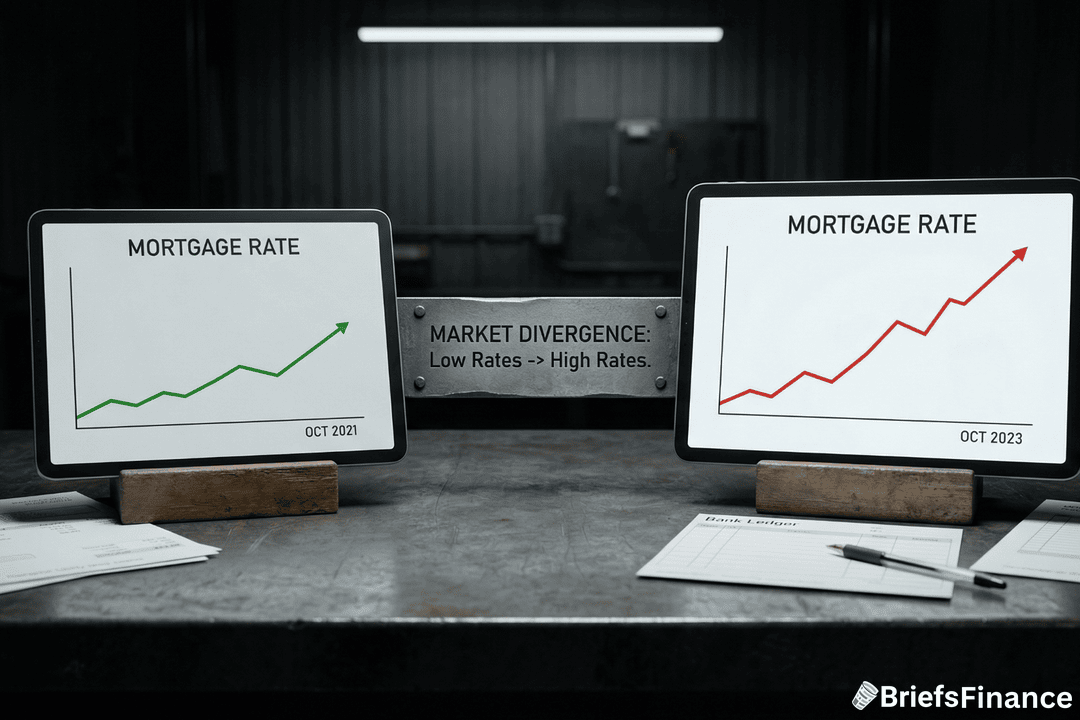
Rates have stayed higher for longer than most investors expected. And the effects are landing very differently depending on where you sit.

If your money is in things that pay you back — rental homes, stocks that pay out, bonds, money market accounts — high rates have been a plus. Your cash earns more just by sitting there.

If you're leaning on credit to close the gap between your pay and your bills, it's the other way around. Every balance costs more.

Every car loan costs more. Every debt with a moving rate costs more each month.

Not a Phase — A Lasting Shift

Mark Zandi, Moody's top economist, put it bluntly. He called the growing gap between rich and poor spending a deep, lasting change — not a blip from rate moves that will fix on its own.

Rich investors are booking fancy trips and eating at nice spots. Lower-income families are cutting back on the basics.

That's not a blip. That's a new way money moves through the economy.

The Asset-Owner Edge

The math isn't hard. Own a rental and your tenants cover your loan while the home gains value.

Hold stocks that pay you out and you get cash no matter what the market does day to day.

Cash in a high-yield savings or money market account earns 4–5% right now. That sounds boring — until you think about it as free money on cash that's just parked.

If you don't own any of those things, none of those perks apply. You just pay more to borrow.

Why It Matters for Spending

Top earners now make up a record share of all spending. That means the economy hangs on their mood more than ever.

A drop in stock prices or a shift in mood among this group could pull back spending faster than a broad slowdown among middle earners. And because their spending feeds company earnings — which feed back into stock prices — any dip could turn into a loop.

What to Watch

Where spending growth sits matters more than the total right now. The engine is running on one part — and that part runs on stock gains.

Disclosure

Get Market Briefs delivered to your inbox every morning for free!

Market briefs opt-in (#63)
No fluff. No noise. No politics. Just finance news you can read in 5 minutes.

Blogs

April 10, 2026
Micron Stock: The AI Memory Play Most Investors Are Missing
  • Micron (MU) is the only U.S. company that makes HBM chips - the short-term memory layer that AI systems need to run.
  • By early 2026, data centers were using about 70% of all memory chips made in the world, creating an 18-month backlog for new orders.
  • Micron's DRAM - or short-term memory chip - revenue jumped 69% year over year, and the company shifted away from consumer products to focus almost entirely on AI.
Read More
April 10, 2026
What Is Working Capital? What Investors Need To Know
  • Working capital is current assets minus current liabilities - it shows if a business can pay its short-term bills.
  • You find it on a company's balance sheet inside its 10-K report.
  • Changes in working capital show up on the cash flow statement and affect how much cash a business really makes.
Read More
April 9, 2026
What Is a Meme Stock? A Simple Guide for New Investors

You've probably heard the term "meme stock" thrown around on […]

Read More
April 9, 2026
Enterprise Value Formula: What It Is and How to Calculate It
  • Enterprise value (EV) shows what a company is really worth - debt and cash included - not just its stock price
  • The enterprise value formula is: Market Cap + Total Debt - Cash and Cash Equivalents
  • Investors use EV with metrics like EBITDA to compare stocks more fairly than market cap alone
Read More
April 8, 2026
Return on Equity: What It Is and How to Use It
  • Return on equity (ROE) measures how much profit a company earns for every dollar of shareholder equity
  • The formula is simple: net income divided by shareholder equity
  • A higher ROE can signal a company that is good at turning investor money into profit - but it is not the full picture
Read More
April 4, 2026
Personal Finance Books That Actually Teach You to Build Wealth

Most investors grow up hearing the same financial advice. Study […]

Read More
April 4, 2026
How to Reduce Taxable Income: 6 Strategies Investors Actually Use

The tax code in the United States is over 2,000 […]

Read More
April 4, 2026
What Is a High-Yield Savings Account - and Is It Worth It?

Most banks pay you almost nothing to hold your money. […]

Read More
April 3, 2026
Best Stocks to Buy Now: A Smarter Way to Think About It

Most investors start their journey the same way. They Google […]

Read More
April 3, 2026
How to Avoid Capital Gains Tax: 7 Legal Strategies Every Investor Should Know

Warren Buffett earned $704 million in dividends in 2021. His […]

Read More
1 2 3 16
Share via
Copy link












