You want your money to work for you.
That can mean two things:
Grow in value.
Or investments that pay you.
While some stocks can do both, others specialize in dividends and cashflow.
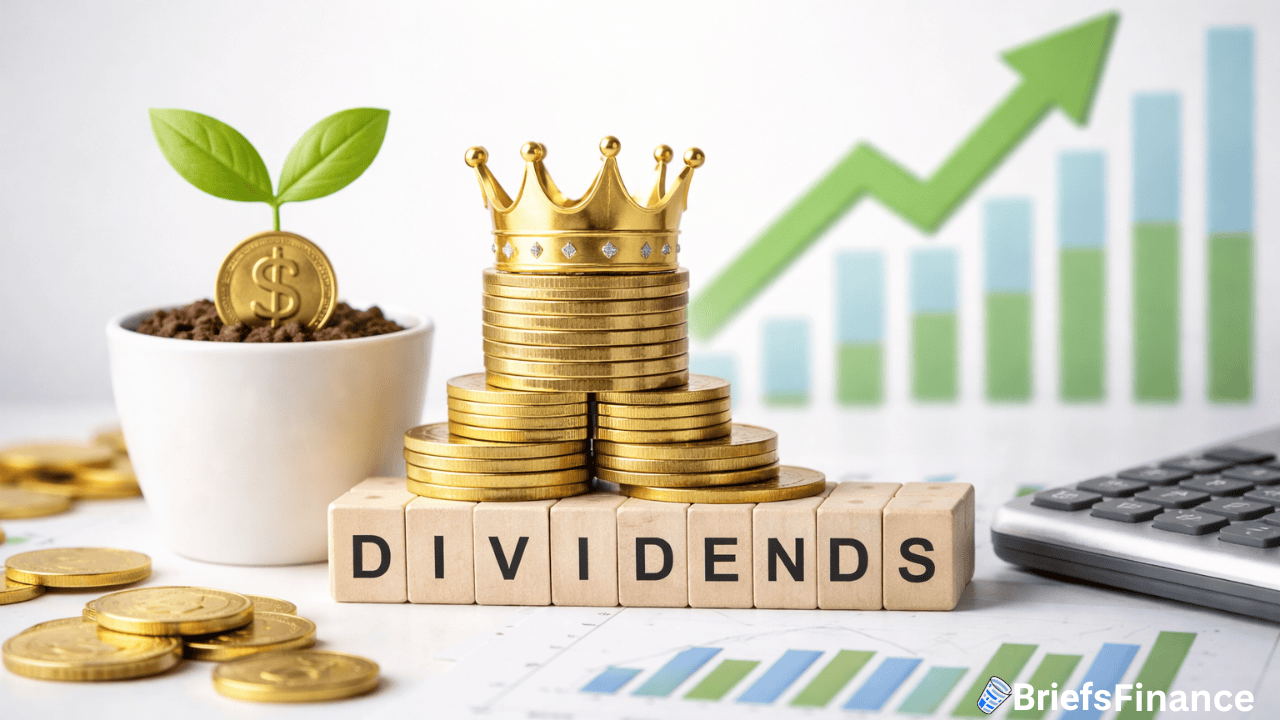
Dividend Kings do exactly that.
These are the royalty of income investing. The most elite dividend stocks on the planet.
Dividend Kings are companies that have increased their dividend payments for at least 50 consecutive years.
Many on our list below have increased their dividend for longer than 50 years.
Let’s break down why dividends matter, how to invest in dividend stocks, and the full list of Dividend Kings right now.
But first: How do you craft a dividend strategy in this market that may make you money?
A rising dividend only counts if it outruns rising prices. Our CEO Jaspreet Singh shows how on September 29th in his free workshop on how to profit from a dollar that is losing its value.
What Is a Dividend?
Before we crown any kings, we need to understand what a dividend actually is.
A dividend is cash that a company pays to its shareholders just for owning the stock. It's a portion of the company's profits distributed directly to investors.
Think of it like this: You own a piece of a profitable company. Instead of keeping all the profits to themselves, management decides to share some with you. That share is your dividend.
Not every company pays dividends.
Growth companies like Amazon typically reinvest everything back into the business to fuel expansion.
But mature, profitable companies often pay dividends because they generate more cash than they need for operations.
Here's how it works: If you own one share of a company trading at $100 with a 4% dividend yield, you get $4 per year just for holding that stock.
Usually paid quarterly, you'd receive $1 every three months.
Own 10 shares? You get $40 per year.
Own 100 shares? That's $400 annually.
Own 1,000 shares? Now we're talking $4,000 in passive income.
The more shares you stack, the more money flows into your account. And this is in addition to any price appreciation the stock experiences.
What Makes a Company a Dividend King?
Any company can pay a dividend. But maintaining and growing that dividend for decades?
That's rare.
A Dividend King is a company that has increased its dividend payment every single year for at least 50 consecutive years.
Think about everything that's happened in the last 50 years:
- Multiple recessions.
- The dot-com crash.
- The 2008 financial crisis.
- The COVID pandemic.
- Inflation spikes.
- Interest rate cycles.
- Technological disruption.
Through all of that chaos, dividend kings kept increasing their payouts to shareholders. That's not luck. That's business excellence.
Dividend Kings vs. Dividend Aristocrats
You might have heard about dividend aristocrats. They're the slightly less elite cousin of Dividend Kings.
Dividend aristocrats have increased their dividends for at least 25 consecutive years and must be part of the S&P 500.
That's impressive, but it's only half the track record of a Dividend King.
Dividend kings have no S&P 500 requirement. They just need that 50-year streak of consecutive dividend increases.
Many are in the S&P 500, but some are smaller companies that have quietly delivered for shareholders year after year.
There’s also dividend achievers, who have increased their dividend for at least 15 years.
But only the most elite subset of these companies eventually become Dividend Kings after another 25 years of increases.
The Current Dividend Kings List (2026)
As of 2025, there are 55 companies that have earned the Dividend King designation.
Here's the complete list with their stock tickers, years of consecutive dividend increases, and current dividend yields:
| Company | Ticker | Years Increasing Dividend | Current Yield |
| Hormel Foods | HRL | 59 | 4.8% |
| Tootsie Roll | TR | 58 | 0.8% |
| Stepan | SCL | 57 | 3.4% |
| MSA Safety | MSA | 57 | 1.3% |
| Stanley Black & Decker | SWK | 56 | 4.9% |
| H2O America | HTO | 56 | 3.4% |
| Federal Realty | FRT | 56 | 4.6% |
| California Water Service | CWT | 56 | 2.5% |
| Commerce Bancshares | CBSH | 56 | 2.1% |
| ABM | ABM | 56 | 2.4% |
| Sysco | SYY | 55 | 2.7% |
| Universal | UVV | 54 | 6.1% |
| National Fuel Gas | NFG | 54 | 2.5% |
| Altria | MO | 54 | 6.5% |
| H.B. Fuller | FUL | 54 | 1.6% |
| Black Hills | BKH | 53 | 4.3% |
| Tennant | TNC | 52 | 1.5% |
| Target | TGT | 52 | 5.0% |
| PPG | PPG | 52 | 2.8% |
| Middlesex Water | MSEX | 52 | 2.3% |
| Illinois Tool Works | ITW | 52 | 2.6% |
| W.W. Grainger | GWW | 52 | 0.9% |
| Gorman-Rupp | GRC | 52 | 1.6% |
| Canadian Utilities | CDUAF | 52 | 4.7% |
| Becton Dickinson | BDX | 52 | 2.2% |
| Abbott | ABT | 52 | 1.8% |
| AbbVie | ABBV | 52 | 2.9% |
| RPM | RPM | 51 | 1.9% |
| PepsiCo | PEP | 51 | 3.7% |
| Nucor | NUE | 51 | 1.7% |
| Kimberly-Clark | KMB | 51 | 4.2% |
| Archer Daniels Midland | ADM | 51 | 3.2% |
| Walmart | WMT | 51 | 0.9% |
| S&P Global | SPGI | 51 | 0.8% |
| Fortis | FTS | 51 | 3.4% |
| Consolidated Edison | ED | 50 | 3.4% |
| United Bankshares | UBSI | 50 | 4.2% |
| Automatic Data Processing | ADP | 50 | 2.2% |
| RLI | RLI | 50 | 1.1% |
Note: This list includes companies with 50+ years of consecutive dividend increases as of 2025. Two companies recently joined the list: Automatic Data Processing and MGE Energy.
Why Dividend Kings Matter for Investors
A 50-year track record of dividend increases tells you several things about a company:
Strong Business Model
You can't fake a 50-year streak. These companies have proven business models with durable competitive advantages.
They've weathered recessions, market crashes, technological changes, and every other challenge imaginable while still generating enough profit to pay shareholders more every year.
Reliable Management
Management teams come and go, but Dividend Kings maintain a culture of returning cash to shareholders.
The commitment to that dividend isn't just one CEO's decision - it's embedded in the company's DNA.
Inflation Fighter
A 4% yield today that grows 5% annually will outpace most inflation over time.
Unlike bonds that pay a fixed amount forever, dividend growth stocks help you maintain purchasing power as prices rise.
Predictable Cash Flow
When you're building an income portfolio, predictability matters.
Dividend Kings have demonstrated they can maintain and grow dividends through thick and thin. That reliability is worth a lot.
Compound Growth Machine
When you reinvest those dividends, you buy more shares.
Those shares generate more dividends. Which buy even more shares.
It's a beautiful snowball effect that compounds your wealth over time.
The Power of Dividend Reinvestment
Let's look at how dividend reinvestment actually works using our earlier example.
Say you buy a Dividend King trading at $100 per share with a 4% yield. That generates $4 per year in dividends per share.
With 26 shares costing $2,600, you generate about $104 per year in dividends. That's enough to buy one additional share annually.
Here's where it gets interesting:
Year 5: You now own 31 shares generating $124 annually.
Year 10: You own 38 shares generating nearly $152 annually.
That same $2,600 investment, with no additional money added, is now producing meaningful income.
And this assumes the stock price hasn't grown at all - just the power of reinvesting dividends.
Most brokerages offer automatic dividend reinvestment plans (DRIPs) that automatically use your dividend payments to buy more shares.
Some even offer fractional shares so every penny gets reinvested.
Adding Monthly Contributions
Now let's kick it up a notch. What if you're consistently adding to your position?
Starting with 26 shares ($2,600) and adding just $100 per month:
Year 5:
- Shares owned: 86.
- Portfolio value: $12,400.
- Total invested: $8,600.
- Quarterly dividend: $120.
Every quarter you're getting $120 just for holding the stock.
Year 10:
- Shares owned: 144.
- Portfolio value: $29,300.
- Total invested: $14,600.
- Quarterly dividend: $280.
Over $1,100 per year in dividend income.
Year 20:
- Shares owned: 265.
- Portfolio value: $105,000.
- Total invested: $26,600.
- Quarterly dividend: $1,000.
Year 30:
- Shares owned: 417.
- Portfolio value: $326,000.
- Total invested: $38,600.
- Quarterly dividend: $3,155.
That's $12,620 per year in dividend income from one stock. With just $100 per month invested consistently.
And remember - this is for a single stock. A properly diversified income portfolio would have multiple dividend kings across different sectors, multiplying this effect while reducing risk.
What Sectors Do Dividend Kings Come From?
Consumer Staples (like PepsiCo, Kimberly-Clark, Hormel)
People need toothpaste, toilet paper, and food regardless of the economy. These companies have predictable demand that supports steady dividends.
Industrials (like Illinois Tool Works, W.W. Grainger, Stanley Black & Decker)
Companies making essential industrial products and equipment that businesses need to operate.
Healthcare (like Abbott, AbbVie, Becton Dickinson)
Aging populations and consistent healthcare demand make these businesses resilient dividend payers.
Utilities (like Consolidated Edison, Fortis, Black Hills)
Regulated businesses providing electricity, gas, and water. Stable demand and predictable cash flows make them natural dividend payers.
Financials (like S&P Global, Commerce Bancshares)
Banks and financial services companies generate consistent fees and interest income.
Notice what's missing? Technology companies.
Information technology and communications sectors have zero Dividend Kings.
Tech companies typically reinvest profits for growth rather than paying dividends. That's fine for growth investors, but income investors look elsewhere.
The Risks You Need to Know
Dividend kings aren't risk-free. Even with 50-year track records, things can go wrong.
Dividend Cuts Are Possible
Companies can pause or reduce dividends anytime.
During the COVID pandemic, many companies cut dividends to preserve cash.
Even some former dividend aristocrats lost their status. Exxon Mobil kept its dividend flat in 2020 for the first time since the 1980s but didn't cut it entirely.
Interest Rate Sensitivity
When interest rates rise, dividend stocks can become less attractive compared to bonds and savings accounts offering higher yields.
This can pressure stock prices even if the dividend itself doesn't change.
Concentrated Risk
If you put too much in one stock or sector, you're vulnerable. Energy stocks fell in 2020 when oil prices crashed.
REITs in 2008 during the housing crisis. Focusing too much on just income assets could lead to losses if those companies run out of cash.
Inflation Erosion
While dividend growth helps fight inflation, there's no guarantee dividends will grow faster than inflation. Some years they won't keep pace.
Tax Considerations
Dividends are taxable income. In a taxable brokerage account, you pay taxes on dividends the year you receive them, even if you reinvest them.
Qualified dividends get preferential tax treatment (0%, 15%, or 20% depending on income), but this still impacts your returns.
The Bottom Line on Dividend Kings
Dividend Kings represent the pinnacle of income investing. These 55+ companies have proven they can deliver for shareholders through literally any economic environment imaginable.
A 50-year streak of increasing dividends isn't luck - It's the kind of track record that should make any investor pay attention.
Dividend kings aren't flashy. But they'll quietly pay you quarter after quarter, year after year, while you focus on living your life.
But keep in mind: Investing has risks. Just because these companies have been paying a dividend, doesn’t mean future dividends or increases are guaranteed.
Companies can stop paying anytime, as they are not required to pay a dividend at all.
Plus, Dividend Kings typically do not grow in share price as quickly as a tech company. So while you may earn regular dividends, you may give up huge price gains.
In the end, only you can decide what is right for your portfolio.
So always do your own research and due diligence before investing, and keep your goals, risk tolerance, and time horizon in mind.
Decades of dividend growth mean little if the dollar shrinks faster. Join our CEO Jaspreet Singh on September 29th for a free workshop on how to profit from a dollar that is losing its value.