Free NewsletterPro Login

Tesla Ends Production of Model S and X, Shifts to Robot Manufacturing

A stylized illustration of a cylindrical cup with blue arrows and lines indicating a swirling or rotational motion inside the cup.
Published Jan 28, 2026
Share:
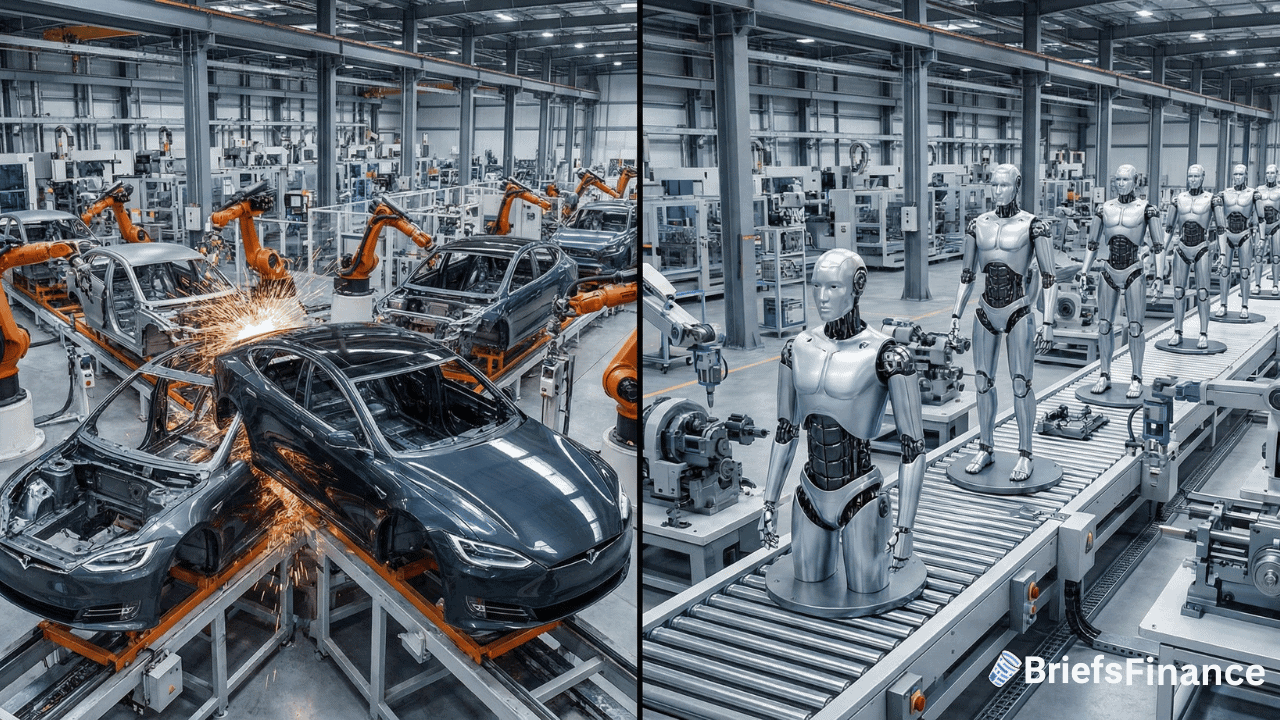
Industrial robots assemble cars, such as the Tesla Model S, on a factory line (left), while humanoid robots are assembled on a separate line (right); both scenes showcase advanced robot manufacturing and automation in industry.
Summary:

  • On January 28, 2026, Elon Musk announced Tesla will stop making Model S and X vehicles.
  • The Fremont factory will be repurposed to produce Optimus humanoid robots, with a production capacity of 1 million units per year.
  • The Model S debuted in 2012 and the Model X in 2015; both are being phased out due to rising competition in the EV market.

Elon Musk's Announcement

During a call on January 28, 2026, Tesla CEO Elon Musk stated that the company is ending production of its Model S and X vehicles.

Musk mentioned that it's time for these models to conclude with what he called an "honorable discharge." He encouraged potential buyers to order these models while they are still available.

Transition to Robot Manufacturing

The Fremont factory in California will be converted to manufacture Optimus humanoid robots. Musk disclosed that the new line is designed to produce 1 million units per year.

He emphasized that this new production line will require a completely new supply chain, distinct from what was used for the Model S and X.

Impact on Tesla's Sales

Tesla's decision to phase out the Model S and X comes amid increased competition in the electric vehicle market.

The Model S was first sold in 2012, followed by the Model X in 2015. Over recent years, Tesla has cut prices on these models as competition has intensified.

In its 2025 earnings report, Tesla experienced its first annual revenue decline in history, with sales falling in three of the last four quarters.

The company revealed that its Model 3 and Model Y accounted for a staggering 97% of its total 1.59 million deliveries last year.

Future Plans for Optimus

Tesla aims to unveil the third generation of its Optimus robot in the first quarter of 2026.

This new version is intended for mass production and is part of Musk's vision for the company's future, which includes a shift away from traditional electric vehicles toward advanced robotics.

What’s Next for Tesla?

With the shift away from the Model S and X, Tesla plans to increase its workforce at the Fremont facility. Musk stated that this will lead to a significant increase in output, focusing on the development and production of the Optimus robots.

As Tesla pivots to this new venture, it will be interesting to see how this impacts the company's overall strategy and market position.

Disclosure

Get Market Briefs delivered to your inbox every morning for free!

No fluff. No noise. No politics. Just finance news you can read in 5 minutes.

Blogs

May 1, 2026
Asset Allocation by Age: The Right Portfolio Mix at Every Stage of Life
  • Younger investors should hold mostly stocks because they have decades to recover from crashes and benefit from compounding.
  • Allocations gradually shift toward bonds and stable income as retirement approaches, but stocks remain important even past age 65 to outpace inflation.
  • Annual rebalancing is essential - it forces you to buy low and sell high while keeping your portfolio aligned with your actual life stage.
Read More
April 30, 2026
Stablecoin Explained: Why Some Cryptocurrencies Actually Aren't Volatile
  • Stablecoins are cryptocurrencies pegged to stable assets like the US dollar, giving crypto-style speed and access without the volatility of Bitcoin or Ethereum.
  • Fiat-backed stablecoins like USDC are the safest option, while algorithmic stablecoins have failed spectacularly and should generally be avoided.
  • Stablecoins fit a portfolio as cash reserves with better yields, a hedge against crypto volatility, and a fast, cheap rail for international transactions.
Read More
April 30, 2026
Buy Now, Pay Later Risks: Why This "Easy" Payment Method Is Dangerous to Your Wealth
  • Buy now, pay later services like Klarna, Affirm, and Sezzle are debt products designed to feel harmless while keeping users in a cycle of overspending.
  • BNPL exploits psychological debt blindness, triggers late fees, and damages credit scores without helping users build positive credit history.
  • Building real wealth means waiting 30 days, paying upfront when you have the cash, and avoiding systems built to extract money from your future income.
Read More
April 30, 2026
Dividend Payout Ratio: The Secret Metric That Shows If a Stock Is Safe or Risky
  • Dividend payout ratio is total dividends paid divided by net income, showing the percentage of earnings a company returns to shareholders.
  • A 20-50% payout ratio is generally safe and sustainable, while ratios above 75% often signal a dividend cut is coming.
  • High dividend yields can be warning signs, not opportunities - safety and dividend growth matter more than the headline yield number.
Read More
April 30, 2026
Ethereum for Beginners: What It Is and Why Smart Investors Are Paying Attention
  • Ethereum is a blockchain platform that runs smart contracts, while Ether (ETH) is the cryptocurrency that powers the network.
  • Use cases include decentralized finance, NFTs, gaming, supply chain tracking, and digital identity - many still experimental.
  • Most investors should treat Ethereum as a small allocation hedge using dollar-cost averaging, not a get-rich-quick lottery ticket.
Read More
April 30, 2026
Dollar Cost Averaging Strategy: How to Beat Emotion and Build Wealth Steadily
  • Dollar cost averaging means investing the same amount at regular intervals regardless of what the market is doing.
  • The strategy automatically buys more shares when prices are low and fewer when prices are high, lowering your average cost over time.
  • DCA removes emotion, eliminates the need to time the market, and turns volatility into a mathematical advantage for long-term investors.
Read More
April 30, 2026
The BRRRR Strategy: How to Build Real Estate Wealth Without Big Money Down
  • BRRRR stands for Buy, Rehab, Rent, Refinance, Repeat - a five-step framework for scaling real estate without saving for big down payments.
  • The strategy works by buying distressed properties below market value, adding value through smart renovations, and pulling out equity through refinancing.
  • Tax advantages like depreciation and mortgage interest deductions make BRRRR a powerful tool for owners willing to manage tenants and contractors.
Read More
April 30, 2026
What Is GDP? A Beginner's Guide to Understanding Economic Growth
  • GDP measures the total value of everything a country produces and acts as the speedometer of the economy.
  • Strong GDP growth lifts businesses, dividends, and stock prices, while weak growth signals caution for investors.
  • Real GDP and GDP per capita matter more than the headline number when judging whether your wealth is actually growing.
Read More
April 29, 2026
What Is Blockchain? A Plain English Guide For Investors
  • Blockchain is a digital ledger that records every transaction on a public network.
  • Once a transaction is recorded, it cannot be changed or deleted.
  • It is the foundation of Bitcoin, Ethereum, and thousands of other cryptocurrencies.
Read More
April 29, 2026
How To Negotiate Bills: The Script That Saves You Hundreds A Year
  • Most monthly bills are negotiable, even though most Americans never try.
  • A simple phone call with the right script can lower your phone, internet, and utility bills.
  • The key rule is to be nice. Customer service reps have more flexibility than most people realize.
Read More
1 2 3 20
Share via
Copy link









