Pro Login

Mitsubishi to Acquire U.S. Shale Gas Assets for $7.5 Billion

A stylized illustration of a cylindrical cup with blue arrows and lines indicating a swirling or rotational motion inside the cup.
Published Jan 16, 2026
Share:
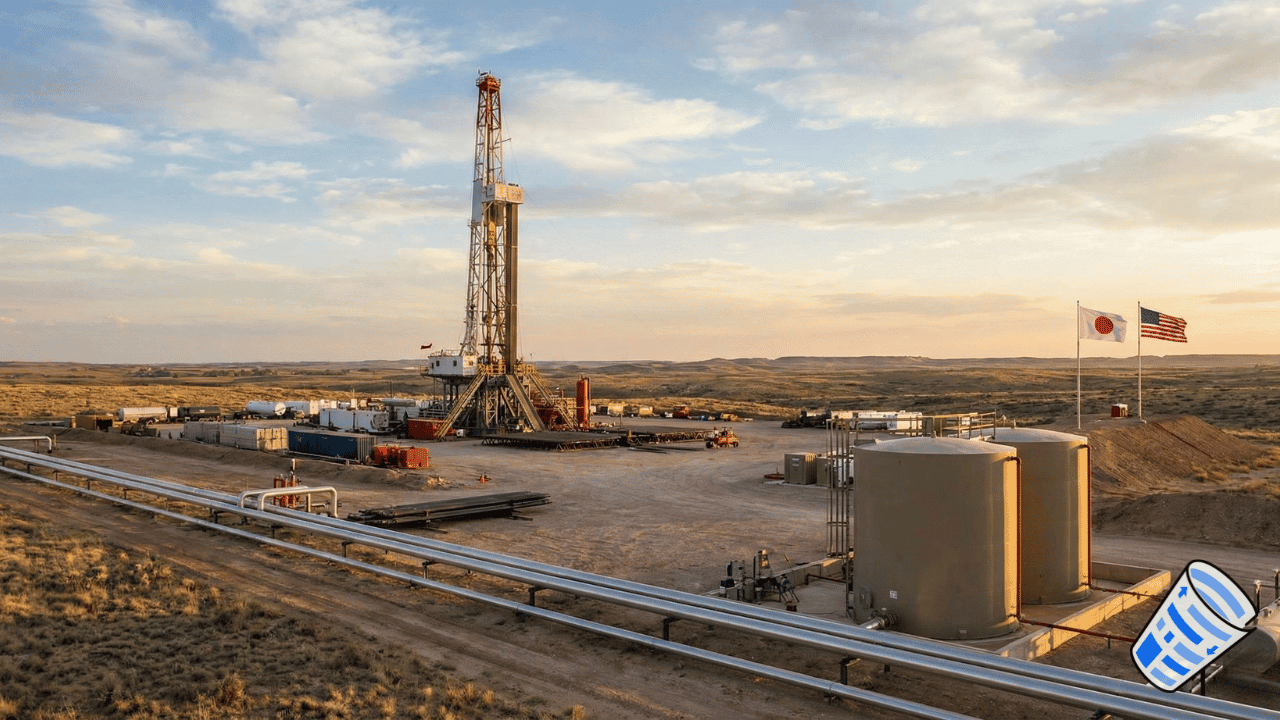
An oil drilling rig operates at a worksite in a flat, rural landscape, with storage tanks, equipment, and Japanese and U.S. flags visible—signaling Mitsubishi’s involvement in a recent U.S. shale gas acquisition.
Summary:

  • Mitsubishi Corporation will acquire shale gas assets for $7.53 billion, including $2.33 billion in debt.
  • The deal marks the largest acquisition by a Japanese company in the U.S. shale sector, with $5.2 billion in equity purchases.
  • The investment aims to strengthen Mitsubishi's natural gas and LNG businesses amid rising U.S. power needs.

Major Acquisition Details

Mitsubishi Corporation announced on January 16, 2026, that it will acquire shale gas assets in the U.S. from Aethon Energy Management for a total of $7.53 billion.

This amount includes $2.33 billion in debt. The deal features $5.2 billion in equity purchases and is notable as the largest acquisition by a Japanese company in the American shale sector, according to CNBC.

Strategic Moves in the Energy Market

The acquisition reflects Mitsubishi's strategy to strengthen its position in the natural gas and liquefied natural gas (LNG) markets.

The company aims to address the increasing power demands from data centers and manufacturing in the United States. Mitsubishi explained that this investment will enhance its earnings base and support its efforts to create an integrated value chain in the U.S. energy market.

Impact on LNG Production Capacity

Mitsubishi currently has a total LNG production capacity of about 15 million metric tons per year. The addition of Aethon’s assets is expected to double this capacity, reinforcing Mitsubishi's role in the growing LNG market.

This expansion comes at a time when Japan is making significant investments in energy projects in the U.S., including a recent $1.5 billion investment by JERA in the Haynesville Shale basin.

Market Reactions and Future Plans

Following the announcement of the acquisition, shares of Mitsubishi fell by 2%. Despite this dip, the company remains committed to expanding its investments in natural gas, with projects already established in Alaska, Malaysia, Canada, and Indonesia.

Mitsubishi also plans to engage further in U.S. power generation and manufacturing businesses, aiming to capitalize on competitive upstream gas projects.

What's Next for Mitsubishi?

As Mitsubishi moves forward with this acquisition, it will likely continue to explore opportunities in the U.S. energy market.

The company's existing partnerships in upstream shale gas development with U.S. energy firm Ovintiv, along with its midstream marketing through CIMA Energy in Houston, position it well for further growth. Mitsubishi's strategic focus on LNG exports via its projects, such as LNG Canada and Cameron LNG, indicates a robust plan to enhance its presence in the global energy landscape.

Disclosure

Get Market Briefs delivered to your inbox every morning for free!

No fluff. No noise. No politics. Just finance news you can read in 5 minutes.

Blogs

April 15, 2026
What Is a Put Option? A Simple Guide for Investors
  • A put option is a contract that gives you the right to sell a stock at a set price before a set date.
  • Investors use put options to protect their portfolio against losses or to profit when they think a stock will drop.
  • The most you can lose when buying a put option is the premium you paid for the contract.
Read More
April 13, 2026
What Is Free Cash Flow? How To Find It & Why It's Important
  • Free cash flow is the cash a company has left after paying its bills and putting money back into the business.
  • Investors use free cash flow to figure out what a company is really worth - and if the stock is a good deal.
  • You can find free cash flow on a company's cash flow report, one of three key reports every public company files.
Read More
April 13, 2026
Non Taxable Income: What It Is and Why Investors Care

Non taxable income is money you earn that the IRS does not tax - like Roth IRA cash, muni bond interest, and certain investment gains. The U.S. tax code taxes workers, investors, and business owners at very different rates. Tools like Roth accounts, muni bonds, and real estate write-offs can help you keep more of what you earn.

Read More
April 11, 2026
Nasdaq Index Fund: A Beginner's Guide to Investing in the Nasdaq 100
  • A Nasdaq index fund lets you invest in the 100 biggest non-bank companies on the stock market all at once.
  • You can access the Nasdaq through index funds, mutual funds, or ETFs like QQQ - each with its own fees, trading rules, and style.
  • Picking the right Nasdaq index fund comes down to three things: who runs it, what is in it, and what it costs.
Read More
April 11, 2026
What Is Wealth? It's Not What Most People Think
  • Wealth is about owning assets that grow and pay you - not just earning a high salary.
  • In a capitalist system, there are two ways to get paid: from your labor and from your capital.
  • Building wealth takes a shift in mindset, a money system, and the habit of investing before you spend.
Read More
April 10, 2026
Micron Stock: The AI Memory Play Most Investors Are Missing
  • Micron (MU) is the only U.S. company that makes HBM chips - the short-term memory layer that AI systems need to run.
  • By early 2026, data centers were using about 70% of all memory chips made in the world, creating an 18-month backlog for new orders.
  • Micron's DRAM - or short-term memory chip - revenue jumped 69% year over year, and the company shifted away from consumer products to focus almost entirely on AI.
Read More
April 10, 2026
What Is Working Capital? What Investors Need To Know
  • Working capital is current assets minus current liabilities - it shows if a business can pay its short-term bills.
  • You find it on a company's balance sheet inside its 10-K report.
  • Changes in working capital show up on the cash flow statement and affect how much cash a business really makes.
Read More
April 9, 2026
What Is a Meme Stock? A Simple Guide for New Investors

You've probably heard the term "meme stock" thrown around on […]

Read More
April 9, 2026
Enterprise Value Formula: What It Is and How to Calculate It
  • Enterprise value (EV) shows what a company is really worth - debt and cash included - not just its stock price
  • The enterprise value formula is: Market Cap + Total Debt - Cash and Cash Equivalents
  • Investors use EV with metrics like EBITDA to compare stocks more fairly than market cap alone
Read More
April 8, 2026
Return on Equity: What It Is and How to Use It
  • Return on equity (ROE) measures how much profit a company earns for every dollar of shareholder equity
  • The formula is simple: net income divided by shareholder equity
  • A higher ROE can signal a company that is good at turning investor money into profit - but it is not the full picture
Read More
1 2 3 17
Share via
Copy link









