Over the last few years, the global economy has started to shift away from U.S. dominance.
What does that mean? For decades, the world economy has been controlled by U.S. trade agreements - but that is now being challenged by a rapidly growing partnership: BRICS.
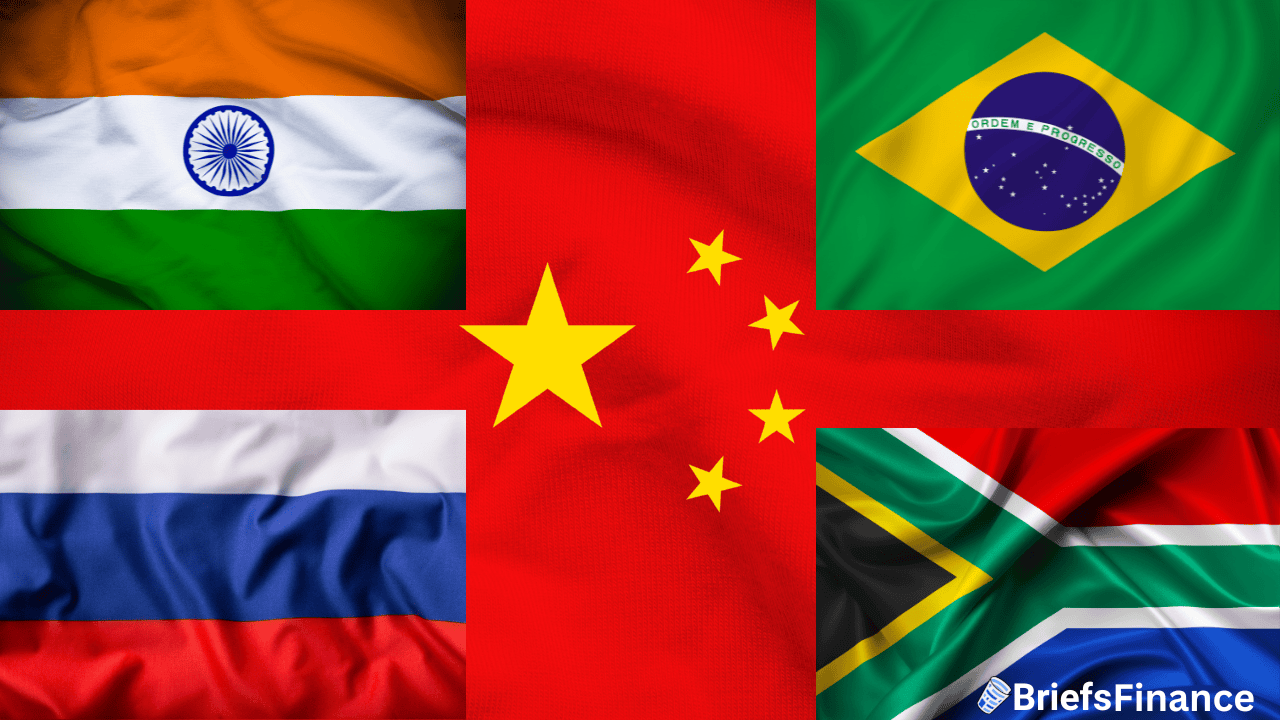
The acronym stands for:
- Brazil.
- Russia.
- India.
- China.
- South Africa.
But this trade group has expanded far beyond its original five members.
As of 2025, BRICS includes 20 countries accounting for 30% of nominal global GDP and around 55% of the world's working-age population.
For context, the United States accounts for roughly 15% of world GDP and less than 5% of the global working-age population.
With fast growing economies and a bigger grip on global trade, BRICS nations are gaining more influence on the world stage, which investors may want to pay attention to.
Our analysts have identified this as a Broad Market Shift creating potential investment opportunities:
U.S. tariffs, economic volatility, and dollar instability are pushing emerging markets toward BRICS membership - and investors who understand this shift may profit from the companies and currencies benefiting from this realignment.
- By the way, we covered the specific investment opportunities in-depth in our Market Briefs Pro report weeks ago - click here to get exclusive access to the full report.
Let's break down what BRICS means for investors, where the opportunities exist, and what risks you'll need to consider.
What Is BRICS? Understanding the Emerging Economic Power
BRICS was formed in 2009 with five founding nations: Brazil, Russia, India, China, and South Africa.
The goal was simple: foster trade and political cooperation beyond traditional Western economies like the U.S. and European Union.
Since then, BRICS has grown.
According to data from the International Monetary Fund, BRICS has expanded to include:
Full member nations (10 total): Egypt, Ethiopia, Iran, the United Arab Emirates, and Indonesia joined between 2024-2025.
Partner nations (10 total): Algeria, Belarus, Bolivia, Cuba, Kazakhstan, Malaysia, Nigeria, Thailand, Turkey, Uganda, Uzbekistan, and Vietnam.
Together, these 20 countries now make up roughly 40% of the global economy measured by purchasing power parity as of 2025.
Here's what that means in comparison:
| Economic Bloc | Share of Global GDP (PPP) | Share of World Population | 2025 GDP Growth Rate |
| BRICS | 40-44% | 55% | 3.4% |
| G7 Nations | 28% | ~10% | 1.2% |
| United States | ~15% | 4.2% | 1.4% |
Sources: IMF World Economic Outlook, RBC Wealth Management
The bottom line: BRICS has become one of the strongest trade blocs in the world - and it's expanding quickly while outgrowing developed Western economies.
Why BRICS Creates Investment Opportunities Right Now
The investment opportunity in BRICS countries stems from emerging markets and their growth.
Simply put - emerging markets are seeing explosive growth as the U.S. economy experiences volatility and dollars lose value.
The U.S. Dollar Is Losing Its Grip
Since 1944, the U.S. dollar has been the global reserve currency.
That means most of the world's central banks hold dollars to save, invest, and use for trade.
Why did the dollar dominate for so long? Stability. The U.S. economy and its huge military made the dollar stable and safe for years.
But that's changing.
In the first half of 2025, the U.S. dollar fell by more than 10%, its worst performance in over 50 years.
Rising U.S. debt, aggressive tariffs, and geopolitical tensions have put pressure on the dollar's value.
Major credit rating agencies like Moody's and Fitch have downgraded the U.S. credit rating in recent years, making it riskier to invest in American assets.
Meanwhile, all five core BRICS currencies strengthened against the dollar in 2025.
That currency strengthening has led other nations to begin increasing their reserve holdings of BRICS currencies, further boosting these countries' markets and economies.
BRICS ETFs Are Crushing the S&P 500
The results speak for themselves:
- iShares Brazil ETF: Up 36% as of November 11 2025.
- iShares China ETF: Up 37% as of November 11 2025.
- S&P 500: Up only 13% as of November 11 2025.
Even the iShares India ETF, which faced pressure from 50% U.S. tariffs, has shown long-term strength despite short-term volatility.
Why the outperformance? Opportunities within BRICS nations are growing as investors look beyond the U.S. dollar to other currencies and economies showcasing strong, sustained growth.
Is It Good to Invest in BRICS Countries? The Real Opportunities
For U.S. investors, BRICS exposure offers diversification into some of the world's fastest-growing economies. But not all BRICS opportunities are created equal.
Let's examine the most accessible investment opportunities for American investors.
South Africa: The "S" in BRICS
South Africa joined BRICS in 2010, and its economy has grown consistently since - particularly in 2025.
The iShares MSCI South Africa ETF (EZA) gives investors broad exposure to mid-sized South African companies.
As of November 11 2025, the ETF has grown by 50%, not only beating the S&P 500 but outperforming other BRICS-related ETFs as well.
Why South Africa specifically?
The country is the world's largest platinum producer - platinum is valued at over $1,400 per ounce as of November 2025, up 80% in the last five years.
Over 16% of the South Africa ETF invests in Naspers Limited, a tech investment and media company that owns stakes in:
- Media24 (South Africa's largest print and digital media business).
- Takealot (largest ecommerce platform in South Africa).
- Tencent (early Naspers investment now worth $221 billion, over 3x Naspers' market value).
The ETF's other top holdings include precious metal mining companies and major South African banks - sectors positioned to potentially benefit as the South African economy expands and BRICS grows stronger.
UAE & Dubai: New Member, Massive Growth
The United Arab Emirates (UAE) became a BRICS member in January 2024, and its GDP reached an all-time record high that same year, hitting $537 billion.
UAE's economy has nearly doubled over the last 20 years, growing every year since 2020.
What else? In September 2025, UAE's government-owned investment fund MGX took a large stake in TikTok U.S. alongside Oracle and Silver Lake, now owning 45% of TikTok valued at $14 billion.
UAE ETFs are hard to come by and investing in individual companies is also difficult for American investors.
With that said, VEON Ltd. (VEON) offers exposure to this opportunity. VEON is a Dubai-based telecommunications company with strong international operations.
Shares are up 65% over the last five years, and the company has shown consistent growth since UAE joined BRICS.
VEON's largest market segment is Pakistan - which has applied for BRICS membership recently.
As BRICS expands, VEON's business in member and partner nations positions it to benefit from increased trade using BRICS currencies rather than dollars.
- We give you actual data and research on VEON and other opportunities from this shift in our Market Briefs Pro report - you can learn more here.
Turkey: The Next BRICS Member?
Turkey is not yet a full BRICS member, but it's a partner nation that has applied for full membership.
BRICS has made it clear though that it is looking to add more countries - making Turkey's full membership likely in the near future.
What happens next? Turkish companies will gain access to BRICS trade advantages - which could help businesses in the country and its GDP to grow faster.
The iShares MSCI Turkey ETF (TUR) offers exposure to this potential.
Turkey faces a 15% tariff from the U.S. on all imported goods, leading the country to seek alternate trading partners.
While the ETF is down around 4% year-to-date as of December 2025, it's up over 45% in the last five years, proving its worth as a long-term investment.
Turkey’s GDP has also grown every year since 2020, hitting a record $1.3 trillion in 2024 - growing by almost $600 billion since 2020.
Top holdings include Aselsan Elektronik (defense manufacturer up 194% YTD and 2,500% over five years) and Birlesik Magazalar (supermarket chain expanding into Egypt, another BRICS member).
How U.S. Tariffs Drive This Shift
Tariffs are a major reason BRICS growth is shifting now.
In 2025, broad U.S. tariffs have put pressure on several countries, causing them to form new alliances and move business away from the U.S.
- Turkey faces 15% tariffs on all imported goods.
- India faces 50% tariffs on certain products.
- China continues facing tariffs imposed during previous administrations.
Higher tariffs = higher costs for businesses trading with the U.S. - so seeking alternative trading parents might make sense for some countries.
BRICS membership offers countries:
Lower transaction costs through direct systems that are not corralled by U.S. banks.
Reduced currency risk by trading in local BRICS currencies instead of converting to dollars.
Access to trade networks representing 40% of global GDP without Western intermediaries.
The U.S. remains a dominant superpower for now.
But as BRICS develops, companies positioned within BRICS economies may have competitive advantages that could lead businesses to grow, along with the investment opportunities.
How Will BRICS Affect the Stock Market?
The rise of BRICS may impact the stock market in a variety of positive and negative ways:
Potential Positive Impacts
Diversification: BRICS offers exposure to economies growing faster than developed markets.
Commodity plays: BRICS nations have rare earth and precious metal deposits, meaning they could be pure-plays into commodities.
Currency appreciation: As BRICS currencies strengthen against the dollar, companies operating in those markets may see earnings growth when converted to dollars
Potential Negative Impacts
Dollar weakness: If the dollar loses its reserve currency status, it could weaken the dollar's value, lowering purchasing power for U.S. consumers and investors.
Geopolitical tension: Increased BRICS cooperation could lead to trade competition, creating volatility in global markets
U.S. market pressure: The world currently trades in dollars - if that were to change, companies may face pressure with current cash reserves and margins.
According to IMF projections, BRICS GDP is growing fast the U.S. gdp - that could mean economic power shifts over the next decade.
Risks to Consider Before Investing in BRICS
Investing in BRICS may also create some issues for investors’ portfolios in the coming years:
Geopolitical Risks
The biggest risk for American investors is government restrictions.
The U.S. banned investments in Russian companies after the Ukraine invasion - and could do the same with other BRICS nations.
U.S. relations with India and China remain tense as well, with tariffs still in place.
Currency Exchange Rate Risk
Foreign investments expose you to currency fluctuations.
Even if a stock rises in local currency, your returns could be reduced if that currency weakens against the dollar when you sell.
This works both ways - currency appreciation can boost returns, but volatility creates uncertainty.
BRICS currencies have strengthened in 2025, but there's no guarantee that trend continues.
Internal BRICS Conflicts
BRICS is not like the European Union - where all member states are governed by similar laws.
Each BRICS nation has different cultures and laws, which often sparks fighting between them
Economic Instability
Many BRICS and partner nations are still emerging markets with underdeveloped financial systems.
Economic crises in one member could impact other countries, similar to how Greece's recession hurt the broader European Union in 2009.
FAQs: Investing in BRICS Countries
Is it good to invest in BRICS?
BRICS offers significant growth potential with GDP expansion of 3.4% in 2025 (versus 1.4% for the U.S.). However, BRICS investments carry higher risk due to geopolitical tensions, currency volatility, and political instability.
BRICS is best suited for investors seeking emerging market exposure with tolerance for volatility and a long-term (5-10 year) investment horizon.
What happens to the U.S. dollar if BRICS succeeds?
If BRICS succeeds in its goals, it could gain more influence on the world stage.
This would affect U.S. purchasing power and potentially increase inflation.
However, the dollar remains dominant as of 2025, with deep liquidity and institutional backing - complete displacement would take decades, if it happens at all.
How will BRICS affect the stock market?
BRICS growth creates opportunities in emerging market stocks, commodities, and infrastructure while potentially pressuring dollar-dependent U.S. companies.
Over time, more competition from outside countries and businesses will put pressure on American businesses, their profit ,and share values.
What are the risks of investing in BRICS countries?
Key risks include:
- Geopolitical tensions (sanctions, trade wars).
- Currency exchange rate fluctuations.
- Political instability within member nations.
- Underdeveloped financial systems.
- Potential internal conflicts between BRICS members with competing interests.
The Bottom Line: BRICS and the Changing Global Economy
The global economy is shifting. The U.S. used to call the shots when it came to trade and money, but BRICS is growing in influence.
With 40% of global GDP, 55% of the world's working-age population, and currency systems strengthening against the dollar, BRICS represents one of the most significant market shifts in modern history.
What Investors Need to Know
The United States will remain a dominant superpower for years to come.
But as BRICS develops, it seeks to tilt global trade in its favor - creating opportunities for investors who understand this Broad Market Shift.
For American investors, BRICS may be a chance to diversify beyond U.S. stocks and gain exposure to some of the world's fastest-growing economies.
Just remember: higher potential returns come with higher risks.
The next few years will reveal whether BRICS becomes a true alternative to U.S. markets or whether internal conflicts and coordination challenges limit its growth.
Either way, investors will want to keep this shift in mind as the global economy continues evolving.
Want to learn more about market shifts creating investment opportunities?
Subscribe to Market Briefs Pro for weekly deep-dive reports identifying where smart money is moving before it hits the mainstream.