Free NewsletterPro Login

Warning: Undefined variable $stocks in /var/www/briefs.co/htdocs/wp-content/plugins/oxygen/component-framework/components/classes/code-block.class.php(133) : eval()'d code on line 448

Warning: foreach() argument must be of type array|object, null given in /var/www/briefs.co/htdocs/wp-content/plugins/oxygen/component-framework/components/classes/code-block.class.php(133) : eval()'d code on line 448

Warning: Undefined variable $funds in /var/www/briefs.co/htdocs/wp-content/plugins/oxygen/component-framework/components/classes/code-block.class.php(133) : eval()'d code on line 472

Warning: foreach() argument must be of type array|object, null given in /var/www/briefs.co/htdocs/wp-content/plugins/oxygen/component-framework/components/classes/code-block.class.php(133) : eval()'d code on line 472
/* the link was here */
×
Free investor livestream — Nov 17

How To Use ChatGPT & Claude To Research Stocks Like A Pro

01
The prompt we use to break down any stock
02
How to fact-check what AI tells you
03
How to compare two stocks in minutes
Home » Deep Briefs »  » BRIEFS EXCLUSIVE: 43% Of Respondents Say Bills Outran Their Income Over Past Two Years

BRIEFS EXCLUSIVE: 43% Of Respondents Say Bills Outran Their Income Over Past Two Years

Published: Sep 25, 2026 
Disclosure: Briefs Finance is not a broker-dealer or investment adviser. All content is general information and for educational purposes only, not individualized advice or recommendations to buy or sell any security. Investing involves significant risk, including possible loss of principal, and past performance does not guarantee future results. You are solely responsible for your investment decisions and should consult a licensed financial, legal, or tax professional before acting on any information provided.
Summary:
  • 43% of the 494 Market Briefs readers surveyed said their bills grew faster than their income over the past two years, even though 79% could cover a surprise $5,000 expense tomorrow.
  • Half of readers own gold or crypto, the two classic bets against a weaker dollar, and only 13% bought nothing at all in the last 12 months.
  • The median reader says it takes $150,000 a year to feel financially secure, about $62,000 above the U.S. median household income.

Inflation is running hotter, and paychecks are not keeping up.

Four in five of the investors who took our survey could cover a surprise $5,000 bill tomorrow without borrowing, and three in four have at least $500 a month they could put to work.

But, nearly half of them still said their bills grew faster than their income over the past two years.
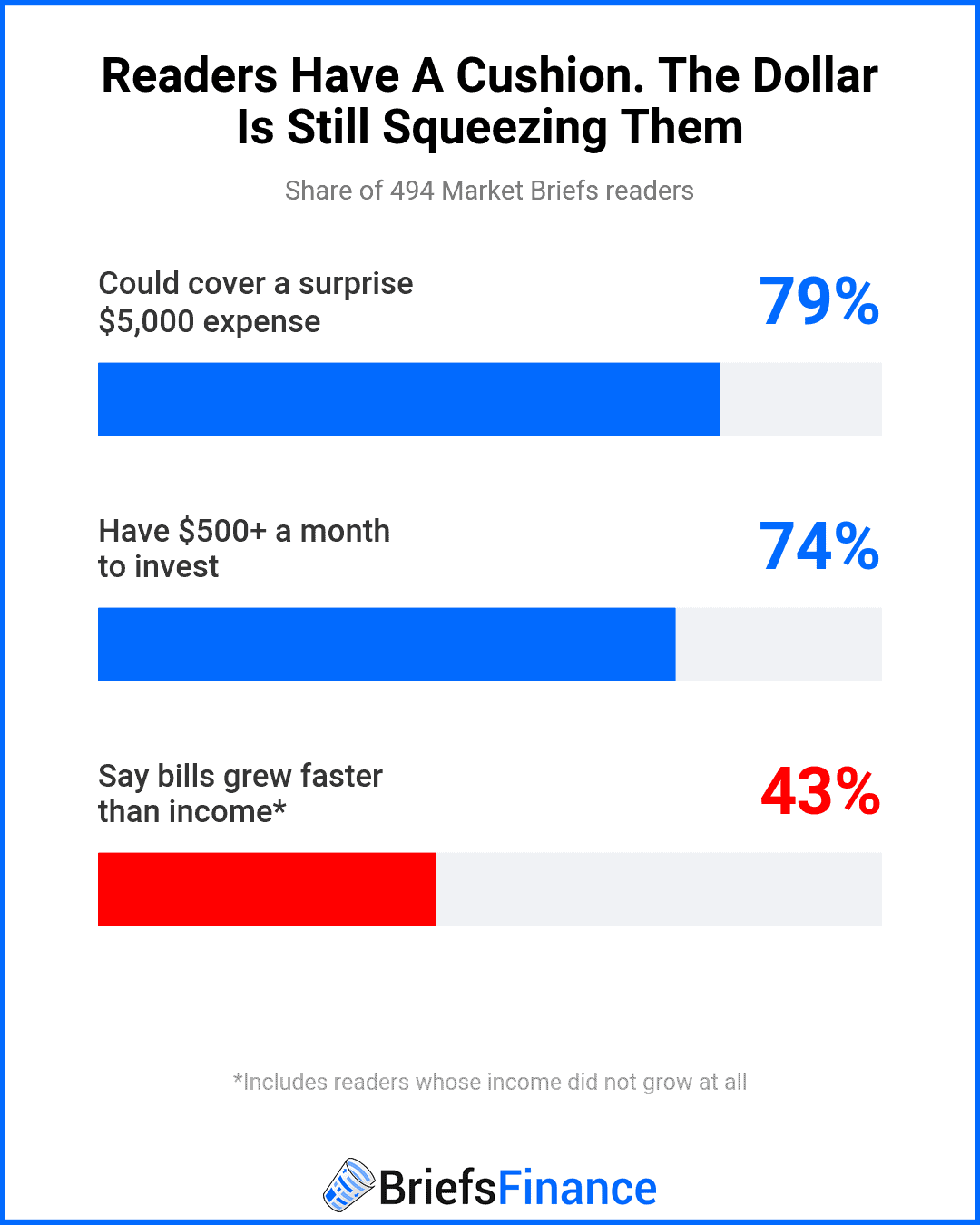
Bar chart: 79% of Market Briefs readers could cover a surprise $5,000 expense and 74% have $500 a month to invest, yet 43% say bills grew faster than income
Source: Market Briefs reader survey, Sept. 19-23, 2026 (494 responses)

This comes as annual inflation sits at 3.4%, which means prices are going up, and the dollar is losing value.

The dollar losing value didn't happen overnight, either.

The national debt just crossed $40 trillion, gold has passed Treasuries as the world's top reserve asset, and when our CEO polled his audience, the dollar losing value ranked as their #1 economic worry.

"The stronger your dollar is, the cheaper your groceries are, the cheaper your cars are, the cheaper your electronics are," said Jaspreet Singh, CEO of Briefs Finance.

"But if people don't have trust in the dollar ... the prices of everything go up. Your paycheck doesn't buy as much, your savings don't buy as much."

So in mid September, 2026, we asked our readers how the dollar losing value is impacting their finances.

Here's what they said.

The Dollar Showed Up First In The Bills

Only 23% of readers said their income grew faster than their bills over the last two years. A third called it roughly even, while 32% said the bills won and 11% said their income didn't grow at all.
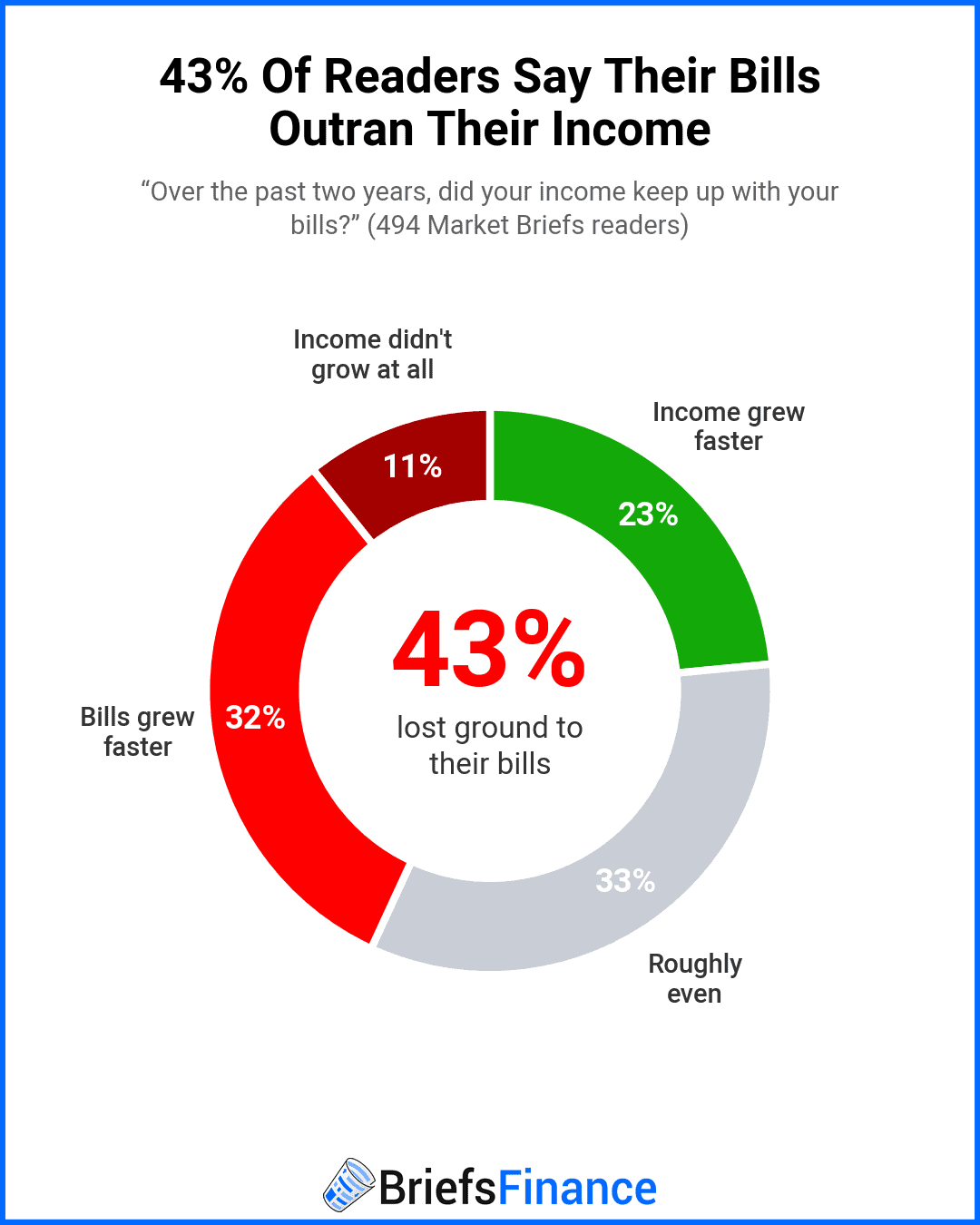
Donut chart of whether readers' income kept up with their bills over two years: 23% income grew faster, 33% roughly even, 32% bills grew faster, 11% income did not grow
Source: Market Briefs reader survey, Sept. 19-23, 2026 (494 responses)

Put those last two groups together and 43% of readers lost ground, with the loss landing hardest in the prime earning years.

Nearly half of readers between 30 and 59 fell behind, compared with about a third of readers over 60.
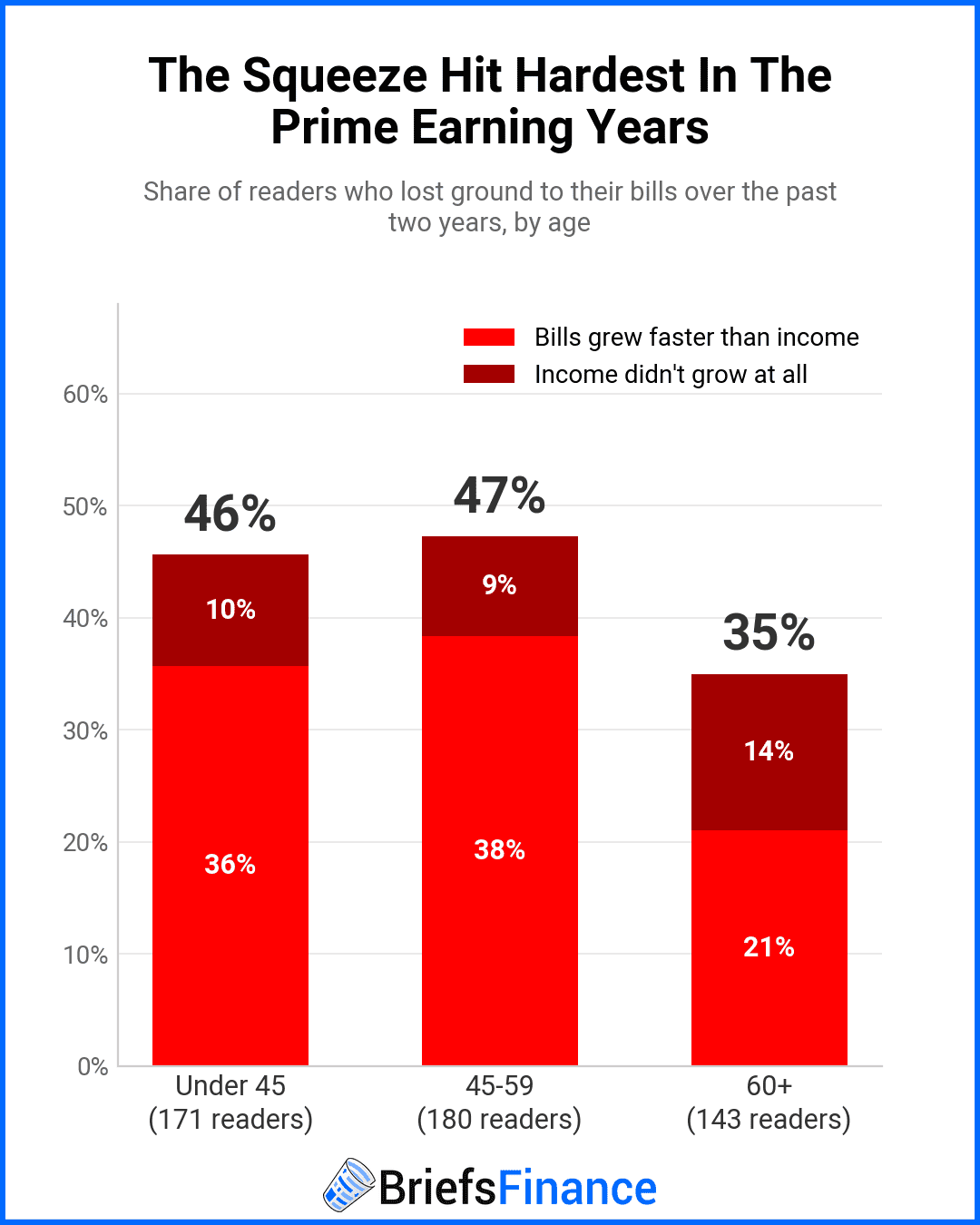
Stacked column chart of readers who lost ground to their bills by age: 46% under 45, 47% ages 45-59, 35% ages 60 and up
Source: Market Briefs reader survey, Sept. 19-23, 2026 (494 responses)

This is how a weaker dollar arrives. It doesn't come as one big bill; it comes as a paycheck that grows a little while everything it has to cover grows a little more, until one year the raise doesn't reach the end of the month.

The strain shows in what's keeping readers from investing more: Among readers who lost ground, a third said they're paying off debt first and another 30% said there's nothing left after bills.

Among readers whose income outran their bills, 62% said nothing is holding them back at all.
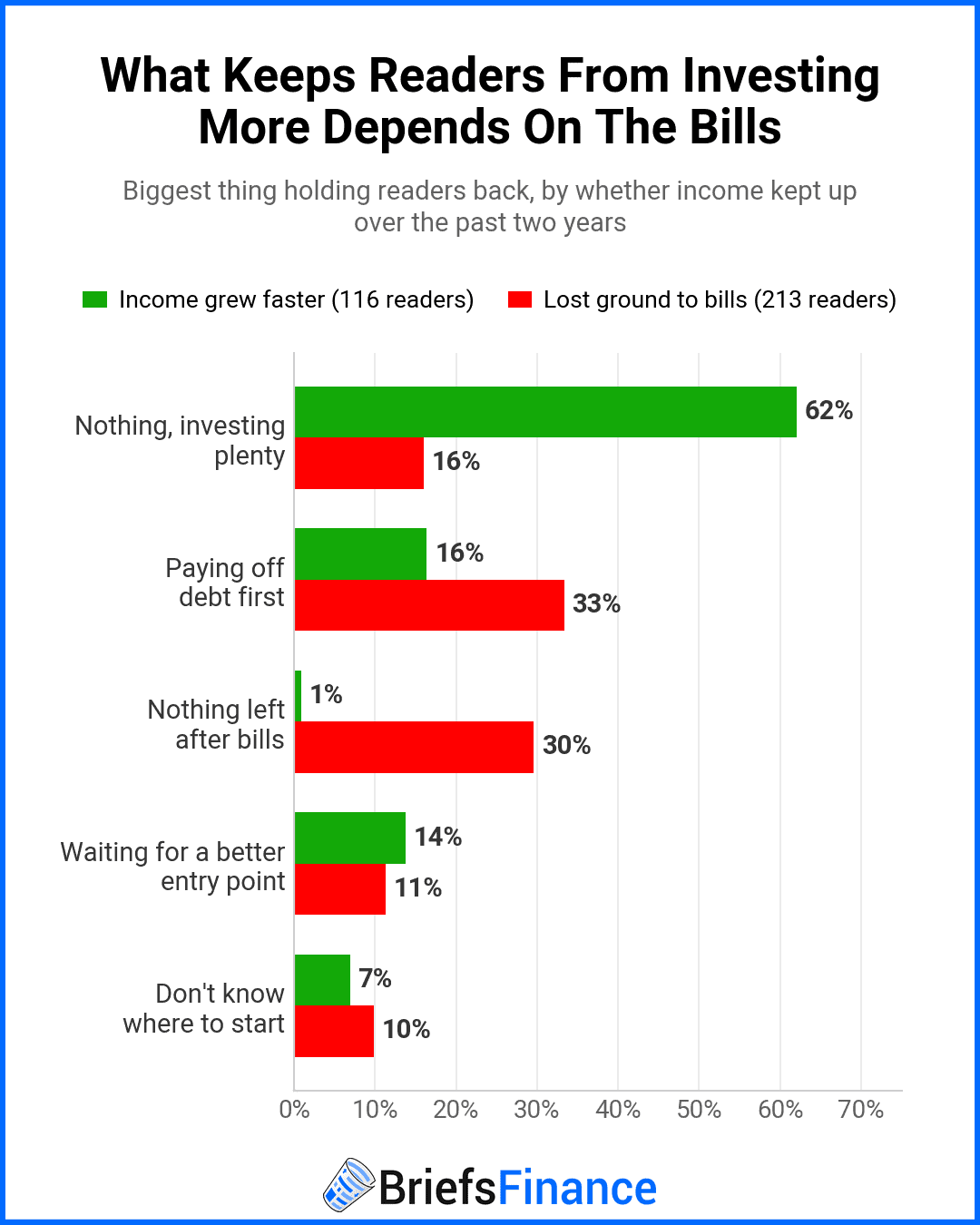
Grouped bar chart comparing what keeps readers from investing more, for readers whose income grew faster versus readers who lost ground to bills
Source: Market Briefs reader survey, Sept. 19-23, 2026 (494 responses)

Debt is where the room splits, with more than half of readers either owing nothing or paying under 4% on their biggest balance while 13% pay over 15% on theirs.

Among that 13%, 62% say the debt is exactly what's keeping them out of the market, and every dollar going to interest at that rate is a dollar that never gets the chance to become an asset.
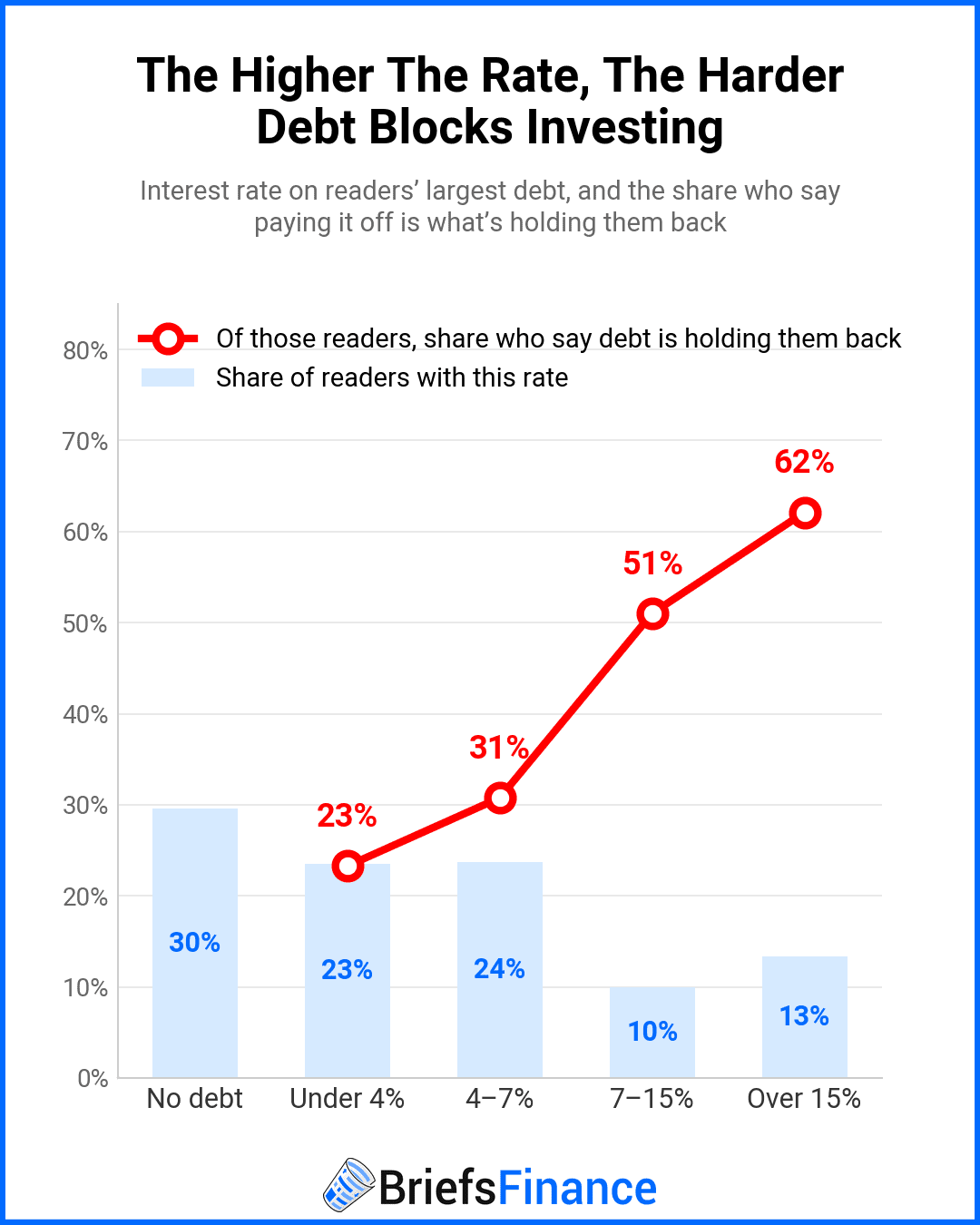
Chart of readers' largest debt interest rate, showing the share who say debt is holding them back rising from 23% under 4% to 62% over 15%
Source: Market Briefs reader survey, Sept. 19-23, 2026 (494 responses)

Our CEO Jaspreet Singh is taking on exactly this problem in a free live workshop on September 29th: how investors can profit from the dollar losing value instead of just absorbing it.

Readers Keep Little In Cash, And What They Keep Earns Under 4%

Cash is the one holding that takes the dollar's slide in full.

Half keep less than 10% of their money in cash or a savings account, only 7% keep more than half of it there, and just 5% hold nothing but cash.
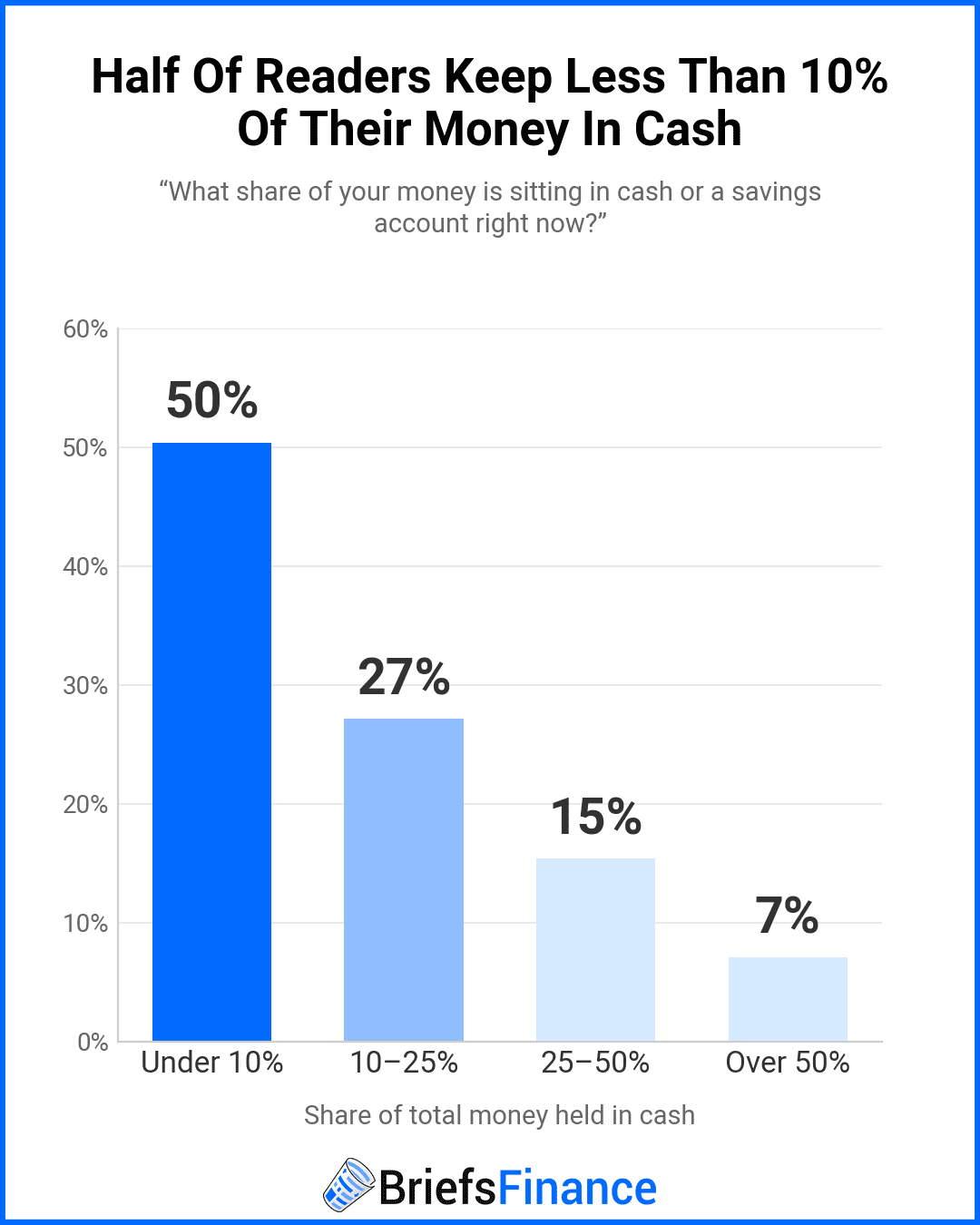
Column chart of the share of money readers hold in cash: 50% under 10%, 27% 10-25%, 15% 25-50%, 7% over 50%
Source: Market Briefs reader survey, Sept. 19-23, 2026 (494 responses)

The cash they did keep is a different story. Three in four readers said their savings account isn't earning more than 4%, another 5% weren't sure, and just one in five said yes.
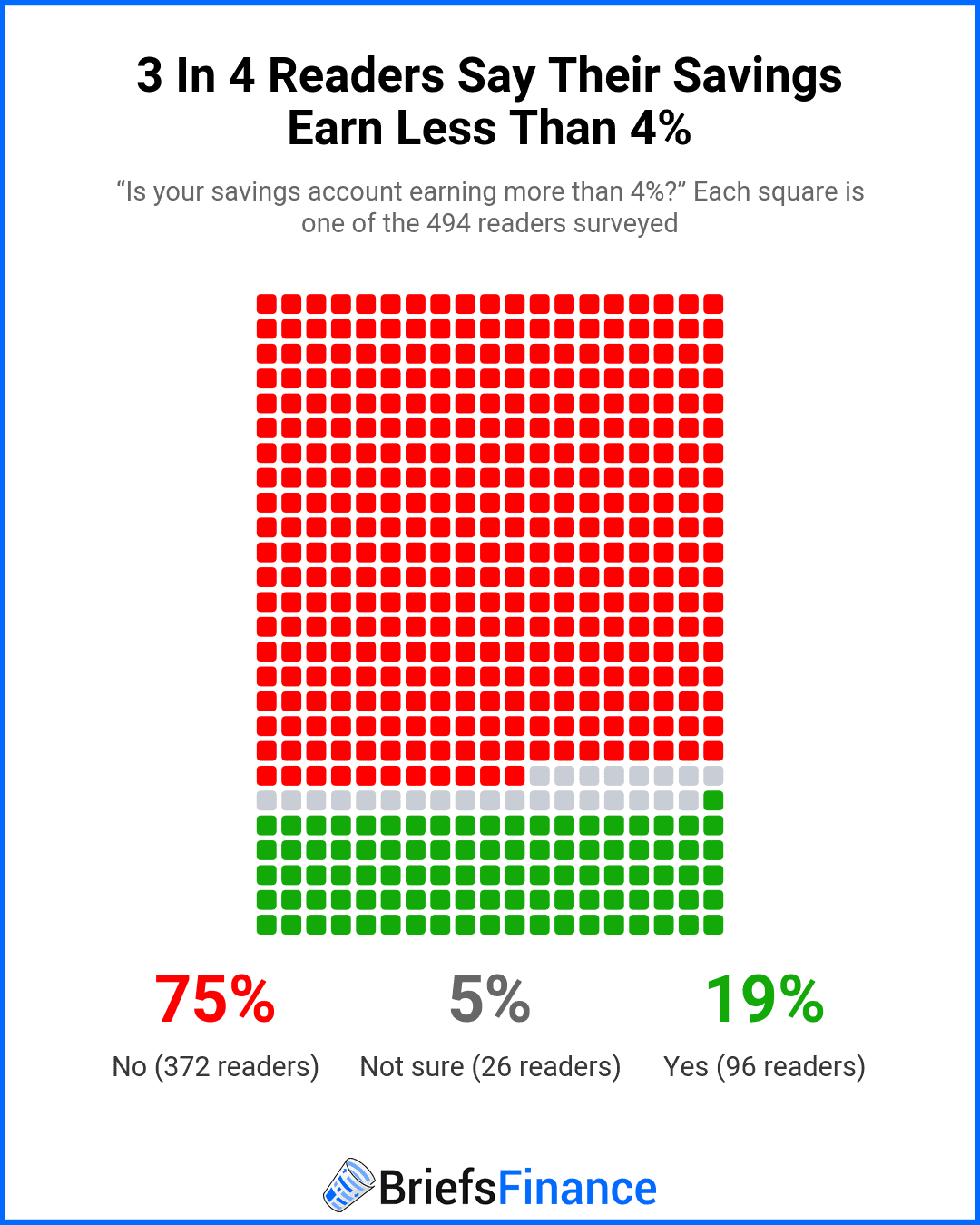
Waffle chart of 494 squares showing 75% of readers say their savings account earns under 4%, 5% are not sure and 19% say yes
Source: Market Briefs reader survey, Sept. 19-23, 2026 (494 responses)

The answer barely changes with how much cash a reader holds. Among the 22% of readers who keep more than a quarter of their money in cash, 72% said no.
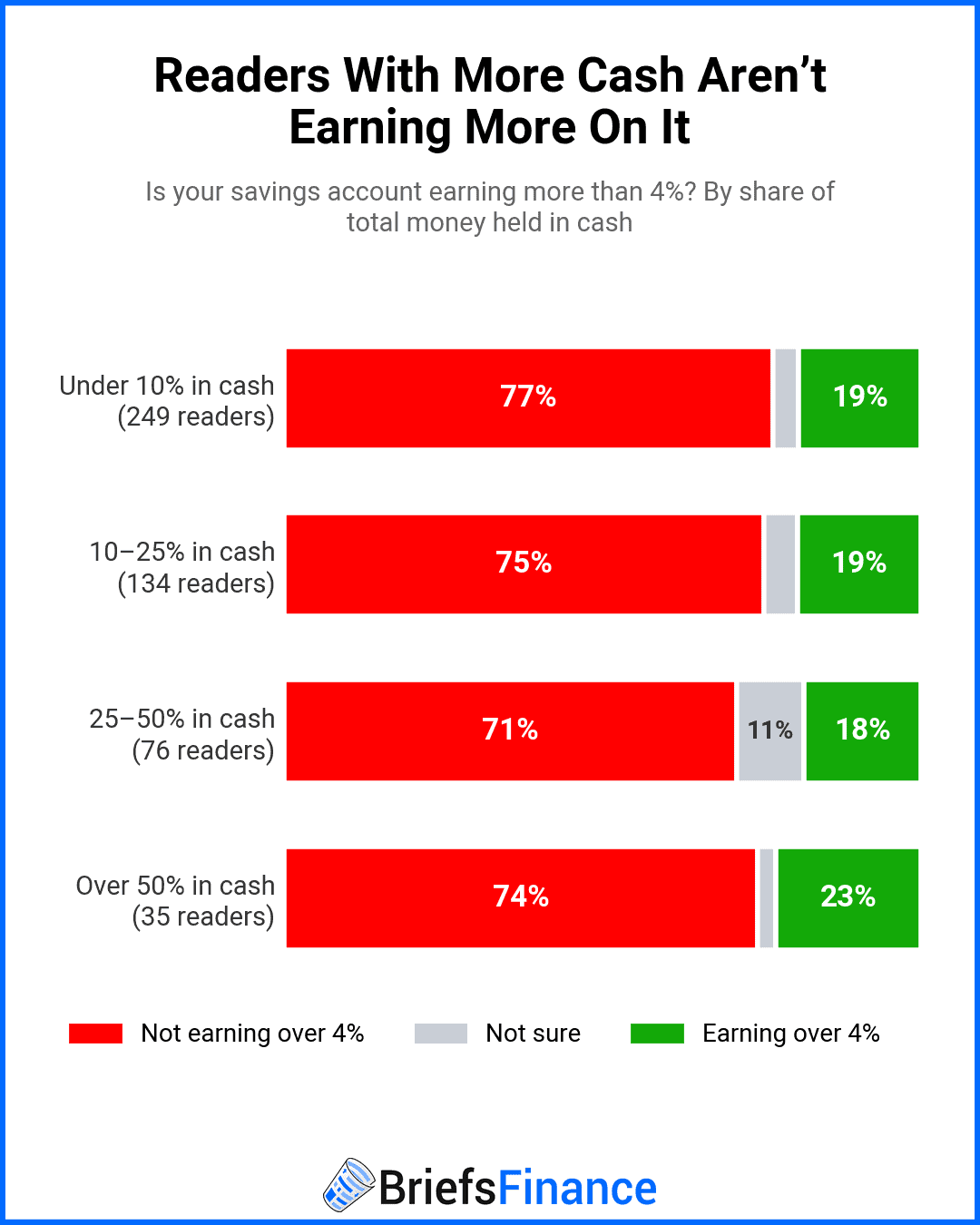
Stacked bar chart showing the share of readers earning over 4% on savings stays near one in five regardless of how much cash they hold
Source: Market Briefs reader survey, Sept. 19-23, 2026 (494 responses)

For most of the country, that's the default setting. The average savings account in the U.S. paid 0.37% in September, according to FDIC data.

Cash sitting at that rate doesn't hold still while prices rise - it loses value by almost the full rate of inflation every year, and the statement never shows it.

The Rest Of The Money Went Into Things That Aren't Dollars

For the typical reader, that leaves more than 90% of their money in assets, which tend to reprice when the dollar weakens rather than just sit there and shrink.

Here's what some of our readers own right now:

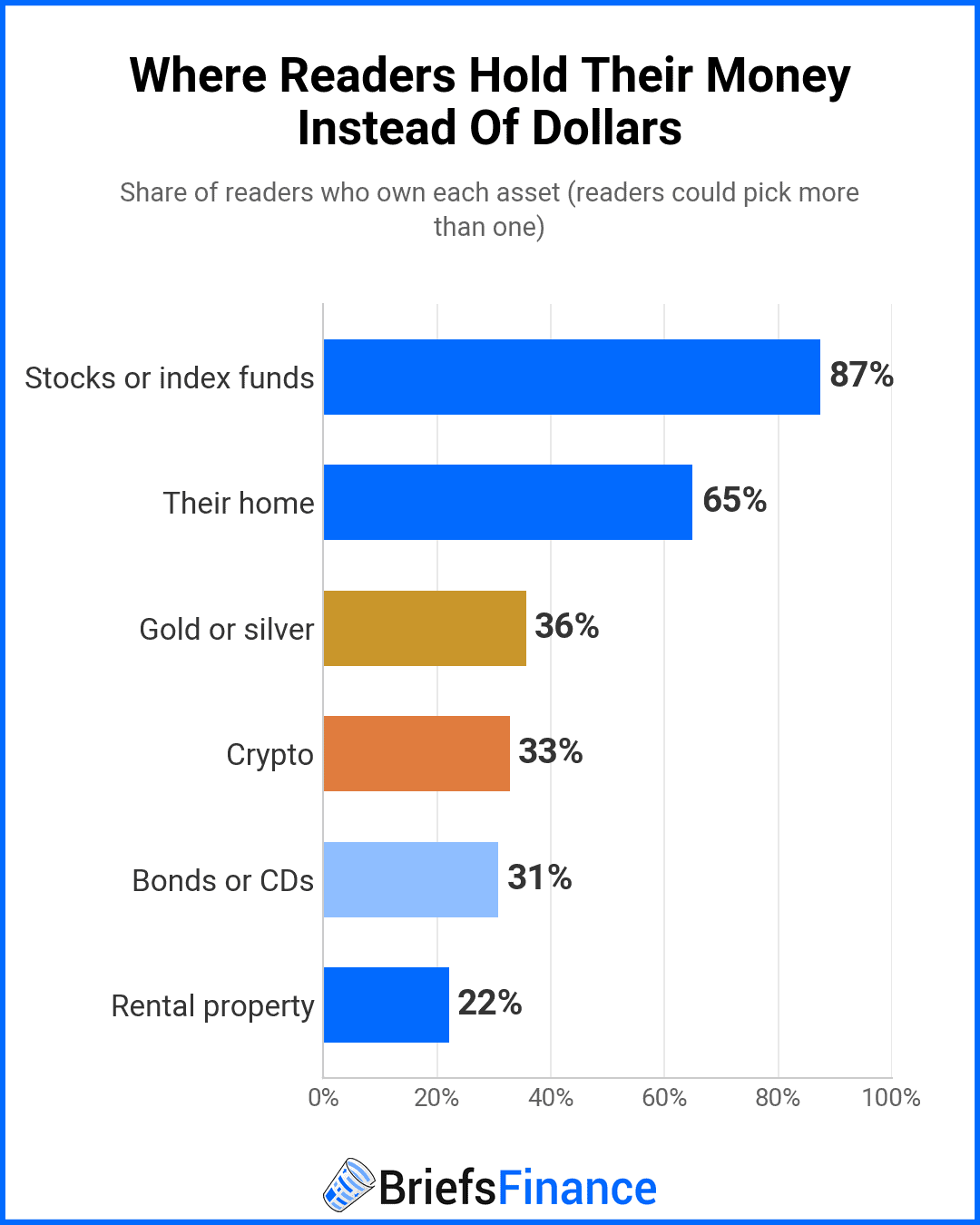
  • Stocks or index funds: 87%
  • Their home: 65%
  • Gold or silver: 36%
  • Crypto: 33%
  • Bonds or CDs: 31%
  • Rental property: 22%
Horizontal bar chart of what readers own: stocks or index funds 87%, home 65%, gold or silver 36%, crypto 33%, bonds or CDs 31%, rental property 22%
Source: Market Briefs reader survey, Sept. 19-23, 2026 (494 responses)

Gold and crypto are the two worth pausing on, because both are the classic bets that the dollar keeps losing value. Half of readers own at least one of them, and that share barely moves from one age group to the next.

What changes is the pick: 43% of readers over 60 own gold or silver and 24% own crypto, while readers under 45 flip it, with 41% owning crypto and 32% owning gold.
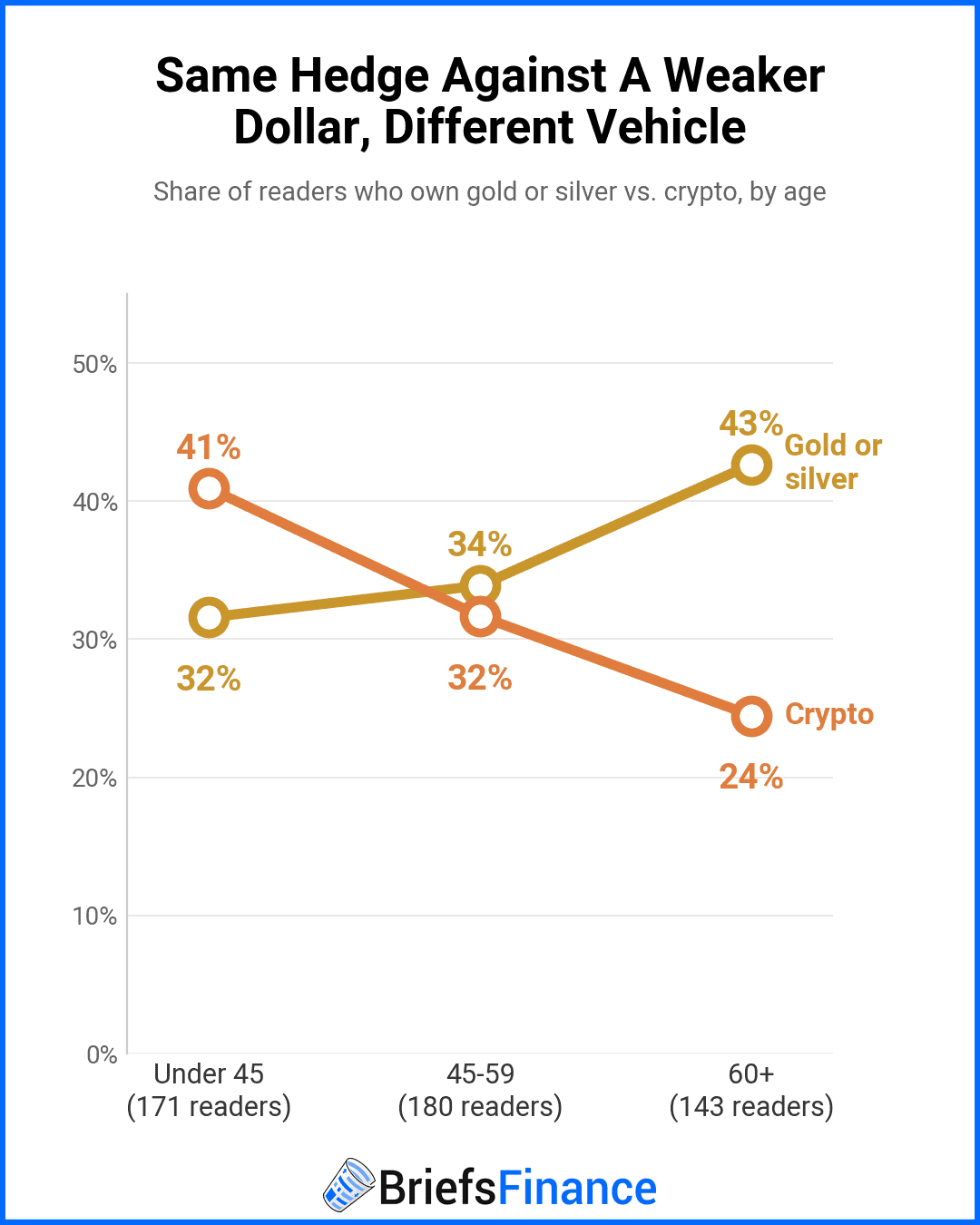
Line chart of gold versus crypto ownership by age: gold rises from 32% under 45 to 43% at 60 and up, while crypto falls from 41% to 24%
Source: Market Briefs reader survey, Sept. 19-23, 2026 (494 responses)

Same instinct, different vehicle: one generation wants to own something tangible and the other buys digital assets, but both are trying to hold something a printing press can't make more of.

And the buying hasn't stopped. 81% of readers put money into stocks in the last 12 months, 44% bought gold, crypto or real estate, and only 13% bought nothing at all.
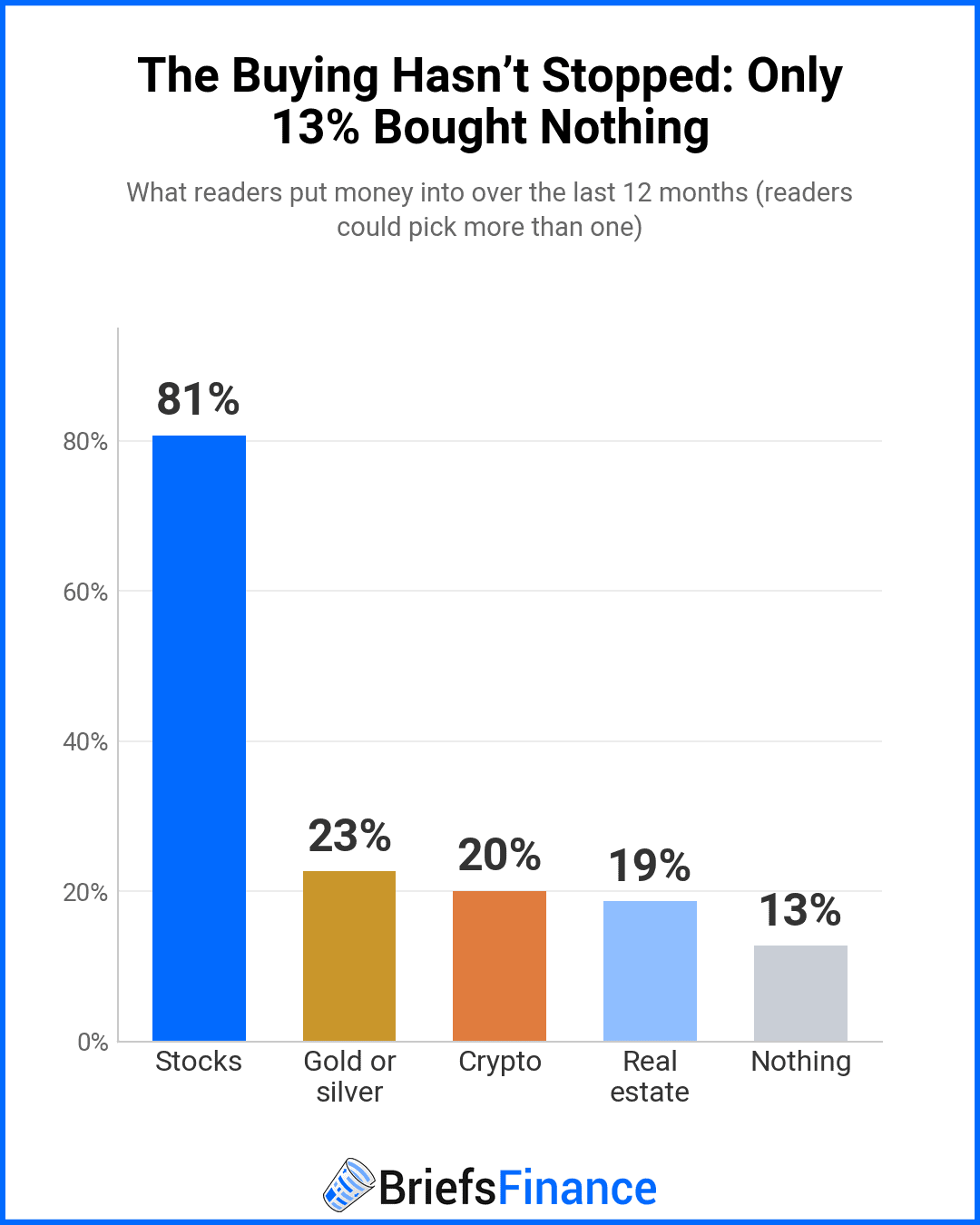
Column chart of what readers invested in over the last 12 months: stocks 81%, gold or silver 23%, crypto 20%, real estate 19%, nothing 13%
Source: Market Briefs reader survey, Sept. 19-23, 2026 (494 responses)

The Finish Line Moved To $150,000 A Year

A dollar that buys less doesn't just raise the bills - it raises the number it takes to feel safe.

We asked what annual income would make readers feel financially secure today and the median answer was $150,000, the single most common answer was $200,000, and four in five readers named at least $100,000.
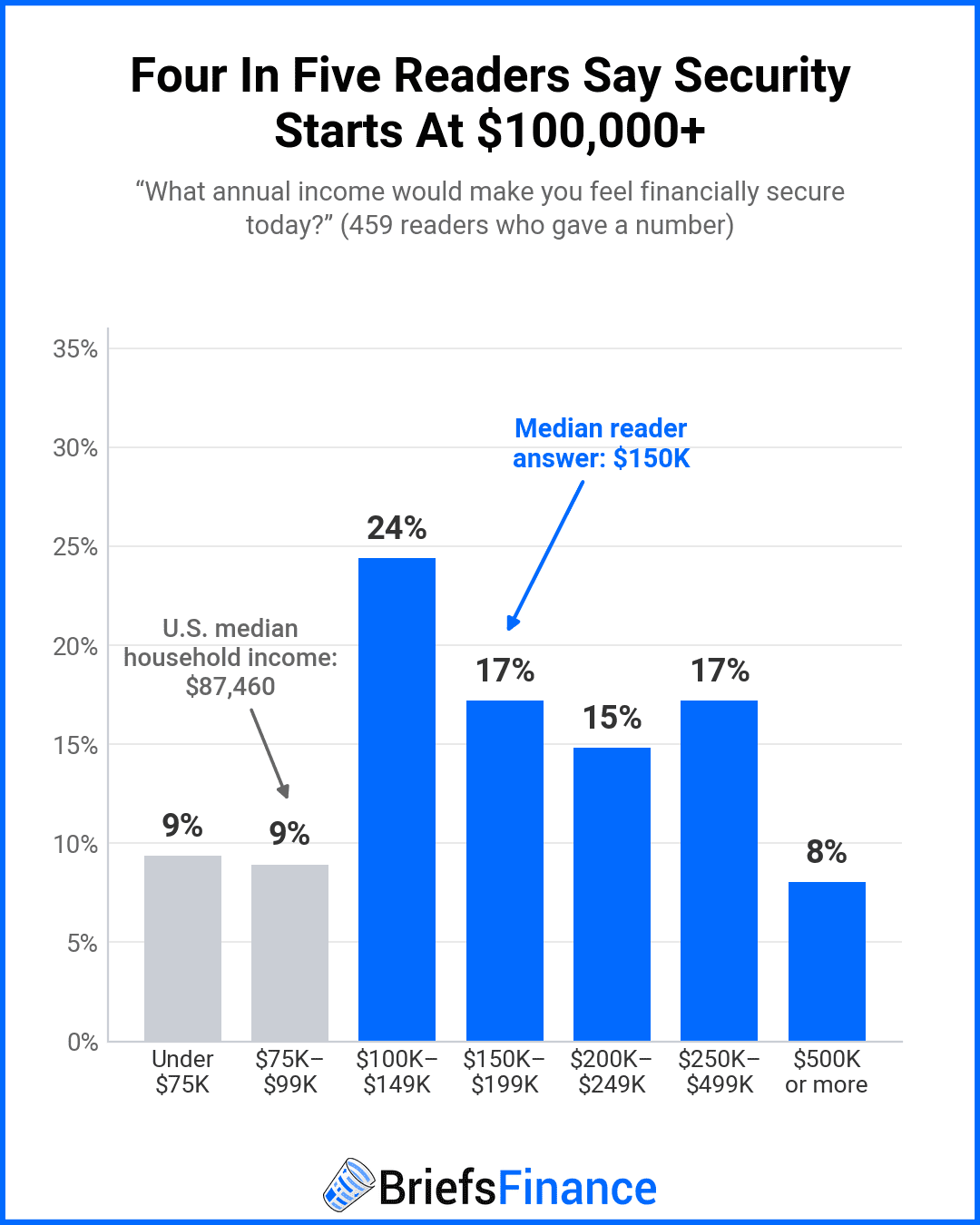
Histogram of the annual income readers say would make them feel financially secure, with a median answer of $150,000 versus the U.S. median household income of $87,460
Source: Market Briefs reader survey, Sept. 19-23, 2026 (459 readers who gave a number); U.S. Census Bureau

For comparison, the Census Bureau reported earlier this month that the median U.S. household earned $87,460 in 2025 - a record high, and still about $62,000 short of what the typical Market Briefs reader calls secure.
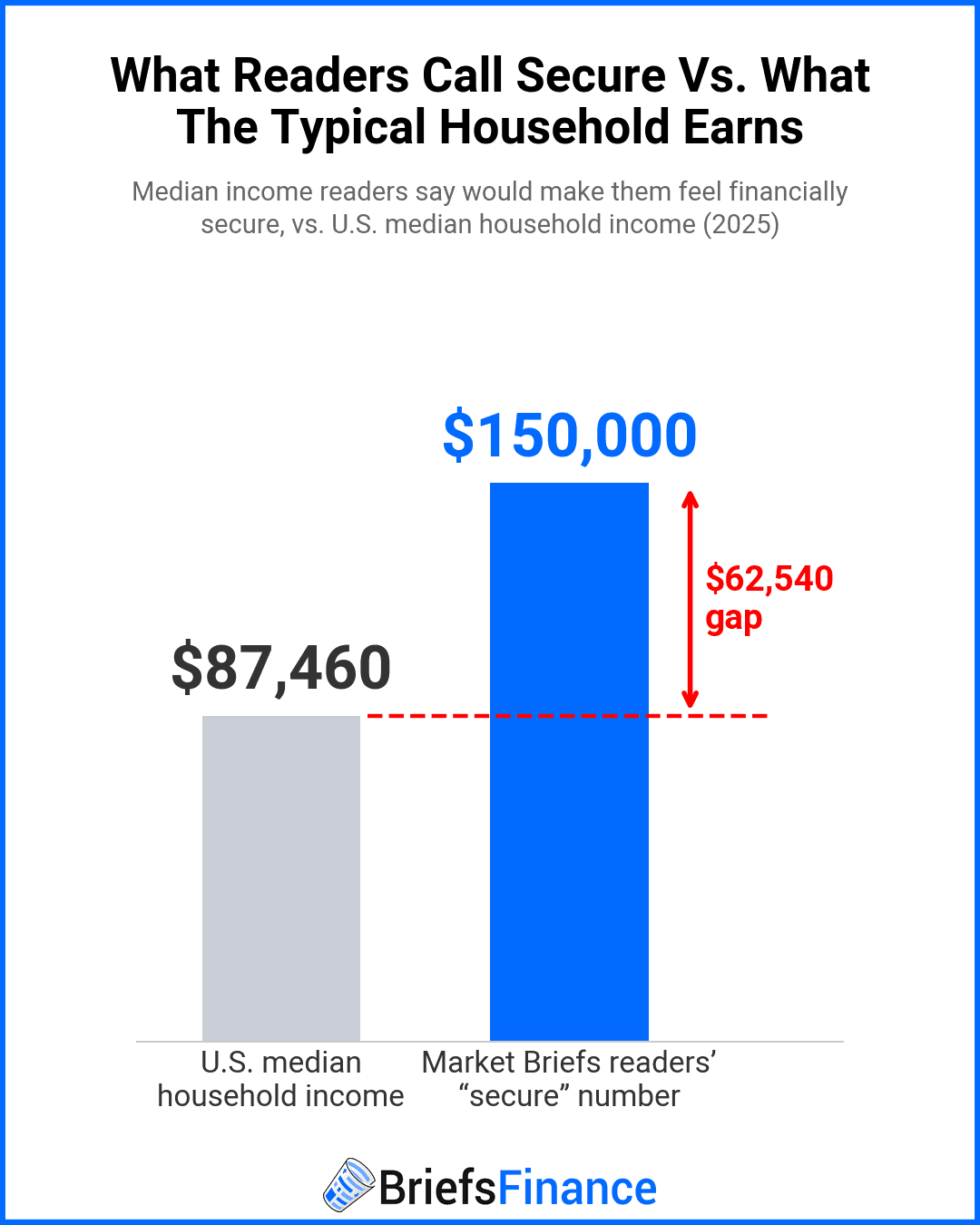
Bar chart comparing the U.S. median household income of $87,460 with readers' median financial security number of $150,000, a $62,540 gap
Source: Market Briefs reader survey, Sept. 19-23, 2026 (459 readers who gave a number); U.S. Census Bureau (2025 median household income)

The number climbs through the working years and comes back down, with readers between 30 and 44 putting it at $150,000, readers between 45 and 59 at $200,000 and readers over 60 at $130,000.
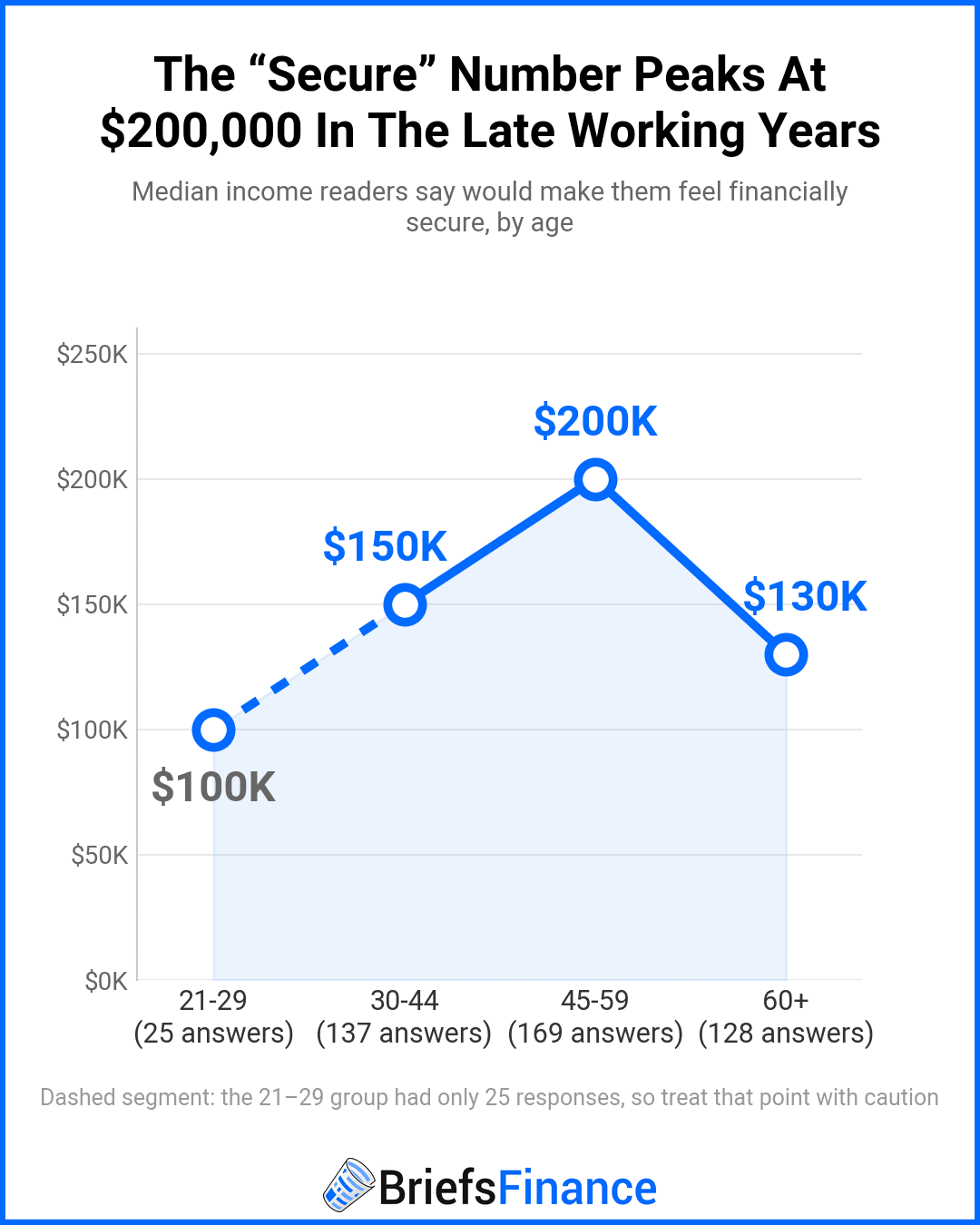
Line chart of readers' median financial security number by age, peaking at $200,000 for ages 45-59
Source: Market Briefs reader survey, Sept. 19-23, 2026 (459 readers who gave a number)

The 45 to 59 group set the highest bar, and it's also one of the two age groups where nearly half lost ground to their bills. The readers who felt the weaker dollar the most asked for the most to feel safe from it.

The answer moves with means too: Readers with $500 a month to invest said $170,000 would do it, while readers without that $500 said $120,000.

The more room a reader has, the further away "secure" seems.
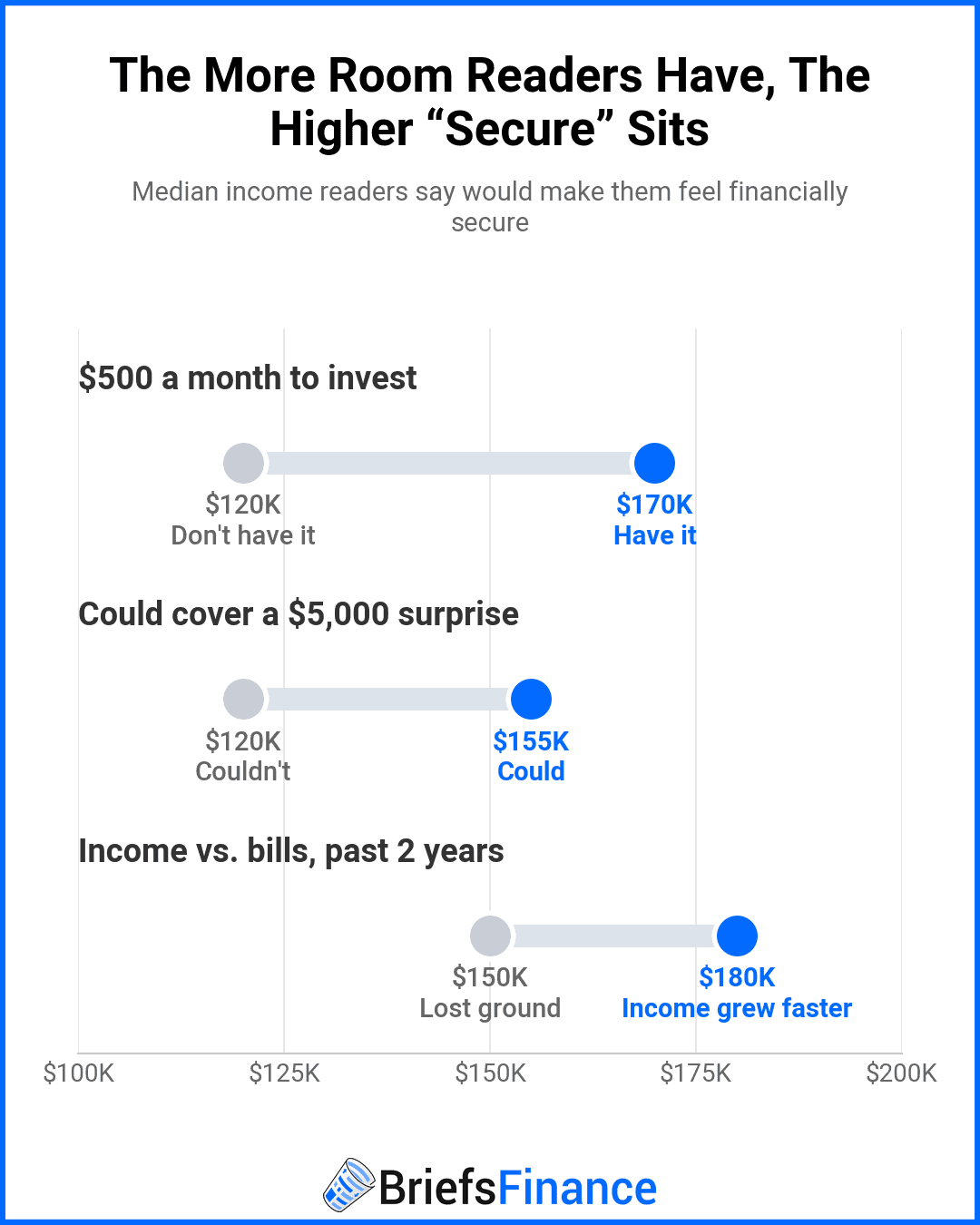
Dumbbell chart showing readers with more financial room name a higher income to feel secure, such as $170,000 for those with $500 a month to invest versus $120,000 without
Source: Market Briefs reader survey, Sept. 19-23, 2026 (459 readers who gave a number)

Sixteen readers skipped the number entirely and wrote that they're already there. One retiree described a 2.75% mortgage with three years left and no other debt, another wrote that cash flow is king, and a couple said no income figure would do it - being debt-free would.

116 Readers Have Money On The Sidelines, Most Of It In Cash

Not everyone who isn't investing more is short on cash. 12% of readers said they're waiting for a better entry point, and another 11% said they don't know where to start.

That's 116 readers, and most of them have the means: 88% have at least $500 a month to invest, and 90% could cover a $5,000 surprise tomorrow.

A third of them also keep more than a quarter of their money in cash, and only 17% are earning over 4% on it.

So the better entry point they're waiting for is being paid for in dollars that lose value while they wait - the one holding in this survey that buys less simply by sitting there.
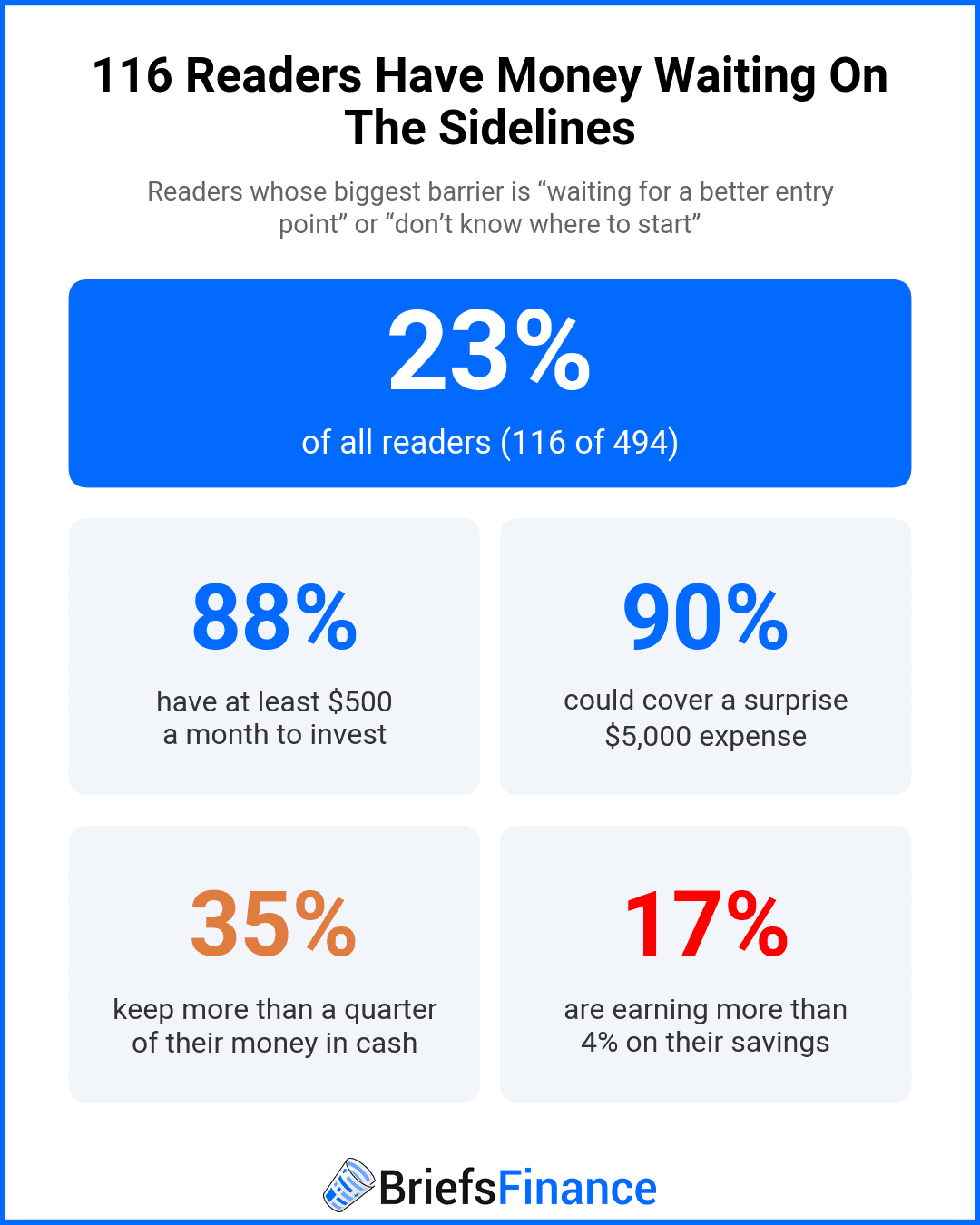
Dashboard of the 116 readers waiting on the sidelines: 88% have $500 a month to invest, 90% could cover $5,000, 35% keep over a quarter in cash, 17% earn over 4%
Source: Market Briefs reader survey, Sept. 19-23, 2026 (494 responses)

The difference between this group and the 32% of readers who said nothing is holding them back isn't money - it's knowing what to do with it.

That's the group the September 29th workshop is built for. Jaspreet Singh is walking through how investors can profit from a dollar that's losing value, live and free, and you can save your seat here.

The Gap Between Readers Getting Ahead And Readers Falling Behind

Readers whose income beat their bills don't own different things than readers who fell behind, and gold or crypto ownership sits at 53% in both groups.

What separates them is room. Among readers whose income grew faster, 97% put money into something in the past 12 months and 91% have $500 a month to invest.

Among readers who lost ground, by contrast, 60% have the $500 and nearly one in five bought nothing at all last year.
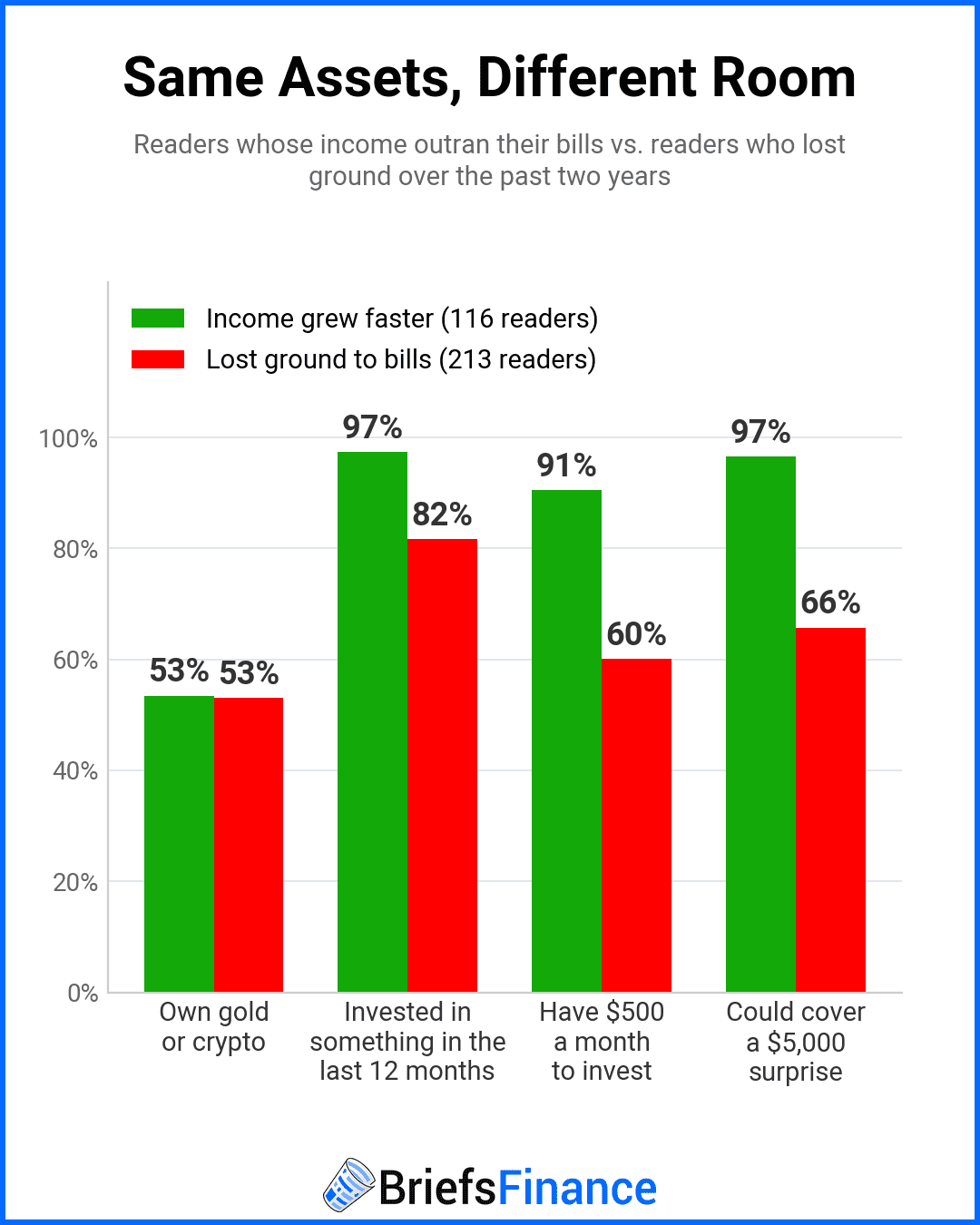
Grouped column chart: readers ahead of and behind their bills both own gold or crypto at 53%, but differ on investing, spare cash and emergency cushion
Source: Market Briefs reader survey, Sept. 19-23, 2026 (494 responses)

The weaker dollar raised prices on both groups equally.

The difference is what happened after: One group still had dollars left over to turn into assets, and the other watched those dollars get spent, at higher prices, before they could become anything else.

A dollar losing value costs every reader at the register. It only costs them a portfolio when it stops them from building one.

Jaspreet Singh's workshop on September 29th picks up right there: how investors can profit from the dollar losing value rather than just paying for it. It's live, it's free, and registration is open here.


Methodology: Market Briefs surveyed its newsletter readers from September 20 to 23, 2026. The survey went out to a list of roughly 350,000 subscribers, and 494 readers completed it. Results reflect readers who chose to respond and were not weighted, so they describe Market Briefs readers, not all Americans. Income figures come from the 459 readers who typed in a number; ranges were counted at their midpoint and monthly figures were annualized. Some questions allowed more than one answer, and percentages may not total 100 due to rounding.



Tag »

More Deep Briefs

FOMC Meeting: Why the Fed Is Getting Nervous, and Why AI Stocks Feel It

Midterm Elections: Where the Money Could Move if Republicans or Democrats Win

Brazil Stock Market Crash: Why Lula's Win Matters to U.S. Investors

Credit Utilization: How Paying Down Cards Can Help Your Score

How to Calculate Your Net Worth, With a Worked Example

How to Get Out of Debt on a Low Income, Step by Step

How to Save Money on a Low Income, With a Budget Example

How to Budget With an Irregular Income, Even in Lean Months

How to Track Your Spending in 15 Minutes a Week

Should You Invest or Pay Off Debt? How to Decide

Pay Yourself First: What It Means and How to Automate It

What Is a Good Credit Score? Ranges and What Moves Yours

How to Lower Your Credit Card Interest Rate, With a Call Script

How Does Credit Card Interest Work? A Plain-English Guide

Credit Card Minimum Payment: What Happens If You Only Pay It

Should You Save or Pay Off Debt First? How to Decide

Debt Snowball vs Avalanche: Which Card to Pay First

What Is a Sinking Fund? How to Start One

Are We in a Recession? 5 Threats to the Economy and Where the Money Is Moving

How Boring Math Makes You Rich: The Briefs Money Spreadsheet, Explained

Common Investing Mistakes: Why a Stock Grade Is One Tool, Not the Whole Toolkit

How to Read a Company's Numbers Without a Finance Degree (Using Briefs Terminal)

What Type of Investor Am I? The Three Investor Archetypes, Explained

How to Build a Stock Watchlist That Isn't Just Stocks You Heard About

How to Choose an ETF That Matches Your Idea (Using the ETF Planning Tool)

Is This Stock a Good Buy? How to Use the Briefs Score to Tell If a Stock Fits the Way You Invest

How to Tell an Asset From a Liability: The One Question to Ask Before You Buy Anything

How to Build Your First $2,000 Emergency Fund and Wipe Out Every Debt Over 10%

How to Invest Through a Crash: 3 Rules From the Worst-Timed Investor Alive

Active vs. Passive Investing: How To Build A Million Dollar Portfolio Faster

Growth, Income, or Wealth Preservation: How To Build Wealth No Matter Which Way You Invest

What Is the Briefs Connector? A Simple Guide

Is a Recession Coming? What the Last Five Rate Hiking Cycles Say

Fed Interest Rates May Rise Again in 2026 - and the Newest Culprit Is AI

Housing Market 2026: Why Office Buildings Are Cracking Before Houses Do

Dividend Investing vs. Growth Investing: Why the Slower Portfolio Can End Up Bigger

Why Is Gold Going Down? A 5.2% Treasury Yield Just Took Its Job

The Strategic Bitcoin Reserve: Why the Government Wants Bitcoin to Explode

BRIEFS EXCLUSIVE: 43% Of Respondents Say Bills Outran Their Income Over Past Two Years

The Economy Is Booming. So Why Did Stocks and Bonds Fall Together?

The 2026 Economic Reset Is Starting: Are We in a Recession, or Is the Pain Still Ahead?

Are We in a Recession? Without AI, America Might Already Be in One - and Washington Knows It

Will Interest Rates Go Down in 2026? Where the Money Moves Either Way

How the Federal Reserve Makes Money - and Why It Just Posted Its Biggest Loss Ever

Kevin Warsh Just Defied Trump: What the Fed Rate Hike Means for Your Money

Why America Bailed Out the Yen: The Japan Carry Trade, the Dollar and Your Mortgage Rate

Treasury Yields Are Spiking Because Lenders Are Backing Away From U.S. Debt

Fiat Currency Runs on Trust, and the World Just Stopped Trusting the Dollar

When Will RAM Prices Go Down? Inside the Memory Shortage

How Is the Economy Doing? Washington Says It's Fixed, but the Numbers Don't Agree

US National Debt Hits $40 Trillion: Why the Economy Hasn't Collapsed Yet

Your 401k Is Fueling the AI Bubble

What Is Wealth Preservation? How To Protect Your Money From Anything

Why Is Everything So Expensive? Why Prices May Never Come Back Down

US Housing Market: Why Renting Can Cost Less Than Buying

An Interest Rate Hike in 2026? The Fed Just Broke Its Own Script

5 Passive Income Ideas That Pay You Whether You Work or Not

The Best Way to Invest 10k: Three Options To Transform 10K into 10 Million

The Tax Write Offs the Rich Are Using in 2026 While the IRS Shrinks

America Is Running Out of Debt Buyers. Treasury Bills Are the Government's Fix

How to Get the Most From Your Guideline 401k

Principal 401k: What to Know About Your Plan

What a Tariff Dividend Means for Your Money

No Tax on Overtime: How Overtime Pay Is Taxed

Reading the Silver Price Forecast for 2026

What to Do When Reddit Stocks Go Viral

Why Is Bitcoin Dropping? 4 Reasons Bitcoin Falls

The Fidelity 500 Index Fund, Made Simple for Beginners

USA Penny Stocks: Risks and Rewards Explained

Finding Cheap Stocks to Buy Now Without Getting Burned

Best Dividend Stocks: A Beginner's Playbook

Roth 401k, Explained for New Investors

How a Roth IRA Calculator Shows Your Future Wealth

Portfolio Diversification: Why Putting All Your Eggs in One Basket Destroys Wealth

Non Taxable Income: What It Is and Why It Matters

What Are Semiconductor Stocks? Chip Stocks Explained

How Stocks Work: A Simple Guide for Beginners

Stop Loss vs Stop Limit: What's the Difference?

Energy Stocks: A Simple Guide for Investors

What Is a Stop Loss Order? A Simple Guide

Best S&P 500 Index Fund: How to Choose One

What Are Penny Stocks? Risks and Rewards Explained

Best Stocks for Beginners With Little Money

Tech Stocks: A Simple Guide for New Investors

What Is a Joint Stock Company? A Simple Guide

Capital Gains Tax in California: A Simple Guide

Top Covered Call ETFs: How to Compare Them

What Are Stock Options? A Plain-English Guide

EBITDA Margin: What It Is and How to Calculate It

What Is Taxable Income? A Simple Guide for Investors

What Is a Covered Call? How the Strategy Works

What Is Gross Margin? A Simple Guide for Investors

What Is a Dividend? A Plain-English Guide for Investors

Financial Literacy Books That Actually Build Wealth

What Is a Roth Conversion? A Simple Guide

Trailing Stop Loss: How to Protect Your Gains

5 Types of Wealth: Why Money Is Only One of Them

How to Invest in Private Equity: A Beginner's Guide

What Is a Call Option? A Simple Guide With Examples

EBITDA Formula: How to Calculate It Step by Step

1 2 3 4

Get Market Briefs delivered to your inbox every morning for free!

No fluff. No noise. No politics. Just finance news you can read in 5 minutes.
Join Free

Blogs

November 3, 2026
How to Budget Every Payday: 5 Moves So You Never Worry About Money
  • A median earner could make about $4.7 million over a career, yet most retire with closer to $13,000 in the bank because of a keeping problem, not an income problem.
  • Audit your money, save $2,000, pay off credit card debt, then automate a 75/15/10 split across three bank accounts.
  • Earn more only after your system is in place, then protect what you build with an accountant, attorneys, the right insurance, and an estate plan.
Read More
November 3, 2026
How to Invest in Stocks: 5 Things to Do Before You Invest Your First Dollar
  • Paying off credit card debt at around 22% interest beats the stock market's roughly 10% average, and even Warren Buffett's 19%.
  • Save $2,000 in a separate emergency fund, learn to research with AI, and decide whether you're a growth, income, or wealth preservation investor.
  • Write down a plan for buying during market crashes, which have happened 25 times in the last 100 years.
Read More
November 3, 2026
Best ETFs to Buy: 5 Three-ETF Portfolios for Every Investing Goal
  • An ETF is a basket of stocks, so one purchase spreads your money across many companies instead of riding on just one.
  • Jaspreet Singh laid out five portfolios of three ETFs each, built for kids, cash flow, growth, slow and steady growth, and protection from a weaker dollar.
  • Based on 10-year average returns, $500 a month could grow to between about $660,000 and $3.1 million over 30 years, though past returns never guarantee future ones.
Read More
November 3, 2026
Best Investments of a Generation: 5 Market Shifts Backed by Your Tax Dollars
  • Private companies are about to spend $1 trillion a year on AI, and the Trump administration is putting tax dollars behind the same industries.
  • The five shifts are AI and its supply chain, robotics, rare earths, energy, and defense.
  • Each comes with real risk, from an AI bubble to wars ending or a new Congress, so these are ideas to research, not sure things.
Read More
November 3, 2026
How to Get Ahead Financially: 10 Moves to Make While Everyone Else Falls Behind
  • Learning a high-income AI skill, or building AI tools for tradespeople, can raise your earning power in a tough job market.
  • Higher interest rates, the 2025 tax cuts, Trump accounts, and stacked cash back can put more money back in your pocket.
  • Following where government money is moving, keeping cash ready for market crashes, and investing in your own education can speed up your wealth.
Read More
November 3, 2026
National Debt at $40 Trillion: Why Inflation Is the Hidden Tax, and Who Profits From It
  • Time magazine asked President Trump how he'd tackle the $40 trillion national debt, and he suggested inflation could help pay it off, a cost that lands on everyday Americans.
  • From 1971 to 2025, cars, houses, and college outpaced both inflation and incomes, while the S&P 500 grew more than 33,000% with dividends reinvested.
  • The U.S. can default, inflate, or outgrow its debt, and history shows each path rewards different assets.
Read More
November 3, 2026
FOMC Meeting: Why the Fed Is Getting Nervous, and Why AI Stocks Feel It
  • At its latest meeting, the Fed held rates steady but warned it may raise them again, because inflation is running near 3.5% against a 2% target.
  • Oil prices, tariffs, AI's hunger for energy, and government spending are all pushing prices higher, and gold, silver, and bitcoin fell on the Fed's news.
  • Chinese AI stocks are down about 40% in a few months and Google fell more than 10% in a day, raising fears that higher rates could pop an AI bubble.
Read More
November 3, 2026
Midterm Elections: Where the Money Could Move if Republicans or Democrats Win
  • The U.S. government spent about $7.5 trillion last year, and the midterm elections could change which industries get more of that money.
  • A Republican win could favor manufacturing, fossil fuels, banks, and defense.
  • A Democratic win could favor healthcare, weight-loss drugs, clean energy, and infrastructure.
Read More
November 3, 2026
Brazil Stock Market Crash: Why Lula's Win Matters to U.S. Investors
  • Brazil's stock market fell more than 20% in a few days, and its currency dropped 8%, after Lula won a presidential election investors expected him to lose.
  • The shock reaches U.S. investors through coffee and beef prices, the BRICS push away from the dollar, and a market that had become an investor favorite.
  • The last time Lula first won, in 2002, Brazil's stock market fell more than 20% and then grew 12x by 2008, though nobody knows if that will repeat.
Read More
November 2, 2026
Credit Utilization: How Paying Down Cards Can Help Your Score
  • Credit utilization is your card balances divided by your credit limits, checked overall and card by card.
  • Lower is generally better, and Experian says the effect becomes more noticeable around 30%.
  • Paying down balances and keeping new charges off your cards are the main ways to lower it.
Read More
1 2 3 … 32
Share via
Copy link