There are lots of different tools investors use to build wealth.
Some love tangible things like real estate and gold.
Other investors might like paper assets like stocks and bonds.
But here's the thing: Understanding the difference between stocks and bonds isn't just cocktail party knowledge.
Why? Because knowing the difference will help you determine what type of investor you’d like to be.
And once you know the difference - you can build a strategy and portfolio that works for you.
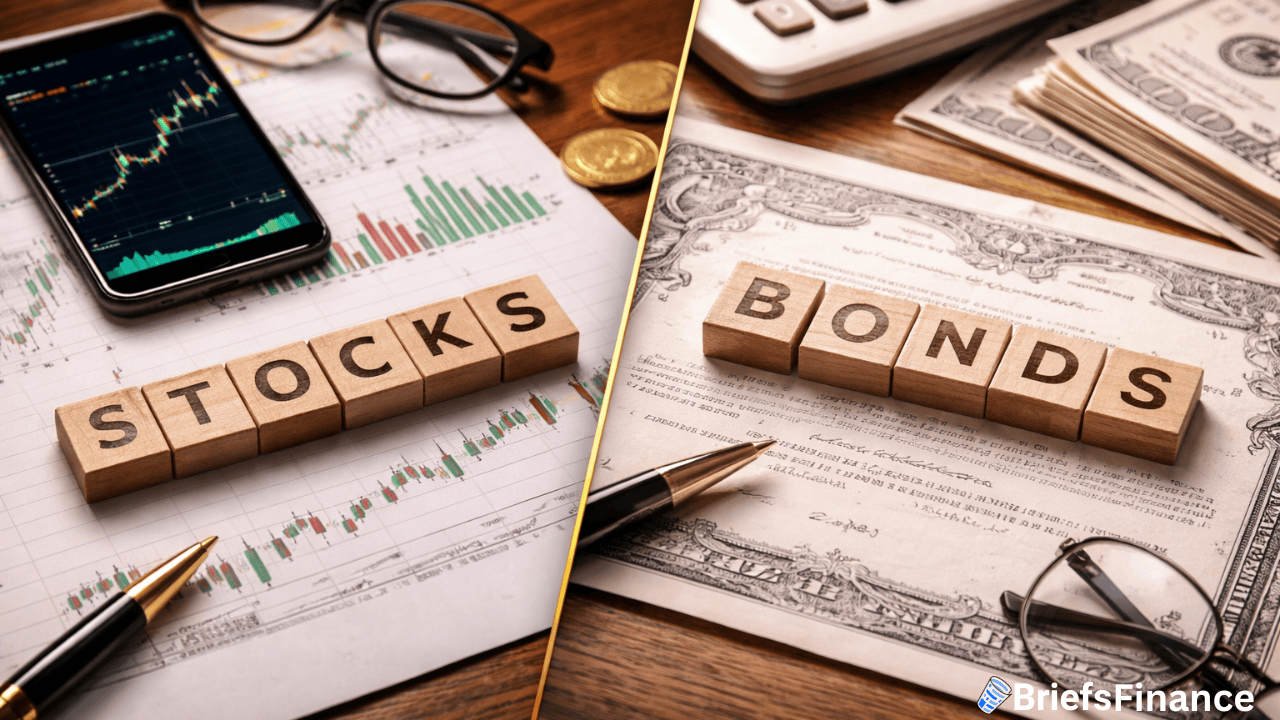
So let's break it down what each one is, the key differences, and the risks and returns of both.
Once you understand the difference between them, you can make the decision on which one you’d like to own.
We’re breaking down individual potential stock market opportunities every week in Market Briefs Pro.
These are stocks our analysts are watching right now - lean more and subscribe to Market Briefs Pro here.
What Are Stocks?
When you buy a stock, you're purchasing a security. A security represents ownership in a company.
This is a legal term,a s securities are regulated by the Securties and Exchange Commission (SEC).
Let's use McDonald's as an example. When you buy McDonald's stock, you own a tiny piece of McDonald's. The company's success directly impacts your investment's value.
A stock is considered an equity security. That’s just a fancy way of saying you have ownership in the asset.
Equity securities are:
- Regulated by the SEC (Securities and Exchange Commission).
- Subject to securities laws and disclosure requirements.
- Valued based on company performance, earnings, and growth potential.
- Income-producing through dividends (not every company has a dividend).
- Backed by real companies with assets, employees, and operations.
How Stock Ownership Works
One stock = one share of ownership in a public company. That share lets you:
- Participate in the company's growth - As McDonald's makes more money and performs better, you benefit as the share price goes up.
- Vote in shareholder meetings - You have some say in company decisions (the more shares you own, the more say you have).
- Potentially receive dividends - Some companies pay out a portion of their profits to shareholders regularly.
What else? You own the company on paper. You can't walk into a McDonald's location and tell employees to fix the ice cream machine.
You don't manage the company day-to-day. You simply own it on paper and participate in its earnings.
Why Companies Sell Stock
Companies go public to raise money. When a company has its initial public offering (IPO), it's the first time that company and its shares are available to the public.
We've seen huge IPOs in the past, like Alibaba, who raised $21 billion in 2014.
Facebook (now Meta), Kraft, and UPS all went public to raise capital for growth.
How You Make Money with Stocks
You can get paid two ways:
1. Appreciation - The stock becomes more valuable as the company grows. If you buy Apple stock at $100 and it rises to $243, you've made money.
2. Dividends - Some companies pay out regular cash payments to shareholders, generally every quarter.
Not every company pays dividends, but when they do, you get paid just for owning the stock.
What Are Bonds?
Bonds are debt instruments where you lend money to a government or corporation. They pay you interest at regular intervals and return your principal at maturity.
Think of it this way: When you buy a bond, you're the bank. Someone needs money, and you're lending it to them.
How Bonds Work
Let's say you buy a U.S. Treasury bond. That means you're literally loaning money to the United States government.
In return:
- The government pays you interest on a regular schedule.
- At the end of the bond's term (maturity date), they give you back your original investment.
The same concept applies to corporate bonds. You loan money to a company like Apple or Coca-Cola, and they pay you interest until the bond matures.
Common Types of Bonds
U.S. Treasury bonds - Backed by the government, considered very safe.
Investment-grade corporate bonds - From financially strong companies.
Municipal bonds - Often tax-free, issued by state and local governments.
How You Make Money with Bonds
Bonds generate predictable income. If you buy a bond paying 3% interest, you'll receive that 3% annually (usually paid semi-annually) until the bond matures.
When the bond matures, you get your initial investment back.
The Key Differences Between Stocks and Bonds
| Feature | Stocks | Bonds |
| What You Get | Ownership in a company | Loan to a company/government |
| Income Type | Dividends (not guaranteed) | Interest (fixed) |
| Return Potential | Higher | Lower |
| Risk Level | Higher | Lower |
| Regulatory Body | SEC | SEC |
| Priority in Bankruptcy | Last in line | First in line |
| Voting Rights | Yes | No |
Risk and Return: The Trade-Off
Stocks: Higher Risk, Higher Potential Reward
Stock prices can be volatile. They move up and down quickly because:
- Markets are liquid - Anyone can buy and sell shares instantly.
- They're easy to value - Anyone can open an app and buy stocks.
- They can be manipulated - Company announcements or government news can swing prices dramatically
Historically though, stocks have delivered higher returns than bonds over the long term. Markets continue to rise despite multiple times where markets go down.
Bonds: Lower Risk, Predictable Income
Bonds offer very predictable income and lower risk than stocks. Benefits include:
- Regular access to cash.
- Protection against interest rate changes.
- Predictable income.
- Good for near-term needs.
But there are drawbacks:
- Lower returns than stocks historically.
- Vulnerable to inflation.
- Interest rate risk (if rates rise, existing bonds lose value).
Investors consdiering bonds are usually doing so as a way to protect against a market downturn or gain steady income.
How to Invest in Stocks and Bonds
Buying Individual Stocks
Open a brokerage account and buy shares directly. You can start with any amount. Research companies, check their financials, and buy ownership.
Buying Stock ETFs
Exchange-traded funds let you invest in a basket of companies instead of picking individual stocks. Examples include:
- VIG (Vanguard Dividend Appreciation ETF)
- SCHD (Schwab U.S. Dividend Equity ETF)
- SPY (tracks the S&P 500)
Buying Individual Bonds
You can buy Treasury bonds directly from TreasuryDirect.gov or corporate bonds through a brokerage account.
Buying Bond ETFs
Bond ETFs provide instant diversification across many bonds:
- BND (Vanguard Total Bond Market ETF)
- AGG (iShares Core U.S. Aggregate Bond ETF)
- BNDX (Vanguard Total International Bond ETF)
Common Mistakes to Avoid With Stocks & Bonds
Mistake #1: Chasing high yields without research. High yields can be dangerous red flags. Companies often have high yields because the stock price has dropped or the dividend is unsustainable.
Mistake #2: Putting all your money in one asset type. If you'd put everything into energy stocks in 2020 when oil prices went negative, you'd have been devastated. Diversification is essential.
Mistake #3: Ignoring time horizon. Stocks are for long-term growth. Bonds are for stability and income. So they serve different purposes - decide which one makes more sense for you.
Mistake #4: Not rebalancing. If your stocks grow to 80% of your portfolio when your target is 70%, you may want to consider selling to get back on track. Rebalancing forces you to "sell high and buy low."
FAQs About Stocks and Bonds
Q: Are stocks riskier than bonds? Yes. Stocks have higher volatility but offer higher potential returns. Bonds provide predictable income but lower growth.
Q: Can I lose money with bonds? Yes. If interest rates rise, existing bond values fall. Also, if the company or government defaults, you could lose your principal.
Q: Should I invest in stocks or bonds first? Most financial advisors recommend a mix of both based on your age and risk tolerance. Younger investors typically hold more stocks. Older investors usually hold more bonds. Bot there’s no one size fits all approach. Do your own due diligence and make a decision that meets your investment goals and risk tolerance.
Q: Do bonds protect against inflation? Not all bonds. Fixed-rate bonds lose purchasing power during inflation. Treasury Inflation-Protected Securities (TIPS) are designed to protect against inflation.
Q: When should I sell stocks and buy bonds? Some investors choose bonds during a market crash or near retirement, since they’re focsued on income rather than growth. In the end, do what makes the most sense for you.
The Bottom Line On Stocks & Bonds
When you own a stock, you gain equity in that company, and are a partial owner.
If that company does well, your stock may appreciate in value - some stocks pay you a dividend just for owning it as well.
When you own a bond, you are are essentially a lneder to a government or company.
While they usually do not grow faster than stocks, they do provide income over time.
The bottom line: Find the right balance for your situation. Your age, risk tolerance, income needs, and time horizon should guide your allocation.
Some investors choose oe or the other while other investors like to have a balance of both.
Both approaaches to stocks and bonds can work for certain investors, it just depends on if you’re looking for income, growth, or a little of both.
Want to find potential stock market investing opportunities? We’re breaking down a new market shift every week in Market Briefs Pro.
What’s that? Market Briefs Pro is our in-depth investing report that gives you all of the data and research you need to make smarter investment decisions.
Discover which stocks our analysts are watching by subscribing to Market Briefs Pro here.