Everyone with an internet connection is using AI to better their business or research a new sour dough recipe.
But AI has an energy problem.
A single ChatGPT query uses about 2.9 watt-hours of energy - roughly 10 times what a Google search takes.
Now multiply that by hundreds of millions of users, and you start to see the problem.
For years, online has been housed in data centers - but the growing demand of AI is causing more and more data centers to be built.
Data centers need a lot of continuous power. And right now, the power grid is struggling to keep up.
In short - countries and companies are trying to figure out how to power data centers effectively, while keeping costs low.
Many are using natural gas turbines, but the future of data centers and AI power may be in nuclear energy.
Right now, two stocks standout in the data center and AI energy race.
Each has their own pros and cons, along with technologies that make them unique.
Let’s break down both, compare them, and explain why nuclear is in focus right now for AI and data centers.
Energy is repricing because the dollar is. Our CEO Jaspreet Singh connects the two on September 29th in his free workshop on how to profit from a dollar that is losing its value.
The AI Energy Crisis No One Talks About
The average U.S. data center uses more power in a single day than 20,000 American households use in a year.
And the demand is only growing.
- Barclays estimates that by 2030, 10% of the world's energy will be used to power data centers.
- Data center energy demand is projected to jump from 74 terawatt-hours in 2022 to 500 terawatt-hours by 2027.
- By 2027, roughly 40% of data centers globally could be constrained by power availability.
And it's why capital is rotating away from speculative AI plays and into the companies that actually keep the lights on, literally.
Why Nuclear Energy Stocks Are Getting Attention
So where does all that power come from?
Nuclear energy currently produces about 19% of all U.S. electricity. It runs 24/7, doesn't depend on the weather, and produces zero carbon emissions.
Tech companies like Microsoft, Amazon, and Google are under growing pressure to make their AI operations environmentally sustainable. They need clean energy - and lots of it.
Nuclear checks both boxes: Massive output and zero carbon.
That's why some of the biggest companies on Earth are signing nuclear power deals worth billions of dollars.
And it's putting nuclear energy stocks on the map for investors who are paying attention.
Two Nuclear Energy Stocks on Wall Street's Radar
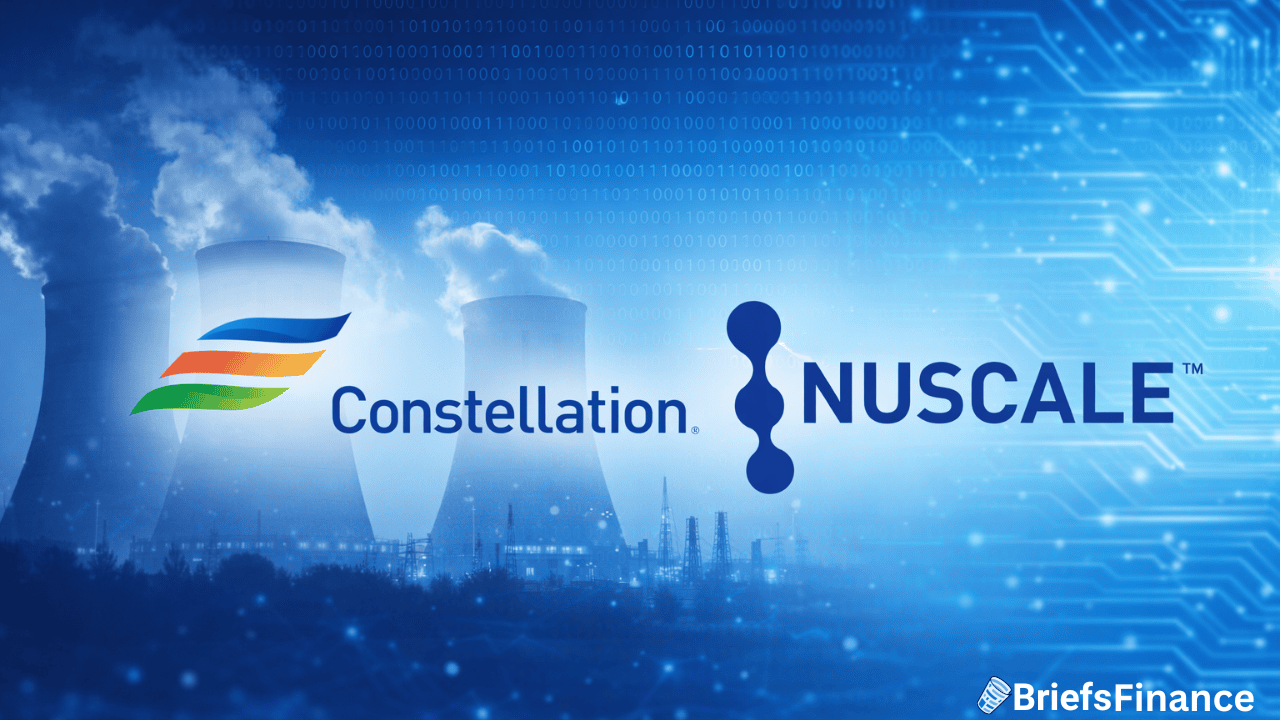
Right now, there are two main stocks that Wall Street is looking at when it comes to nuclear power:
Constellation Energy (CEG)
Constellation Energy operates 21 nuclear reactors across the country - making it the largest nuclear fleet in America.
The company produces 55 gigawatts of capacity, enough to power roughly 40 million homes.
And it generates more carbon-free electricity than any other U.S. company.
What has investors watching: CEG has been supplying nuclear power to data centers since 2015 and has locked in long-term contracts with some of the biggest names in tech.
The stock has faced short-term headwinds from regulatory concerns.
But the demand for its power isn't going anywhere.
NuScale Power (SMR)
NuScale takes a different approach - small modular reactors, or SMRs.
Think of it like this: traditional nuclear plants are massive one-of-a-kind construction projects.
SMRs are more like building blocks - smaller, standardized, and designed to power things like individual data centers.
NuScale holds the only patent to build a 50-megawatt SMR factory, which could power up to 50 data centers once operational.
The catch? NuScale isn't profitable yet and it’s had some setbacks in terms of overspending recently.
But as a first mover in the SMR space for data centers, it's gaining ground with very few competitors.
CEG vs. SMR: A Quick Comparison
| Factor | Constellation Energy (CEG) | NuScale Power (SMR) |
| Approach | Traditional large-scale nuclear | Small modular reactors (SMRs) |
| Nuclear Capacity | 22.1 GW (largest in the U.S.) | Pre-commercial, building toward 50 MW factory |
| Data Center Contracts | Multiple 20-year deals (Microsoft, Meta, U.S. government) | Deal with Entra 1 for Ohio data centers |
| Profitability | Profitable, most recent quarterly EPS of $3.04/share | Not yet profitable, $45M loss in 2024 |
| Risk Profile | Lower risk, established operations | Higher risk, earlier stage |
| Key Advantage | Scale and existing infrastructure | First-mover in SMR for data centers |
Nuclear Energy Stocks: What Could Go Wrong
Data center demand is high today, but there's no guarantee it stays this way.
If a new technology makes AI more energy-efficient, the nuclear energy stocks could fall.
Regulation is another factor. Grid operators and state governments have started implementing energy price caps to protect residential users from rising costs.
That will reduce the amount of money these nuclear companies earn.
Communities are also pushing back on data center expansion.
In 2025, several high-profile data center projects were blocked or delayed due to water usage concerns - since data centers need water for cooling in addition to electricity.
- Amazon's Project Blue was unanimously rejected by the Tucson City Council in August 2025.
- Chandler's City Council in Arizona rejected a 422,000-square-foot AI data center in December 2025.
- Georgia paused all reviews on new data centers in April 2025 citing water issues.
These setbacks could slow the growth that nuclear energy stocks are counting on.
And for a company like NuScale, there's execution risk.
Building new nuclear technology is expensive, and it could be years before SMR facilities are fully operational and generating real revenue.
Investors should weigh these risks carefully when looking at any nuclear energy stock.
The Bottom Line for Investors
AI needs energy - and where it gets that energy is still up in the air.
Nuclear energy is a potential solution for the future - but it’s not a reality yet today.
That makes this a long-term market shift - investors would be aware that it could be years before these two companies really take off.
But for some, those risks also mean rewards.
Nuclear energy stocks sit right at the center of that shift. Data centers are being built at record pace, AI models are getting more power-hungry, and the demand for electricity is climbing.
The question isn't whether data centers need more power.
The question is which companies are best positioned to deliver it - and whether the market has fully priced in what's coming.
Nuclear is a bet on where power gets expensive. The bigger bet is what happens to your dollars in the meantime. Join our CEO Jaspreet Singh on September 29th for a free workshop on how to profit from a dollar that is losing its value.